



The defence sector has been one of the biggest wealth creators on Dalal Street over the past few years. Strong government spending, a growing order pipeline and India’s push towards defence indigenisation have kept investor interest firmly focused on the space.
Among the biggest names in the sector, Bharat Electronics (BEL) and Hindustan Aeronautics (HAL) continue to dominate investor conversations.
Both companies have strong order books and long-term growth opportunities. Despite operating in the same sector, their market valuations tell two very different outlooks.
BEL continues to trade at a significantly higher valuation multiple, while HAL, despite handling some of India’s largest defence manufacturing programmes, trades at a relatively lower earnings multiple.
So, what explains this gap?
Is the market rewarding BEL’s stable execution and predictable earnings? Or does HAL now offer a better risk-reward proposition after concerns surrounding Tejas deliveries and the Advanced Medium Combat Aircraft (AMCA) programme have already been priced in?
Financialexpress.com spoke to market experts across fundamental research, institutional equities and technical analysis. Here’s what the analysts say –
HAL vs BEL: Comparing operational delays and execution visibility
According to Harshit Patel, Director, Equirus Securities, HAL currently offers a more attractive risk-reward opportunity because many of the concerns weighing on the company have already been factored into the stock price.
Harshit Patel said, “We prefer HAL over BEL at the current juncture as we believe most of the negatives, from both an operational and a sentiment perspective, are already in the base for HAL.”
He explained that operational delays continue to remain the biggest challenge for HAL, particularly around the delivery of the Light Combat Aircraft (LCA) Mk1A programme.
Harshit Patel pointed out that HAL has not yet delivered a single LCA Mk1A aircraft because integration work involving electronic warfare systems, avionics and weapon systems is still pending.
“HAL is yet to deliver a single LCA Mk1A, as it has not completed electronic warfare (EW) and avionics integration with the weapon systems. While the Air Force may relax a few parameters that are not critical to combat readiness, it should not, and will not, offer relaxation on most others. Hence, I believe deliveries may not start before 4QFY27, against the company’s revised guidance of Aug-Sep’26,” he noted.
Even so, Harshit Patel believes the production pipeline is ready once these hurdles are cleared.
“However, once deliveries begin, they should ramp up quickly, as 18 airframes are ready and engine deliveries have commenced (GE has already delivered 6 engines). GE has committed to delivering 2 engines per month from 2027 onwards. We build in Mk1A deliveries of 6 / 16 / 20 / 24 / 30 over FY27-FY31,” he added.
Apart from execution, investor sentiment also took a hit after HAL was excluded from the AMCA prototype programme. Patel, however, believes investors may be attaching too much importance to this development.
“HAL’s exclusion from the AMCA prototype tender has been a significant negative, as it reduces visibility on the company’s participation in future sixth-generation platforms. However, this should not impact operational performance for at least the next 15 years, given a massive execution pipeline that includes 180 LCA Mk1A, 120 LCA Mk2, the Su-30 MKI fleet upgrade (Super Sukhoi), 106 HTT-40, 175 LCH Prachand and 400 IMRH, among other programmes.”
Why Analysts expect HAL’s earnings to inflect in FY28–FY29
The next few years could mark a major turning point for HAL as several programmes move into execution simultaneously. Harshit Patel noted, “FY28 and FY29 could be inflection years for HAL, with several major programmes (Mk1A, Prachand, HTT-40 and Su-30) under simultaneous execution. We estimate EBITDA growth of over 20% in both FY28 and FY29, even after factoring in lower margins from an adverse execution mix (i.e., a higher share of manufacturing).”
Harshit Patel believes BEL remains a strong company but says expectations have become significantly higher.
“While BEL is likely to deliver double-digit growth, it could fall short of street expectations as its outstanding OB has declined over the last two years and, at Rs 738 billion at FY26-end, was lower than FY24 levels. We prefer HAL, which is trading at 27x FY28 EPS, over BEL at 39x FY28 EPS,” Harshit Patel said.
HAL Vs BEL: Street weighing upside potential and stability
While Equirus prefers HAL from a valuation perspective, Putta Ravi Kumar, Defence Analyst at Choice Institutional Equities, believes the comparison is not simply about order books.
Instead, he says the valuation gap reflects the market’s confidence in execution.”We believe the BEL vs HAL valuation gap is largely driven by execution visibility rather than order book strength. While Hindustan Aeronautics (HAL) has a significantly larger backlog (~Rs 2.5 lakh crore), execution has been impacted by supply-side constraints, particularly engine availability for Tejas Mk-1A,” added Kumar.
According to him, the availability of engines from General Electric Aerospace remains the single biggest trigger investors should monitor.
“Recent commentary around GE Aerospace stepping up engine supplies, including potential incremental deliveries, is a key monitorable. If this materializes, we expect a sharp pickup in execution and revenue recognition, given HAL’s operating leverage, which could drive earnings upgrades and valuation catch-up,” he said.
On the other hand, Ravi Kumar believes BEL’s premium valuation reflects something very different.
He further added, “In contrast, Bharat Electronics (BEL) offers a structurally more predictable business model, supported by shorter execution cycles and diversified electronics programs. This consistency, in our view, is what the market is paying a premium for.”
He also points out that BEL has not rallied as sharply as several other defence stocks over the past year.
“We also note that BEL’s stock performance has been relatively muted over the past year versus the broader defence space, which provides some valuation comfort at current levels,” added Kumar.
For investors looking over the next year, Kumar added, “From a 12-month perspective, we believe HAL offers higher upside optionality if execution normalizes, while BEL provides better downside protection through earnings stability. In our view, the trade-off is clear — HAL is a recovery-driven re-rating story, whereas BEL remains a steady compounding play.”
BEL vs HAL: What do the charts indicate?
Fundamental investors are not the only ones watching these two defence stocks. Technical analysts are also closely tracking whether the recent correction in BEL has created a buying opportunity or if caution is still warranted.
According to Jigar S. Patel, Senior Manager of Equity Technical Research at Anand Rathi Share and Stock Brokers, BEL’s charts are yet to show a convincing turnaround.
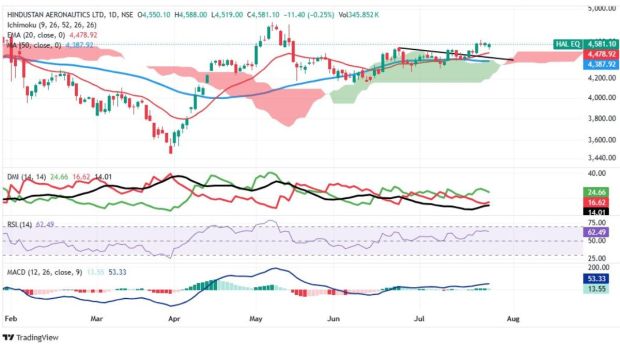
Jigar S. Patel on HAL said that the company continues to maintain a positive medium-term trend, trading above the 20 EMA, 50 SMA, and the Ichimoku Cloud, indicating sustained bullish strength.
He noted, “The DMI shows +DI above -DI, confirming buyers remain in control, while the ADX around 14 suggests the current trend is positive but not yet very strong. The RSI at 62 reflects healthy bullish momentum without entering the overbought zone. Meanwhile, the MACD remains above the zero line with a positive histogram, signalling improving momentum. Overall, the stock is witnessing a gradual uptrend with higher highs and higher lows. As long as it continues to hold above the Ichimoku Cloud and key moving averages, the broader outlook remains constructive, while a decisive breakout above the recent swing high could accelerate the next leg of the uptrend.”
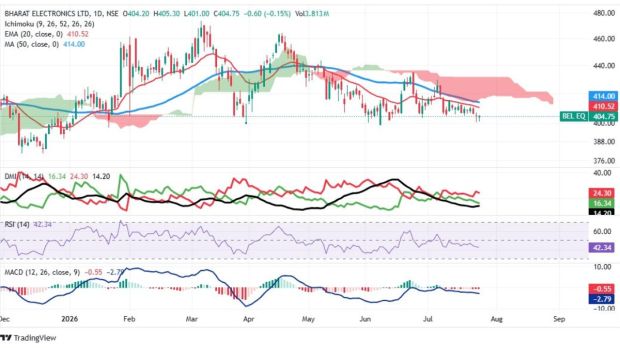
On BEL, Jigar S. Patel noted, “BEL remains under pressure, trading below the 20 EMA, 50 SMA, and the Ichimoku Cloud, indicating a weak short-term trend. The DMI shows -DI (24.30) above +DI (16.34), confirming that sellers continue to dominate, while the ADX at 14.20 suggests the current downtrend lacks strong momentum and may remain range-bound. The RSI at 42 reflects subdued momentum and remains below the bullish threshold of 50. Meanwhile, the MACD is below the zero line with a negative histogram, signalling persistent bearish momentum despite signs of stabilization.”
According to Jigar S. Patel, the stock is currently attempting to stabilise after a prolonged decline. He said, “Overall, the stock is consolidating near an important support zone after a prolonged decline. A sustained move above the key moving averages and the Ichimoku Cloud would be required to improve the near-term outlook, while continued trading below these levels is likely to keep the bias cautious.”
Is the valuation gap between BEL and HAL really new?
One of the biggest talking points among investors is the valuation difference between the two companies.
BEL currently trades at a significantly higher price-to-earnings (P/E) multiple than HAL, leading many investors to wonder whether the premium is justified.
For Geetanjali Kedia, Chief Analyst at SPTulsian Investment Advisers, this is not a recent phenomenon.
According to her, BEL has historically enjoyed a premium because of the nature of its business rather than because of short-term market sentiment.
She added, “BEL has always commanded a higher premium than HAL because of its electronics play and the higher repeat component. So, this P/E mismatch has always been there. We like both the stocks—BEL as well as HAL—and both are on our recommended list.”
HAL largely executes long-cycle aircraft manufacturing programmes where revenue depends on production schedules and delivery milestones. BEL, on the other hand, derives a larger share of business from defence electronics, radar systems, communication equipment and repeat orders, giving investors greater visibility over future earnings.
Recovery story or steady compounder?
Taken together, the views of the four experts point towards two distinctly different investment cases.
HAL is being viewed largely as a recovery story. Most analysts agree that execution delays surrounding the Light Combat Aircraft Mk1A programme have weighed on the stock over the past year. However, if engine supplies improve and deliveries gather pace, the company could witness a meaningful improvement in earnings over the next few years.
BEL presents a different picture. Its execution cycle is relatively shorter, earnings visibility remains stronger and its diversified electronics portfolio has historically supported more consistent financial performance. That stability is also one of the reasons the stock continues to command a higher valuation multiple.
However, expectations from BEL are also considerably higher, meaning investors will closely monitor whether order inflows and execution continue to justify the premium.
The technical picture also adds another dimension. While long-term investors may continue to back BEL’s fundamentals, technical indicators suggest the stock is still trying to establish a stronger base after its recent correction.
Disclaimer: The investment views, analyst preferences, and stock comparisons regarding HAL and BEL expressed in this article are solely those of the featured market experts and do not constitute an offer, solicitation, or direct recommendation to buy, sell, or hold any security. Stock market investments are subject to volatility, operational execution risks, and market fluctuations, and valuation multiples or technical indicators do not guarantee future performance. Readers are strongly advised to conduct independent research and consult a SEBI-registered financial advisor before making any investment decisions. This disclaimer has been generated using AI to support user well-being and responsible content consumption.