




One of India’s best-known value investors has quietly increased his bet on a company the market has been steadily losing confidence in.
On 21 July, Nalanda India Equity Fund, managed by veteran investor Pulak Prasad, acquired a further 423,115 shares, taking its stake in this company to 7.71%. Prasad had started building this position at the start of 2026. The purchase comes at a time when investors are questioning whether the business has entered a prolonged phase of slower growth.
The company is IndiaMART Intermesh, India’s largest business-to-business (B2B) online marketplace. It connects businesses looking to buy with manufacturers, wholesalers and service providers looking to sell. Buyers use the platform free of cost, while suppliers pay annual subscriptions for greater visibility, more enquiries and premium tools. That subscription-based model generates recurring revenue.
Like every successful marketplace, IndiaMART benefits from a network effect. More suppliers attract more buyers, and more buyers make the platform more valuable for suppliers. Today, the platform hosts more than 8.8 million supplier storefronts, 132 million product listings and around 41 million active buyers.
Yet despite that scale, the market is focused on a much smaller number.
A company may have dozens of products, thousands of customers and several drivers of growth. Yet investors often reduce all that complexity to a single metric. Banks become loan growth. Automobile companies become monthly sales. Consumer goods companies become volume growth. Infrastructure companies become order books.
IndiaMART has suffered a similar fate.
Indiamart Intermesh 1-Year Share Price Chart
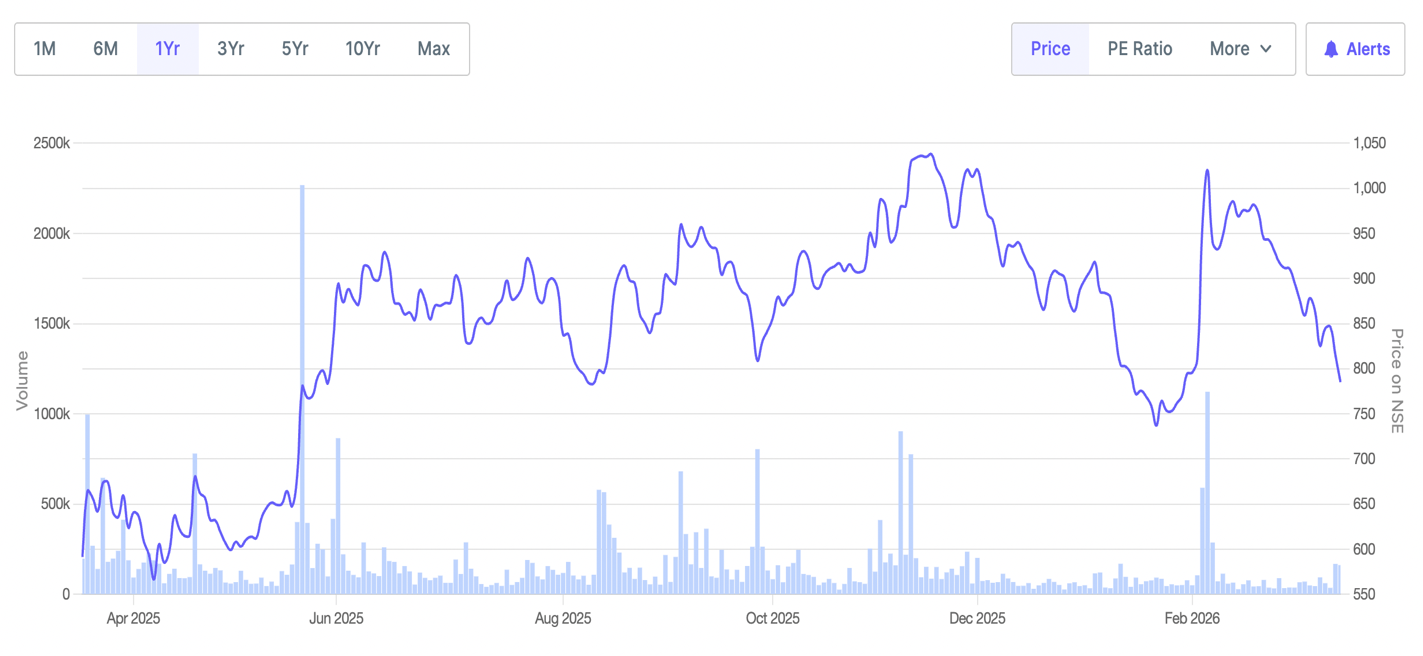
Over the past two years, investors have come to judge the company almost entirely by one metric: the number of paying suppliers. As that number has slowed, so has enthusiasm for the stock. The market has begun to wonder whether India’s largest business-to-business marketplace is entering a prolonged phase of slower growth.
Yet while sentiment has deteriorated, Nalanda Capital, led by veteran investor Pulak Prasad, has quietly increased its stake in the company to over 7.7%. His investment is not proof that the market is wrong. Even the best investors make mistakes. But it does raise an interesting question. Is the market focusing too much on what has changed and too little on what has remained remarkably resilient?
The timing of that question is significant because Indiamart finds itself at an important point in its evolution. Subscriber additions have slowed. Artificial intelligence (AI) is changing how businesses search for information online. Investors are becoming more demanding. Yet the business continues to generate healthy cash flows, maintain high profitability and earn returns on capital that many companies would envy.
So, is the market right to worry, or is it overlooking the bigger picture?
Why one number dominates the conversation
Not every supplier on Indiamart is equally valuable.
The company offers different subscription plans, broadly categorised as Silver, Gold and Platinum. Silver is the entry-level paid plan and is typically chosen by smaller businesses that are more sensitive to pricing. Gold and Platinum customers pay significantly higher subscription fees in return for greater visibility, more enquiries and additional marketing tools.
Subscription-Based Revenue Model
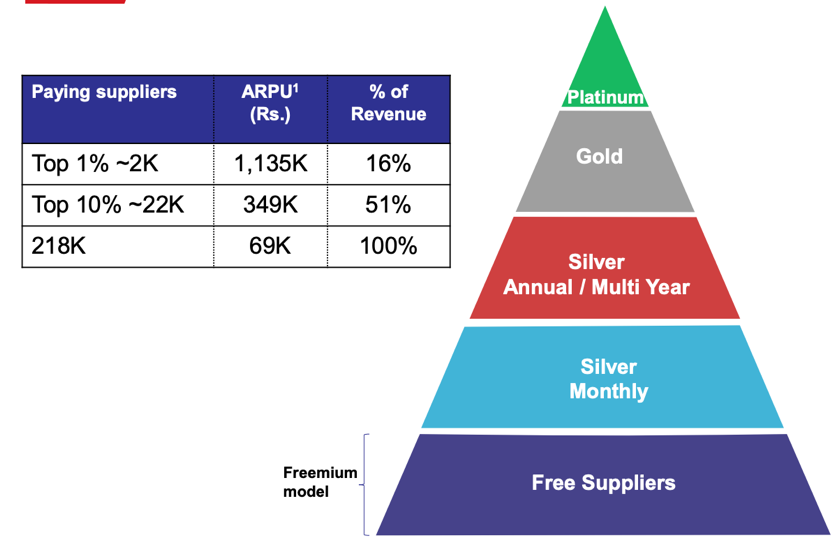
These premium customers also tend to stay on the platform for longer. This metric of differentiation is important because headline subscriber numbers do not tell the entire story.
Gold and Platinum customers account for more than 75% of subscription revenue, highlighting how much more valuable these subscribers are than entry-level Silver customers. Silver customers contribute a much smaller share of revenue but are far more likely to discontinue their subscriptions when business conditions weaken.
Think of it like an airline.
Economy passengers account for most of the seats, but business-class travellers contribute a disproportionately large share of profits. Losing a few economy passengers affects passenger numbers more than profitability. Indiamart’s subscriber base works in much the same way.
The slowdown is real
That does not mean investors are worrying unnecessarily.
Indiamart ended the June quarter with around 218,000 paying suppliers after losing nearly 1,850 suppliers sequentially. Management attributed the decline primarily to elevated churn among Silver subscribers, where monthly attrition remains close to 7%, along with slower additions of new customers.
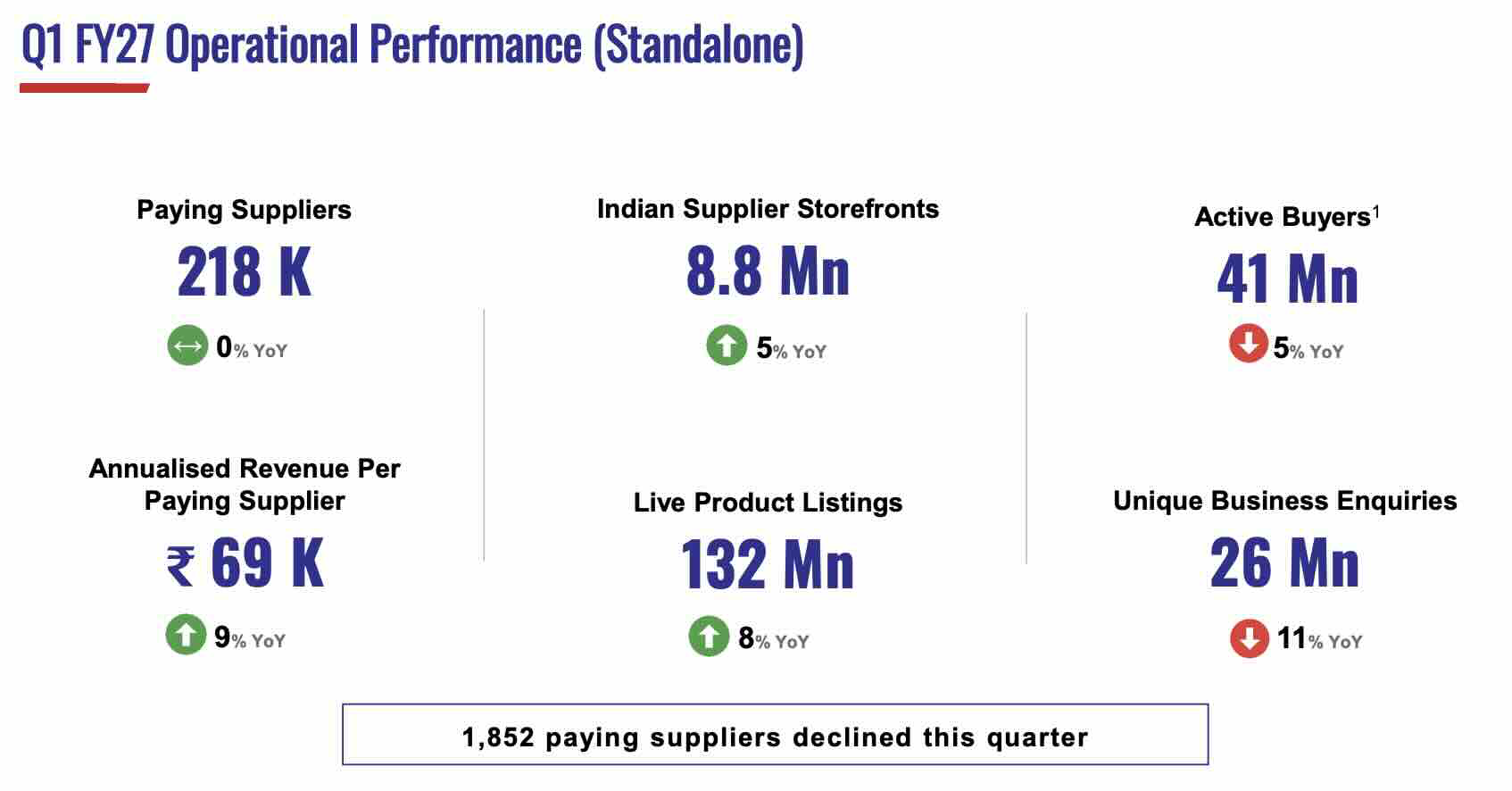
Rather than chasing subscriber growth, management is focusing on improving the quality of its customer base. After all, adding customers who leave quickly creates little long-term value.
The market, however, prefers early signals. One of the first numbers investors watch is collections. Unlike revenue, which is recognised over the life of a subscription, collections represent the money billed and received during the quarter. Collections are often seen as a leading indicator because they become future revenue.
Collections increased by 8% year-on-year in the June quarter, reinforcing concerns that growth is moderating.
Another closely watched metric is deferred revenue. This is money customers have already paid but which the company will recognise as revenue over the coming months. Deferred revenue increased 16% year-on-year to ₹2,014 crore, suggesting that future revenue remains well supported.
The numbers tell a different story
If Indiamart’s business were genuinely weakening, the financial statements would already show it. They don’t.
Revenue increased 11% year-on-year to ₹414 crore during the first quarter of FY27. Earnings Before Interest, Taxes, Depreciation and Amortisation (EBITDA) rose 10% to ₹146 crore, while the EBITDA margin remained at 35%. Net profit increased 12% to ₹172 crore and the business generated ₹163 crore of operating cash flow.
These are not the numbers of a business in decline. Growth has slowed from the post-pandemic surge, but that is often what happens when a company matures.
Once a business has built scale, the more important question is not how fast it is growing, but whether it can continue generating healthy profits and cash. On that count, Indiamart still appears to be holding up well.
What might long-term investors be seeing?
Markets are remarkably good at pricing the next quarter. They are often less successful at pricing the next five years.
Today, the market sees slowing subscriber additions and assumes the business is entering a prolonged phase of lower growth. A long-term investor may instead see a company with recurring subscription income, virtually no debt, high cash generation and customers who continue renewing every year. Those characteristics rarely disappear because of one or two disappointing quarters.
That does not mean subscriber growth is unimportant. It remains the lifeblood of a subscription business. But slowing growth has to be weighed against the quality of the business itself, and that quality is still reflected in the company’s profitability, balance sheet and returns on capital.
The next phase of growth may look different
Most successful subscription businesses eventually reach a point where finding new customers becomes more difficult. The better ones respond not by chasing growth at any cost, but by earning more from the customers they already have.
Indiamart appears to be following that path. The company has steadily increased Annualised Revenue Per Paying Supplier (ARPS), which measures the average annual subscription revenue generated from each paying customer. As businesses upgrade to higher-value plans and purchase additional services, the company earns more from every relationship. That means revenue can continue growing even if subscriber additions become more measured.
Management believes several categories remain underpriced and that it is introducing more category-specific pricing within Platinum subscriptions. Suppliers receiving greater commercial value from the platform are expected to pay higher subscription fees over time.
Instead of focusing only on adding new subscribers, Indiamart is trying to increase the value of each customer relationship. That is often a more profitable strategy for subscription businesses.
The AI question
Every successful business eventually faces a technological shift that convinces investors its business model is under threat. Newspapers faced the internet. Television faced streaming. Today, search engines and online marketplaces are facing generative AI.
The concern is understandable. If businesses increasingly rely on AI assistants to identify suppliers instead of searching online marketplaces directly, platforms like Indiamart could face a different competitive landscape.
Management acknowledges that users are beginning to experiment with AI-powered search but believes it is too early to judge how significantly behaviour will change. Meanwhile, the company is using AI to improve catalogue quality, verify suppliers, recommend better matches, automate customer support and power one of India’s largest AI-enabled voice calling platforms. Whether AI becomes a threat or an opportunity will ultimately depend on how effectively companies like Indiamart adapt to it.
Building beyond the marketplace
While the core marketplace remains the largest contributor to revenue, Indiamart is gradually expanding into adjacent businesses that could deepen its relationship with small enterprises.
Busy Infotech, its accounting software subsidiary, reported 47% year-on-year revenue growth during the June quarter, albeit on a much smaller base. Meanwhile, deferred revenue increased 44%, reflecting healthy demand for its subscription-based software. The company has also incorporated Indiamart Finance Limited, which aims to connect businesses on its platform with lenders offering invoice financing and working capital solutions. Rather than lending from its own balance sheet, Indiamart intends to earn fees by facilitating these relationships.
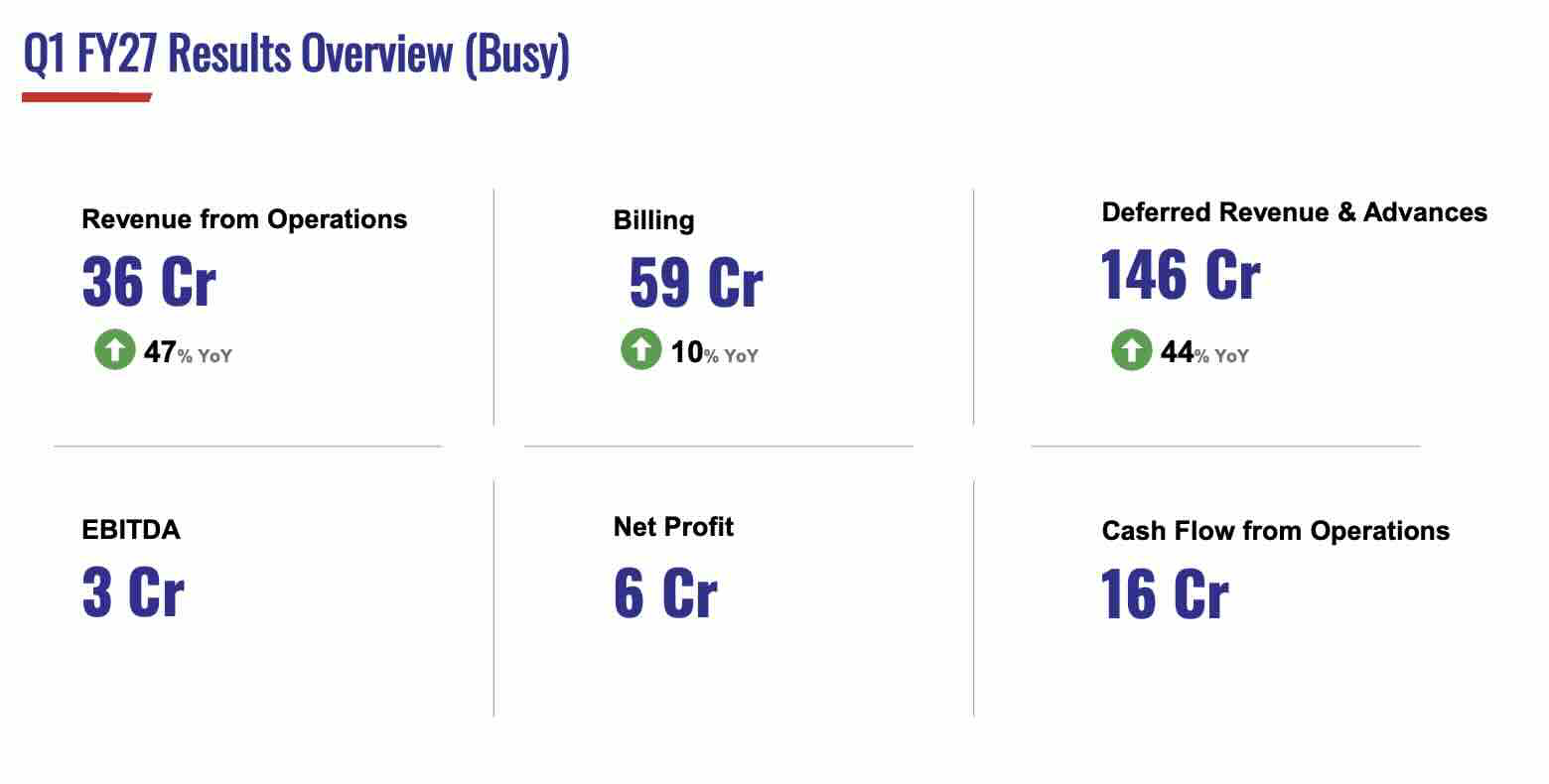
Neither business is large enough to materially influence earnings today. Together, however, they indicate that management is attempting to build a broader ecosystem around India’s small businesses instead of relying exclusively on marketplace subscriptions.
Strong businesses usually have strong balance sheets
One reason Indiamart can afford to think long term is the strength of its balance sheet. The company operates with virtually no debt and consistently generates healthy operating cash flows. Its asset-light business model requires relatively little capital to grow, allowing a significant proportion of earnings to be converted into cash that can be reinvested into new opportunities.
That strength is also reflected in the company’s returns. Indiamart continues to generate Return on Equity (ROE) of around 20.7% and Return on Capital Employed (ROCE) of about 28%, levels that relatively few internet businesses have been able to sustain over long periods.
The market’s verdict versus the business’s reality
The market no longer values Indiamart as the high-growth internet company it once was. Investors appear to believe that slower subscriber additions will eventually translate into structurally lower earnings growth, and that concern is reflected in the stock’s valuation.
That view may prove correct. But it is equally possible that the market is underestimating the company’s pricing power, recurring subscription model and strong balance sheet. Today, Indiamart is being judged largely by one number: paying suppliers. While that metric deserves attention, it is only one part of the investment story.
Pulak Prasad’s increasing stake does not prove the market is wrong. It simply highlights that long-term investors often look beyond quarterly subscriber numbers to assess whether a company’s competitive advantages and underlying economics remain intact. Ultimately, that question will matter far more than a single quarter’s slowdown.
Disclaimer:
Note: We have relied on data from www.Screener.in throughout this article. Only in cases where the data was not available, have we used an alternate, but widely used and accepted source of information.
The purpose of this article is only to share interesting charts, data points and thought-provoking opinions. It is NOT a recommendation. If you wish to consider an investment, you are strongly advised to consult your advisor. This article is strictly for educative purposes only.
Manvi Aggarwal has been tracking the stock markets for nearly two decades. She spent about eight years as a financial analyst at a value-style fund, managing money for international investors. That’s where she honed her expertise in deep-dive research, looking beyond the obvious to spot value where others didn’t. Now, she brings that same sharp eye to uncovering overlooked and misunderstood investment opportunities in Indian equities. As a columnist for LiveMint and Equitymaster, she breaks down complex financial trends into actionable insights for investors.
Disclosure: The writer and her dependents do not hold the stocks discussed in this article. The website managers, its employee(s) and contributors/writers/authors of articles have or may have an outstanding buy or sell position or holding in the securities, options on securities or other related investments of issuers and/or companies discussed therein. The content of the articles and the interpretation of data are solely the personal views of the contributors/ writers/authors. Investors must make their own investment decisions based on their specific objectives, resources and only after consulting such independent advisors as may be necessary.