



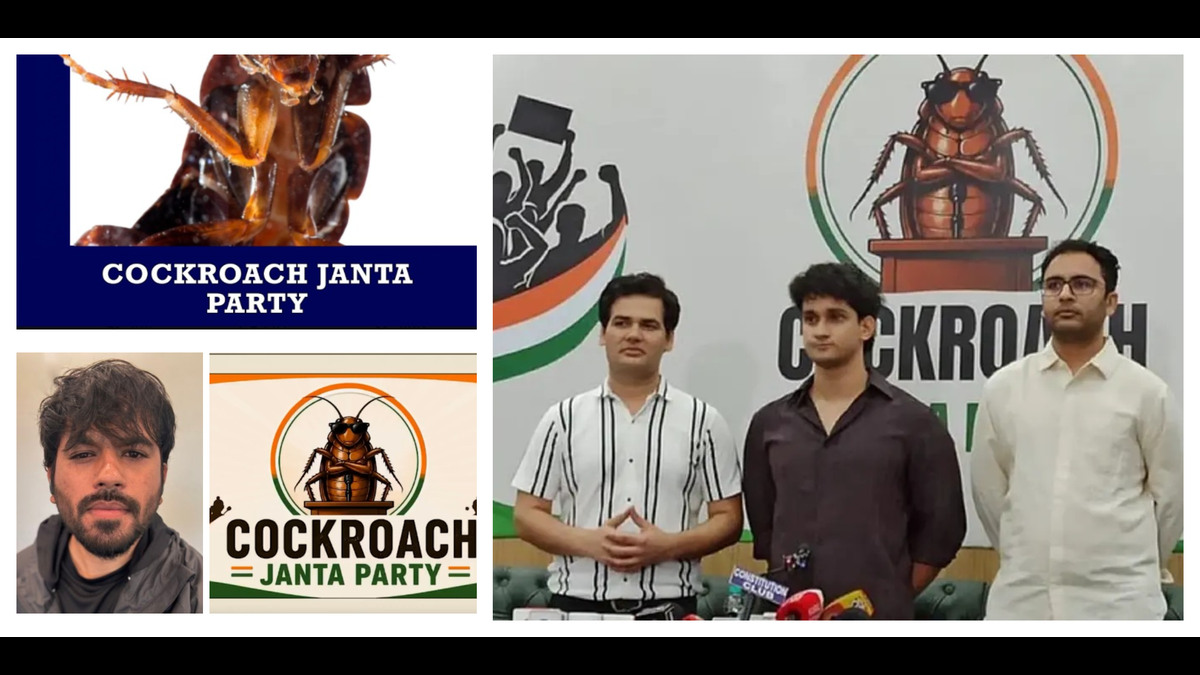
Cockroach Janta Party (CJP), the online-born youth outfit founded by Abhijeet Dipke, has named investigative journalist Saurav Das as its chief spokesperson and political researcher-filmmaker Vijeta Dahiya and former McKinsey consultant Ashutosh Ranka as additional spokespersons. The announcement, made on X on Wednesday (June 3), comes days before Dipke’s planned return to India on Saturday (June 6) to lead a protest at Jantar Mantar demanding the resignation of Union Education Minister Dharmendra Pradhan over alleged examination lapses.
CJP spokesperson Ashutosh Ranka, said, “Yes, Abhijeet (Dipke) has landed. He has also tweeted about it. We are hopeful this will be monumental day in Indian politics. Soon, he will come out, we will go to the police station where he will be seeking permission from Delhi Police and then we will sit at Jantar Mantar.”
Landed.
Looking forward to meet you all at Jantar Mantar. Do not forget to carry a book and our Tiranga!
Offer flowers to policemen as a gesture of compassion & gratitude.
We have to lead this movement with love and peace! https://t.co/HgDSf2gX0U
— Abhijeet Dipke (@abhijeet_dipke) June 6, 2026
Profiles and roles of 3 new members
Saurav Das (chief spokesperson): CJP described Das as an investigative journalist with experience covering legal, judicial and social issues. The party credited him with leading the anti-pollution protests at India Gate in November 2025. Speaking at the press conference earlier, Saurav Das framed the movement as generational and urgent, “There comes a moment when the youth of a nation realise they are angry because they were promised a future, and then mocked, moralised, and treated as disposable for asking where that future went. That moment has arrived. And it is time we change that,” he said.
Vijeta Dahiya (spokesperson): A Delhi Technological University (DTU) graduate, Dahiya has worked as a political researcher, author and filmmaker. CJP highlighted his background in research and content production for digital creators and his creative work in Haryanvi cinema, including the films Dararen and Opri Parai. Dahiya’s appointment signals the outfit’s emphasis on narrative building and youth-oriented content.
Ashutosh Ranka (spokesperson): An alumnus of IIT Kanpur and the London School of Economics, Ranka previously worked with McKinsey & Company in London before returning to India in 2025. CJP noted his involvement in public campaigns in Jaipur around environmental, education and youth issues, and cited his role in movements connected to the NEET paper‑leak controversy. His management-consulting experience is expected to help professionalise CJP’s organisational outreach.
Why the new joining’s matter?
The appointments aim to broaden CJP’s public-facing capacity as it scales from social-media satire into organised protest politics. The trio brings media, research, creative storytelling and professional-management skills- a mix that the party said will help it change the political discourse of India and lead a new generation of leaders. The move also prepares CJP to respond quickly to media queries and to articulate its positions on examination integrity, youth unemployment and governance reforms.
🚨MAJOR ANNOUNCEMENT🚨
Permission for the Cockroach Protest #CJPProtest Secured from Authorities.
Everyone, Proceed straight to Jantar Mantar.
Do NOT go to Parliament Street.
Please come directly to Jantar Mantar.
Dharmendra Pradhan, isteefa do!#cjpprotest
— Saurav Das (@SauravDassss) June 6, 2026
By appointing Das, Dahiya and Ranka, CJP is signalling its intent to combine investigative credibility, digital narrative skills and organisational rigor as it seeks to expand beyond social media into ground mobilisation and public advocacy. As Dipke returns to Delhi, the new spokesperson team will be the primary voice explaining CJP’s demands and strategy- starting with the call for ministerial accountability in the wake of the NEET controversy.
CJP’s protest plans and wider context
Founder Abhijeet Dipke announced on social media that he will return from the US to lead a peaceful demonstration at Jantar Mantar on June 6, demanding Education Minister Dharmendra Pradhan’s resignation amid the NEET‑UG paper‑leak controversy. This year’s NEET-UG was rescheduled to June 21 after widespread disruption and the CBI has launched a probe with several arrests.
Student bodies such as the All India Students’ Association (AISA) have already held demonstrations and prominent figures including education reformer Sonam Wangchuk have signalled support, “I will be joining the CJP members in Delhi on 6th June if nothing changes by 5th June. Any self-respecting Minister should resign if things go so wrong,” Wangchuk said.
Security, legal pushback and the movement’s evolution
Delhi Police said it had not received formal permission from CJP for the Jantar Mantar gathering and described the situation as dynamic while deploying more than 1,000 personnel as a precaution. A public interest litigation (PIL) from Save India Foundation sought preventive measures and the relocation or regulation of the June 6 mobilisation; the Delhi High Court refused to list the PIL for urgent hearing on June 5.
CJP originated as an online satirical response to remarks by the Chief Justice of India Surya Kant and has since transformed into a platform with significant traction among students and youth. The organisation’s transnational digital presence was cited in the PIL as a matter of concern, but CJP’s leadership emphasises peaceful protest and accountability in education.