



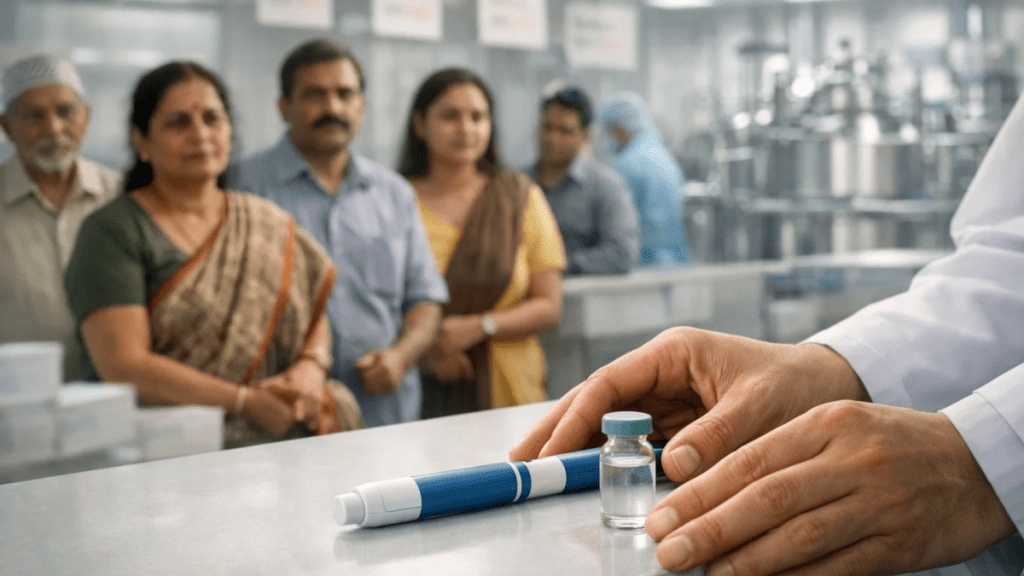
For years, the global weight-loss miracle has been a luxury reserved for India’s ultra-wealthy. With innovator brands like Semaglutide, sold globally as Ozempic, and Tirzepatide costing between Rs 8,000 to 10,000 per month, these cutting-edge obesity drugs have remained out of reach for the masses.
But this could be a matter of the past soon. According to Elara Securities, come March 2026, a massive change is coming in the rich man’s drug, which could easily become pocket-friendly with revised rates coming down to Rs 4,000 – Rs 6,000 per month.
The patent expiry of Semaglutide is expected to trigger a 50% price crash. However, the real story lies in who will capture the resulting volume explosion. Sun-Pharma, Lupin, Torrent, and Intas have emerged as the “Big Four” frontrunners, poised to use their existing metabolic dominance to seize this Rs 10,000-crore opportunity.
The Rs 10,000-crore opportunity
According to the Elara Securities report, the GLP-1 drug category (used for diabetes and obesity) could grow to represent 4-5% of the entire Indian pharma market. The report noted that this class of drugs is at least 3 to 4 times more effective in weight reduction than older treatments.
While the current market for these drugs in India is small, Elara Securities expects it to reach Rs 10,000 crore in the coming years. The report noted that the patent for Semaglutide ends in March 2026, which will allow local companies to launch cheaper versions.
The analysts mentioned that the entry of these “generics” will likely drop the price by half, making the treatment affordable for millions of patients instead of just the top 1%.
Sun Pharma: The scale leader
Sun Pharma stands as a top winner in this race. According to Elara Securities, the company has a massive 15% market share in the diabetes segment. The report noted that Sun Pharma is not just waiting for the patent to end; it is developing its own GLP-1 drug (GL0034), which is currently in Phase-2 clinical trials.
As per the data from Kotak Institutional Equities, Sun Pharma remains a preferred pick with a target price of Rs 2,125. This suggests an upside of roughly 11%. The Elara report noted that Sun’s ability to use its massive field force of medical representatives will give it an edge in reaching doctors across India.
Lupin: The insulin advantage
Lupin is another key player identified by Elara Securities as a major beneficiary. The report noted that companies with a strong history in insulin products have a natural advantage because they already have the “cold-chain” infrastructure needed to store and transport injectable obesity drugs.
Lupin is one of the few Indian companies with an existing insulin portfolio. According to Kotak Institutional Equities, Lupin is a top pick in the sector with a “Fair Value” target of Rs 2,455. Based on its current price, the stock offers an upside of about 14%. The Elara report noted that Lupin’s deep roots in the chronic therapy segment make it a formidable competitor.
Torrent Pharma: The chronic king
Torrent Pharma is frequently cited in the Elara Securities report for its focus on “pure” chronic therapies. The report noted that Torrent earns a very high percentage of its revenue from long-term treatments like diabetes and heart health.
According to Elara, Torrent’s strength lies in its ability to market premium brands to specialists. While the report did not provide a specific target price for Torrent, it grouped the company with the “Big Four” due to its high productivity per medical representative and its history of successfully launching new molecules in the metabolic space.
Intas: The growth outperformer
Intas Pharmaceuticals is the only unlisted company in the “Big Four,” but its performance is critical to the market. According to the Kotak Institutional Equities report, Intas was a “growth leader” in November 2025, outperforming the general market.
The Elara Securities report noted that Intas has been very aggressive in the metabolic segment. Because Intas is already a leader in many chronic therapy categories, the analysts believe it will be among the first to grab a large slice of the volume once the Semaglutide price drops in 2026.
Who stands to lose? The disruption of legacy pills
The Elara Securities report noted that the rise of obesity drugs will create some losers in the pharmaceutical space. Specifically, older classes of diabetes drugs, such as DPP-4 inhibitors (like Sitagliptin) and SGLT2 inhibitors (like Dapagliflozin), are expected to see a drop in their market share.
- Pills vs. Injectables: While GLP-1s are currently mostly injectables, their superior results are convincing patients to move away from daily pills.
- Bariatric Surgery Decline: The report noted that surgical centers focused on bariatric (weight-loss) surgery might see a decline in patient numbers as more people opt for a weekly injection instead of an operation.
What does it mean for the pharma sector in India?
A key insight from the Elara webinar is that the Indian market will be driven by “volume rather than pricing.” While the price per dose will drop significantly, the sheer number of eligible patients in India, which has one of the highest diabetic populations in the world, means the total revenue for the “Big Four” could increase.
Furthermore, Kotak’s November 2025 data shows that chronic therapies are already growing at 14% year-on-year, nearly triple the speed of acute therapies (5%). This suggests that the market is already primed for long-term treatments, making the 2026 launch of generic GLP-1s a perfectly timed catalyst for the sector.