



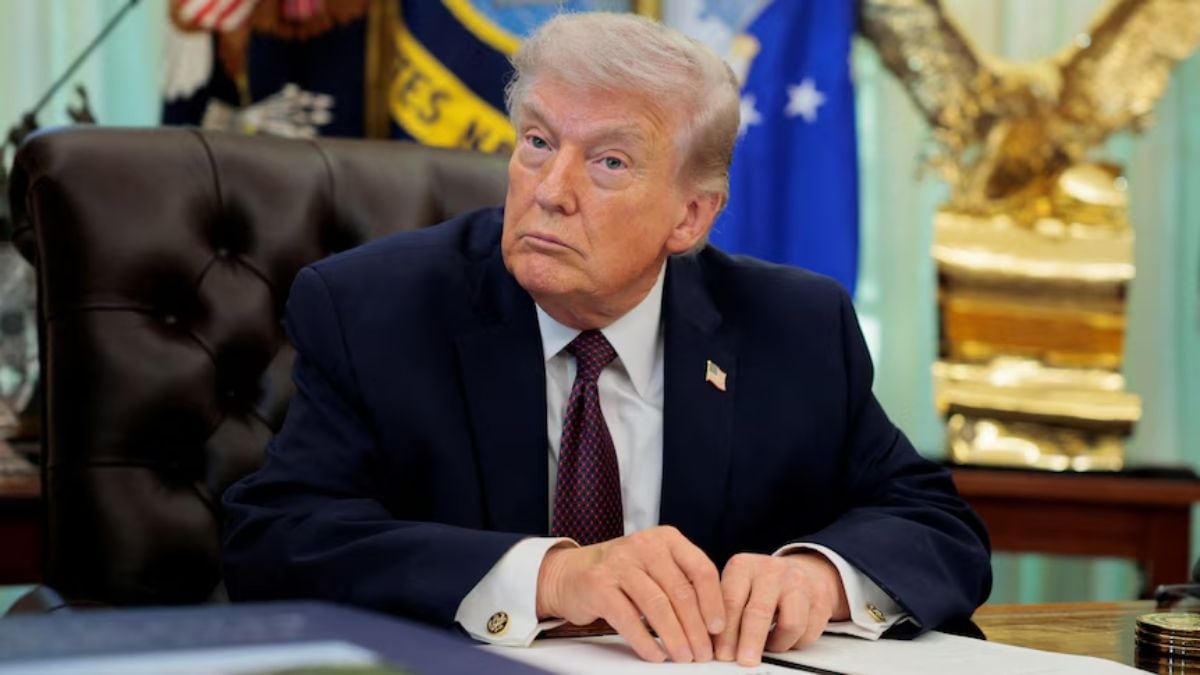
Talks around whether Donald Trump could, in a worst-case scenario, be removed using the 25th Amendment has picked up again—and this time, it’s getting harder to ignore. Over the weekend, the conversation moved beyond the usual political chatter. On prediction markets, where people put money on how events might play out, the odds of something like this happening ticked up. The shift comes at a tense moment, with the Iran war escalating and Trump’s recent remarks drawing sharp reactions.
On Kalshi, traders have been betting on a question that’s suddenly getting more attention: whether the 25th Amendment could be used during Donald Trump’s presidency. People can buy “Yes” or “No” shares depending on what they think will happen.
The “Yes” side has climbed from 28.6% to 35.1% over the past month, marking its second-highest level since the start of Trump’s second term. For context, it was just 15% back in January 2025, according to Kalshi’s data. According to the platform, traders appear to be reacting to a string of high-profile developments, including Trump’s recent social media posts on Iran, the fallout from the Strait of Hormuz disruption, and comments that have raised concerns over threats to civilian infrastructure.
What exactly is the 25th Amendment?
The 25th Amendment was added to the Constitution in 1967, after the assassination of John F. Kennedy exposed gaps in how presidential power is transferred. Despite all the talk, the 25th Amendment has never been used to remove a sitting president. It has mostly been used in temporary situations, like when a president undergoes a medical procedure and briefly hands over power.
Using it in this case would be far more serious. It would require the vice president and a majority of the Cabinet to take formal action. The president can challenge this by writing to Congress. But if the vice president and Cabinet stand firm within four days, then Congress steps in and votes. A two-thirds majority in both houses is needed to keep the president sidelined.
Why is Trump losing
The backdrop is a growing global crisis, with the Iran war reshaping US foreign policy and raising serious questions about leadership decisions at the top. The 25th Amendment is one of the most powerful tools in the US Constitution. It allows the vice president and a majority of the Cabinet to declare that a president is unable to do the job.
Even small shifts in prediction markets like these can influence how people see the situation, politically and economically. They don’t guarantee outcomes, but they do show how public expectations are changing in real time.
Much of the recent spike seems tied to Trump’s own statements, especially his posts about Iran.
The situation escalated after Iran effectively shut down the Strait of Hormuz, a key global oil route. Trump responded with aggressive remarks, including threats targeting infrastructure. On Easter Sunday, he posted a message on Truth Social that quickly grabbed attention for its tone.
“Tuesday will be Power Plant Day, and Bridge Day, all wrapped up in one, in Iran. There will be nothing like it!!! Open the F*****’ Strait you crazy b*******, or you’ll be living in Hell—JUST WATCH! Praise be to Allah,” he wrote.
Impeachment talk around Trump picks up – What the odds are saying right now
The market breaks the question into timelines, asking when—if at all—Trump could be impeached before his current term ends. According to Kalshi, for the very near term, the chances look quite low. Only about 5% of traders think impeachment could happen before June 1, 2026. In market terms, “Yes” shares are priced at just 5 cents, while “No” sits high at 96 cents, showing strong belief that nothing immediate is coming.
By January 1, 2027, the chances rise to around 14%, still relatively low but no longer negligible. By January 1, 2028, the probability climbs sharply to about 69%. That’s a clear sign many traders believe impeachment is more likely over time, even if not right away.
According to Kalshi, the market has seen more than $2 million in trading volume, showing strong interest and active participation.