



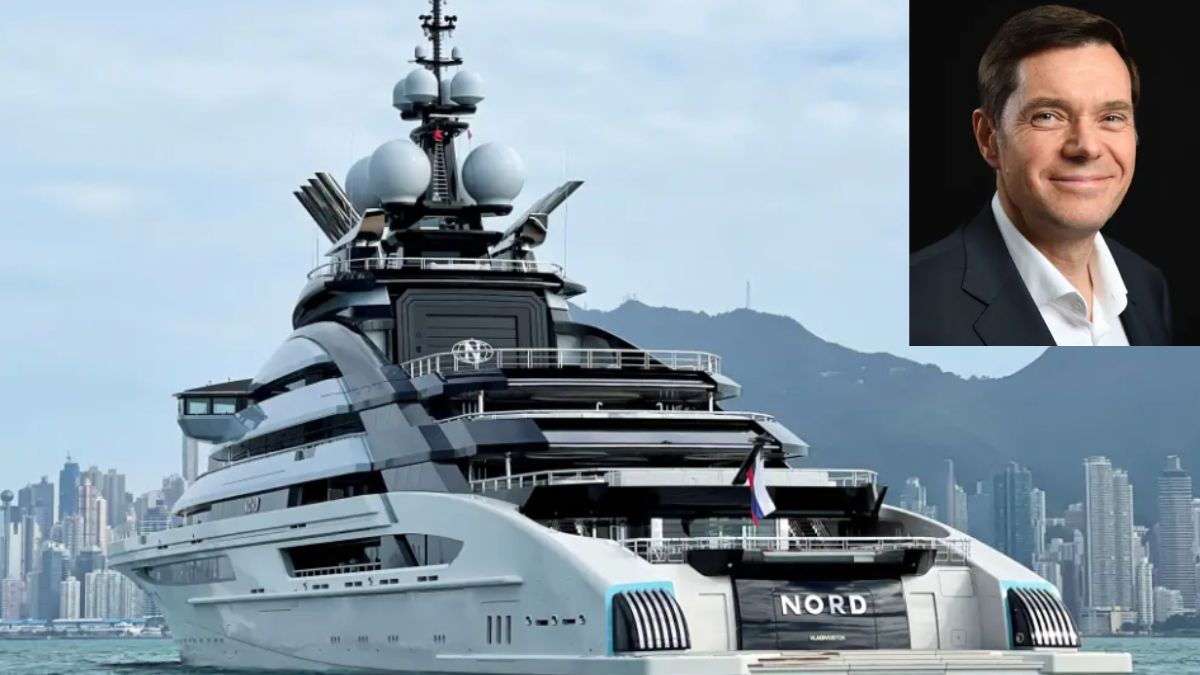
A $500 million luxury superyacht has successfully crossed the Strait of Hormuz, one of the world’s most tense waterways amid escalating US-Iran tensions. The 142-metre superyacht ‘Nord’ departed from Dubai on Friday night and arrived at Al Mouj Marina in Muscat, Oman, on Sunday morning, according to Marine Traffic data.
The vessel’s journey in itself is worth the attention, especially as tension between the US (alongside Israel) and Iran have sent shockwaves through global oil and energy supplies, with the critical waterway emerging as the primary bargaining chip amid the flaring crisis in West Asia.
Making matters even more interesting, it has since come to light that the luxury boat transiting the Gulf waterway over the weekend is linked to Russia’s richest billionaire, Alexei (or Alexey) Mordashov, who is a sanctioned tycoon and, not to forget, one of President Vladimir Putin’s key allies.
Superyacht linked to Russia’s richest man crosses Strait of Hormuz
Although the Russian-flagged boat is formally owned by Mordashov, Nord’s records reveal was registered to a firm owned by the sanctioned billionaire’s wife in 2022, the BBC reported.
According to images of the luxurious vessel available on Yachtbuyer, the 142m-long Nord features two helicopter pads, luxury lounge decks, and a 25 m pool, among many other highlights. With onboard gym, cinema and jacuzzi, it is also capable of carrying smaller craft and submarine, in addition to offering space for 36 guests and 42 crew.
Nord’s journey this weekend appears to have been the same as the one undertaken by vessels crossing the strait with agreement from Iran, according to the Marine Traffic platform’s tracker. At the same time, the route didn’t hint at the yacht stopping in Iran.
As of now, official word on how the civilian ship linked to Putin’s close ally was able to cross the channel is awaited.
A source close to Mordashov quoted by Reuters, however, said, “Iran did not interfere with the movement of the yacht, as it is a civilian vessel of a friendly country conducting a peaceful transit. The American side also raised no questions regarding the yacht’s movement, as it did not call at Iranian ports and has no connection to Iran,”
Who is Alexei Mordashov?
Alexei, who is the general director of investment firm Severgroup, topped Forbes’ list of Russia’s billionaires. Though the son of mill workers, Mordashov found his footing as one of the top guns in Russia after becoming the finance director of a steel mill.
Currently, his net worth is estimated to be $36.9 billion (down from $37 billion as of March 10, 2026), marking an $8.4 million increase from last year’s ranking. As one of the leading ultra-rich Russian figures, Mordashov is associated with the vast reserves of natural resources the country has exported to global markets for decades.
Merely a few days ago, Forbes Russia reported that he and other Russian billionaires on the list have witnessed an overall 11% increase in their wealth to a record $696.5 billion over the past year despite Russia’s ongoing war in Ukraine. The still ongoing conflict left many like Mordashov being targeted by Western sanctions, including from the UK, US, and European Union, unlike ever before.
Even more prominently, Alexey Mordashov, now 60 years old, built his wealth through Severstal, which is possibly the largest steel and mining company in Russia. Having previously led the firm as CEO for 19 years before resigning in 2015, he still holds his post as the majority shareholder (77%) in the steel company.
When hit by sanctions in 2022 over his country’s war on Ukraine, Mordashov was forced to immediately transfer ownership of key assets, including shares of leisure company TUI and mining outfit Nordgold. Consequently, Severstal also lost more than $400 million that year.
The Mordashov-linked Nord and its recent escapades through the Strait of Hormuz have made striking headlines, as the US and Iran struggle to see eye to eye over peace talks. With the US and Israel first launching attacks on Tehran on February 28, Iran has repeatedly used the important waterway as a means to avoid bending to the US’s will amid negotiations.
This has, in turn, severely depleted the traffic through the strait, which was originally used to transport approximately one-fifth of global crude oil and liquefied natural gas (LNG) supplies.
Friday shipping data cited by Reuters suggested that only five ships, including an Iranian oil products tanker, passed through Hormuz in 24 hours at the time. Before the war began in late February, the strait was registering an average of 140 daily passages.