



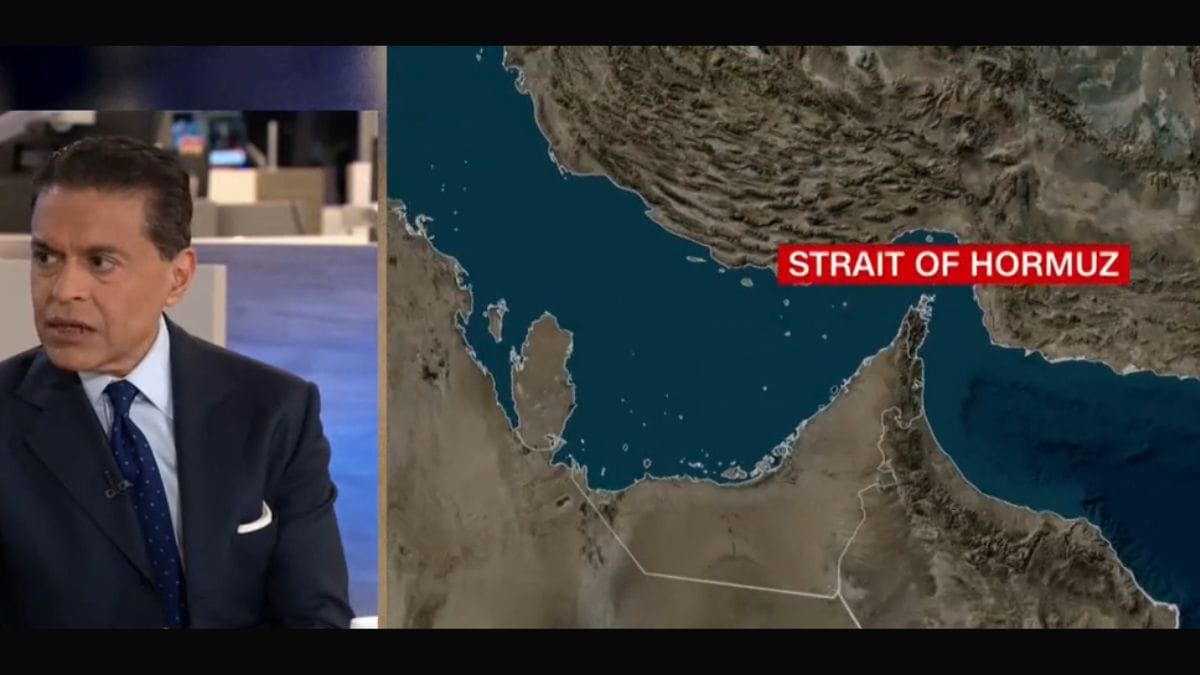
Reacting to the news of the two-week ceasefire agreement between the United States and Iran, Indian-American journalist Fareed Zakaria told his CNN colleague, Anderson Cooper, that the deal in question seemed quite “fragile” owing to the unpredictability of the situation.
Although he expressed optimism about the hopeful deviation from US President Donald Trump’s initial threats to annihilate the entire Iranian civilisation, he argued there was no real trust between the two sides involved in the war.
He further foregrounded that the reported 10-point peace agreement being worked out between the two countries through back channels, including Pakistani intermediaries, and the ongoing war have handed Iran a “far more usable” weapon than nuclear weapons. It’s none other than the important Strait of Hormuz, a crucial maritime chokepoint, which is also an indispensable channel for imports to the Middle East, including food, medicines, and technological supplies.
Indian-American CNN journalist says US-Iran ceasefire is ‘fragile.’
“The last two negotiations the United States was in with Iran, it essentially started bombing Iran in the middle of those negotiations,” the Indian-born CNN columnist said. “It’s not surprising that even though there does seem to be some kind of an agreement, it’s very fragile and probably going to take a while to work out.”
On Tuesday evening (US time), the US and Iran agreed to a two-week ceasefire based on the foundations of multiple conditions. The most important one of these pertained to the temporary reopening of the Strait of Hormuz just ahead of a major deadline. Trump had previously vowed Iranians would be “living in Hell” if the strait isn’t opened by Tuesday.
Despite his repeated threats to Iran’s civilian infrastructure, the MAGA leader backed away from the apocalyptic warning amid claims of Pakistani intervention. Just hours before Trump’s Tuesday deadline, suggesting “a whole civilisation will die tonight, never to be brought back again,” he said he’d agreed to “suspend the bombing and attack of Iran for a period of two weeks” if the strait is reopened.
In a post on Truth Social, the POTUS said he agreed to the conditional ceasefire because “we have already met and exceeded all Military objectives.”
Iran, on its part, issued a 10-point plan urging a complete cessation of war in Iran, Iraq, Lebanon, and Yemen. It also demanded “full commitment” to lifting all sanctions on Iran, the release of frozen Iranian funds held by the US, and a “full payment of compensation for reconstruction costs” to Iran.
“Iran fully commits to not seeking possession of any nuclear weapons,” it added.
Tehran’s Supreme National Security Council further said in a statement, “Iran’s victory in the field would also be consolidated in political negotiations.”
While Israel has also agreed to the provisional peace plans, it claimed Lebanon wouldn’t be part of the ceasefire, according to Israeli Prime Minister Benjamin Netanyahu’s office.
Strait of Hormuz is Iran’s biggest weapon: Fareed Zakaria
With the Strait taking over the focus amid the ongoing war in Iran, the discussions have “strategically” shifted away from the country’s nuclear program, CNN’s Fareed Zakaria argued.
Also calling it a “strategic loss for the United States and its allies,” the Indian-American journalist said the ongoing war has handed Iran “a weapon that is far more usable than nuclear weapons, which is the Strait of Hormuz, choking off global oil supplies, essentially disrupting the global economy.”
About 20% of the world’s oil and liquefied natural gas (LNG) is believed to pass through the strait. In the wake of its closure amid ongoing hostilities, global fuel prices soared beyond comprehension, while fears of shortages loomed. According to the BBC, these prices dropped by around 15% shortly after the ceasefire was announced.
According to estimates from the US Energy Information Administration, about 20 million barrels of oil and oil products passed through the strait per day in 2025. This accounted for nearly $600 billion worth of energy trade per year.
“What they have realised is they have this weapon. They can use it, they can turn it on and off without will, and anything that institutionalises,” Zakaria added. Detailing his understanding of the current circumstances, the CNN journalist argued that it almost seemed as if the US and Gulf were “hostage to Iranian good graces in order to get their product out.”
As could be anticipated, Zakaria emphasised that Iran will inevitably be very reluctant to give up its position in the current power hierarchy owing to its authority over the strait, even though this had never been a point of contention over the past four decades despite the existing tensions between the US and Iran. Zakaria, therefore, blamed America and Israel for “handing over” a consequential weapon to Iran, while the Iranian nuclear program has completely shifted out of focus from the discourse.
“You’ve taken an Iran that was weak, contained, nuclear program-shattered, and you’ve given it control of the strait, enormous new revenue flows, and the nuclear stockpile,” Zakaria said, alluding to reports that Tehran has started charging up to $2 million per ship for “safe passage” through Hormuz.
According to The Associated Press, the Iranian Parliament has approved a draft bill that would formalise the toll fees. JPMorgan further reported that Iran is considering charging 100-130 vessels per day $2 million each. This would amount to $70-$90 billion per year in revenue flows if approved.