



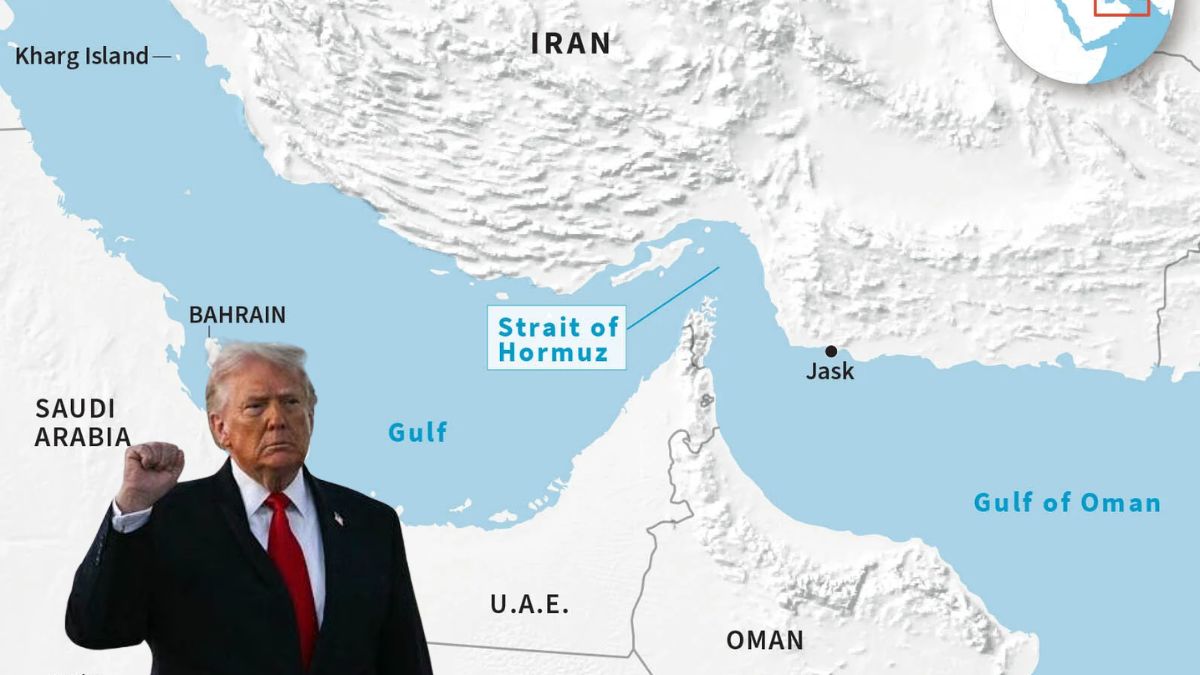
The US has imposed a blockade on ships travelling to or from Iranian ports. While the blockade is ostensibly to guarantee freedom of navigation to vessels of all countries via the Strait of Hormuz, the ultimate aim is to eliminate Tehran’s greatest point of leverage in negotiations, writes Banasree Purkayastha
What are the contours of the US blockade?
Initially, on Sunday, after the US-Iran talks ended with no deal, US President Donald Trump had said the US Navy would start “blockading any and all ships” trying to enter or leave the Strait of Hormuz.
Later, however, the US military Central Command announced that the naval blockade would only stop ships travelling to or from Iranian ports and coastal areas, including all Iranian ports on the Arabian Gulf (Persian Gulf) and Gulf of Oman. It said that the US Navy would “not impede” vessels transiting the Strait travelling to or from other countries.
The blockade began from 14:00 GMT on Monday (7: 30 pm IST). While the US military has not said how it plans to enforce the blockade or whether warplanes would be used, experts say it is unlikely the US military would fire missiles or other weapons at tankers, given the risk of an environmental disaster.
According to experts The Guardian spoke to, the most likely option is the US navy will try to force vessels to change course through threats, and if that doesn’t work, they will launch armed boarding parties to take physical control of the ships.
Why block if goal is to reopen the Strait?
The strait of Hormuz is today Iran’s most effective weapon in its war with the US. Iran has effectively closed the Strait – through which about 20% of global oil moves – by air strikes on ships passing through it and laying mines under the sea, thus driving up oil prices.
Tehran has also reportedly been charging money for some vessels to pass through. In its weekend talks, it had indicated it wants to charge a fee of up to $2 million for each ship that passes through it even after the war ends.
Trump has told Fox News that “we’re not going to let Iran make money on selling oil to people that they like and not people that they don’t like”, and the goal was letting “all or nothing” pass through the crucial shipping channel.
Former US Ambassador to the UN Nikki Haley told CNN that if the US did not do anything to stop Iran, it would not only have leverage but have more money than before to funnel money to its proxies, buy supplies for ballistic missiles and continue its nuclear goals.
How could the blockade hurt Iran?
The aim is to strangle Iran’s oil revenues and destroy its economy, and ultimately force Tehran to accede to Washington’s terms and abandon its nuclear ambitions. China buys most of Iran’s crude through small, independent refineries, paying in Chinese yuan.
Kpler estimates China purchased around 1.4 million barrels of oil per day from Iran in 2025. India has not imported oil from Iran since 2019, but recently Washington gave it a waiver to pick up Iranian cargoes already on sea. Two supertankers with Iranian crude reached India on Sunday.
Iran has responded with threats on all ports in the Persian Gulf and the Gulf of Oman. “Security in the Persian Gulf and the Sea of Oman is either for everyone or for no one,” the Islamic Republic of Iran Broadcasting reported Monday. “No port in the region will be safe,” a statement from the Iranian military and the Revolutionary Guards said.
Retired Admiral Gary Roughead, a former chief of US naval operations, told Reuters that Iran could fire on ships in the Gulf or attack infrastructure of the Gulf states that host US forces. That would mean the end of the fragile two-week ceasefire which expires on April 22.
What will be the broader impact?
Shipping expert Lars Jensen told the BBC that if the US implements the blockade, it would halt a very tiny trickle of vessels. “In the greater scheme of things, it doesn’t really change anything,” he said.
Trump’s threat of preventing safe passage for any ships paying tolls to Iran would also have little impact, he told BBC, as any company doing so would already face sanctions for paying the regime. Maritime expert Jennifer Parker told Al Jazeera that global shipping companies are likely to welcome a US naval presence in the Strait of Hormuz, but they will need more reassurance before attempting to cross it.
Most shipping companies will wait and see whether the current ceasefire holds. The announcement of the blockade has halted the limited ship traffic that resumed in the strait since the ceasefire, said an early report from Lloyd’s List intelligence. Oil prices rose in Monday trading after the announcement.
How many Indian ships are stranded in the region?
As many as 15 Indian-flagged vessels are currently stranded west of the Strait of Hormuz after the US announced the blockade. The stranded vessels include LNG and LPG carriers, crude oil tankers, container ships, a dredger and a chemical tanker. And it is not only ships that are stuck, but also around 20,000 Indian seafarers, in the Persian Gulf and the adjacent areas.
The Indian Navy and a multi-ministry task force is monitoring the situation, with at least six Indian naval ships positioned near the Persian Gulf to assist the stranded vessels with communication, escort operations and safe passage advisories.
The US waiver on purchase of Iranian oil by India expires on April 19 and it now remains to be seen if the blockade impacts any further movement of oil cargoes to India. Industry experts believe some more Iranian crude is expected to reach India over the coming days.