



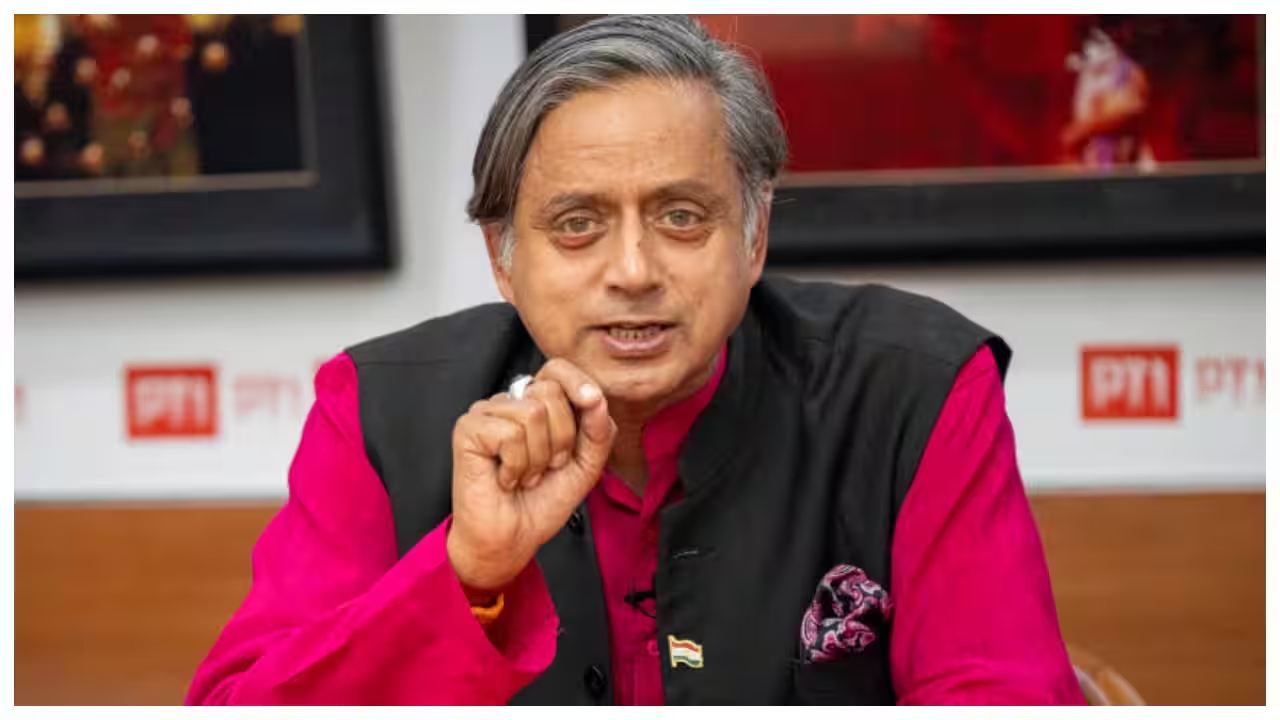
Congress Member of Parliament Shashi Tharoor has urged sweeping policy, infrastructure and tax reforms to make India a more attractive and affordable tourism destination, arguing that the country remains too expensive and inconvenient for many foreign visitors. Speaking at a fireside chat with members of the Indian diaspora in Thailand, he said India should, in theory, be cheaper than Thailand because of its lower per capita income, yet the opposite is often true. Tharoor pointed out what he described as a striking contradiction in regional tourism.
“Thailand is historically very much cheaper to visit for a tourist than India is,” he said, adding, “And that’s a bit ironic because in many ways your per capita income is higher than ours. So we should actually be cheaper than you.”
He argued that financial, tax and policy-related changes are needed to bring down the cost of travel in India. In particular, he highlighted structural bottlenecks in the hospitality industry that push up room rates and make Indian destinations less competitive than those in Southeast Asia.
Hotel costs and regulation
According to Shashi Tharoor, floor space regulations and land-use constraints are among the reasons hotel accommodation in India remains expensive. He said low-density construction means developers have less usable space, forcing them to charge more per room to recover costs.
“I’ve written articles advocating some changes that would make hotel rooms more affordable than they are right now,” he said. “Largely because we have a series of floor space index problems, which means that the available land is being used for fairly low-level building spaces. And so each room constructed has to charge more to break even than in many countries.”
He suggested that if India wants to compete more effectively for global tourists, it must reduce such cost pressures through regulatory reform and better urban planning. Tharoor added the government has an important role in improving tourism, but that role should be focused primarily on infrastructure, regulation and incentives rather than marketing.
He said public authorities need to address persistent problems such as sanitation, waste management, hawking and begging in tourist areas, all of which affect visitor experience.
“The government has to do a lot to make India an easier place to visit,” he said. He added that tourism becomes more viable only when destinations are clean, accessible and supported by efficient services.
Private sector push
The Congress leader questioned whether government officials are the right people to promote India as a tourism brand. “But the truth is, bureaucrats are not great at this stuff,” he said.
He drew a distinction between policymaking and destination marketing, saying that private sector players are better suited to sell India to the world through packages, outreach and active promotion. “I think what I would rather have is to let the private sector do that,” he said, while the government focuses on the enabling environment.
Tharoor did, however, praise former bureaucrat Amitabh Kant for his role in building the “Incredible India” campaign, calling it one of the notable exceptions to what he described as generally weak official tourism promotion.
“I’ve seen Indian tourism promotion over decades, and except for a few inspiring exceptions like my friend Amitabh Kant, who devised the Incredible India campaign, I would say that a lot of that is not well done by government officials,” he said.
India trail in numbers
To underscore the scale of the challenge, Tharoor said Bangkok alone receives more tourists in one month than India does in an entire year. India recorded 9.95 million foreign tourist arrivals in 2024, still below pre-pandemic levels. Thailand, by contrast, welcomed more than 35.5 million international tourists in 2024, exceeding its target and reflecting a much stronger recovery.
The comparison, he suggested, shows that India needs more than slogans to compete for global tourism. Lower costs, better infrastructure and a more active private sector role, he argued, are essential if the country wants to convert its cultural and geographical advantages into sustained tourist inflows.
What needs fixing?
Shashi Tharoor’s remarks amount to a critique of India’s tourism ecosystem as much as a policy suggestion. He said the government should concentrate on making the sector viable and affordable for both operators and tourists by improving tax policy, easing regulations and upgrading infrastructure.
“Let the government handle the infrastructure, the tax incentives, and so on that can make tourism viable, affordable both for the operators in India and for the tourists who we need to attract to our country,” he said.
His comments come at a time when India is still trying to close the gap with regional tourism leaders, even as destinations such as Thailand continue to outperform it in both visitor numbers and international appeal.