




At a time when companies are talking about work-life balance and flexibility, a founder’s honest LinkedIn post has started a fresh debate. Malik A shared how he lost one of his best employees because he refused her request to work from home on Fridays.
The employee’s job was mostly independent. She asked if she could work remotely just one day a week. Malik said no. He later admitted that he was thinking ahead and worrying about what might happen next.
“I thought if I said yes everyone would ask. The office would be empty on Fridays. It would spiral out of control,” he wrote.
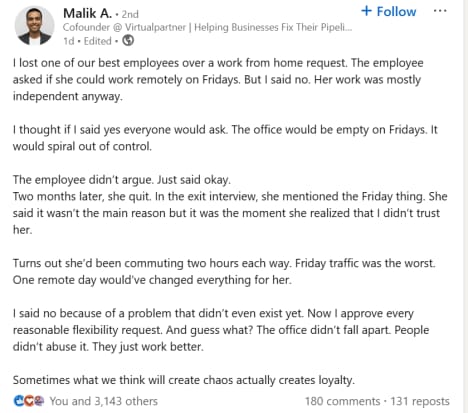
The employee did not argue. “Just said okay,” he added.
The resignation that changed his thinking
Two months later, she quit. In her exit interview, she brought up the Friday request. Malik wrote, “She said it wasn’t the main reason but it was the moment she realised that I didn’t trust her.”
That line stayed with him. He also learned something he hadn’t fully considered before. She had been commuting two hours each way, and Fridays were the worst due to traffic. One remote day could have made a big difference in her week.
“Turns out she’d been commuting two hours each way. Friday traffic was the worst. One remote day would’ve changed everything for her,” he wrote.
Looking back, Malik admitted, “I said no because of a problem that didn’t even exist yet.”
A new approach to flexibility
After she left, he decided to change his mindset. He now approves reasonable flexibility requests. And the chaos he once feared never happened.
“And guess what? The office didn’t fall apart. People didn’t abuse it. They just work better,” he shared. He ended his post saying, “Sometimes what we think will create chaos actually creates loyalty.”
Remote work is growing worldwide
According to a study by FMC Group, about 330 million people worldwide work remotely, either fully or in hybrid roles. Remote-capable digital jobs are expected to grow 25 percent by 2030. Technology, changing expectations, and the long-term impact of the pandemic have all pushed this shift. For many employees, flexibility is no longer a bonus but it is important.
LinkedIn users react
Many users appreciated Malik’s honesty. “It’s refreshing to see someone admit where they went wrong on LinkedIn,” one person commented, adding that vulnerability and accountability are needed on the platform.
Another user wrote, “It’s funny how companies suddenly start listening only after someone resigns. When employees are still around and trying to address real problems, their voices often go unheard.”
Trust was a common theme in the reactions. As one comment put it, “Lack of flexibility narrows your available pool of candidates. Not fatal, but far from ideal.”