



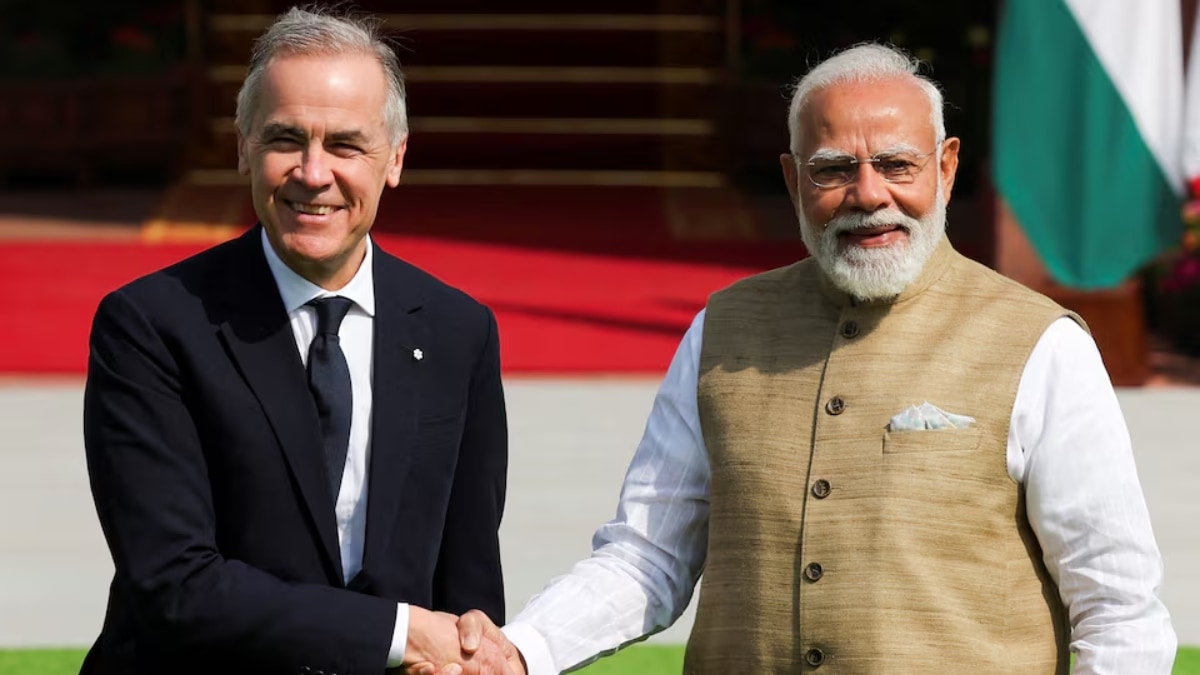
The significant improvement in Indo-Canadian relations no doubt reflects their strategic compulsion to engage more closely with one another as the rules-based global trading order is being undermined by the tariff disruption of US President Donald Trump. Canadian Prime Minister Mark Carney—who is on a four-day visit to India—had a productive meeting with his Indian counterpart, Narendra Modi, and reaffirmed advancing to a Canada-India economic partnership agreement by the end of this year that will double bilateral trade to $50 billion by 2030. Canada’s two-way trade in goods and services with India hit $23 billion last year. India and Canada are diversifying their trading relationships in a more divided and uncertain world. Both sides have also sealed a long-pending 10-year uranium supply agreement between Cameco Corporation, one of the world’s largest publicly traded uranium producers, and India’s Department of Atomic Energy. Nuclear cooperation is on the anvil to harness Canada’s expertise in building large-scale and small modular reactors. Bilateral agreements have been inked for cooperation in renewal energy, critical minerals, and cultural and technological cooperation.
The Carney-Modi meeting—which follows their earlier ones on the sidelines of a G7 summit at Kananaskis and G20 summit in Johannesburg last year—is a harbinger of a reset in bilateral relations that hit rock-bottom during the last three years. Indo-Canadian diplomatic relations deteriorated after Justin Trudeau, then Canada’s premier, stated on the floor of Parliament in September 2023 that his country’s security agencies were investigating “credible allegations of a potential link” between Indian government agencies and the killing of a Khalistani Sikh leader, Hardeep Singh Nijjar, on Canadian soil. India has strongly rejected these charges. The good news is that the calibrated steps to restore normalcy in the bilateral relationship is perhaps being ring-fenced from the judicial process vis-à-vis Nijjar’s killing with conversations at the highest levels regarding concerns about criminal activities with possible links to India, continued law enforcement dialogue, and discussions of security matters. In a background briefing to journalists ahead of Carney’s visit, Ottawa signalled that India is no longer linked to violent crimes on its soil, according to Toronto Star. This does vindicate India’s position.
For such reasons, Carney rightly states that his visit marks the “end of a challenging period and, more importantly, the beginning of a new, more ambitious partnership between two confident and complementary nations”. Both nations are middle powers and have much to gain from a closer engagement that is bound to grow manifold with larger two-way investment flows. Canada has invested $4.3 billion in India from April 2000 to December 2025, much of it from portfolio investors. Pension funds have invested $100 billion. India’s outbound investments to Canada were more modest at $2.2 billion. Around 600 Canadian companies have a presence in India, while 30-odd Indian companies have operations in Canada.
However, the deepest link between the two nations is the Indian diaspora with 1.8 million Indo-Canadians and another million non-resident Indians. Currently, there are 400,000 Indian students, which is twice the number in the US and four times of the UK. The Canada-India Talent and Innovation Strategy has launched 13 new partnerships with McGill University, University of Toronto, and University of British Columbia, focusing on artificial intelligence, health sciences, and digital architecture. These people-to-people ties must be nurtured as the bilateral relationship is definitely set to improve.