



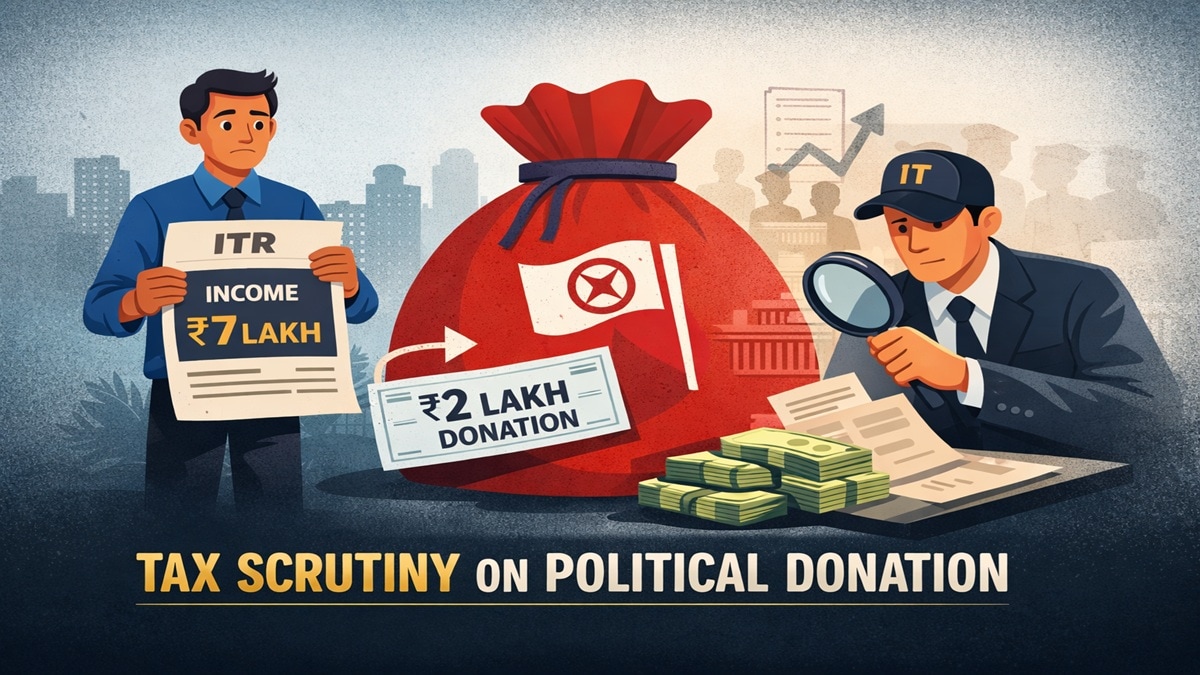
The Income Tax Appellate Tribunal (ITAT) Mumbai recently rejected a taxpayer’s claim for deduction on a political donation, holding that the payment was part of a bogus donation scheme used to claim tax benefits.
The ruling came in the case Prasad Siddharth Thorat vs ITO, Ward-14(3)(1), Mumbai (ITA No. 5504/Mum/2025) for Assessment Year 2019-20, decided by the SMC Bench of ITAT Mumbai on January 7, 2026.
The taxpayer, a salaried individual, had filed his income tax return on July 24, 2019, declaring a total income of Rs 7.31 lakh. In the return, he claimed a deduction of Rs 2 lakh under Section 80GGC for a donation made to Rashtriya Samajwadi Party (Secular) through banking channels.
Section 80GGC allows taxpayers to claim deduction for donations made to political parties, provided the contribution is not made in cash.
The assessee argued that the donation was made through account-payee cheque and the political party was registered under Section 29A of the Representation of the People Act. He also submitted documents such as receipt, PAN and registration proof in support of the claim.
However, the Assessing Officer (AO) disallowed the deduction, and the decision was later upheld by the Commissioner of Income Tax (Appeals).
Tax experts say the provision itself allows a full deduction but has often been misused in the past.
CA Akshay Jain, Partner, Direct Tax, NPV & Associates LLP explains: “Under section 80GGC of the Income Tax Act an assessee can claim 100% deduction of the donation made to the political parties. Assessees used to take the benefit of this section and used this section for reducing the taxable income. However, it was discovered by the revenue authorities that this was used by assessees for claiming wrongful deduction and evading taxes.”
“Assessees used to give donation to the political parties and the amount was return back to them in cash after deducting the commission. When revenue authorities came to know of this loophole, they had sent messages and emails to these assessees reminding them to file updated return and pay the taxes which has been evaded previously.”
Investigation into alleged bogus donation network
According to the tribunal order, the tax department received information from the Investigation Wing about a nationwide scam involving fake donations to political parties to claim tax deductions.
The investigation pointed to the Rashtriya Samajvadi Party (Secular) as one of the entities allegedly involved in the scheme.
Search proceedings conducted in September 2022 revealed that the party allegedly operated a network where:
-Donations were received through cheque or banking channels
-The funds were routed through shell entities or intermediary accounts under the guise of business transactions
-Cash was eventually withdrawn and returned to donors after deducting a commission of around 3.5% to 5%
-Statements recorded during the search also indicated that party officials admitted to the existence of the bogus donation mechanism.
Statements during search:
During the investigation, Bishwajeet Singh, who managed party operations, allegedly admitted that the party was involved in arranging bogus donations through a network of chartered accountants and intermediaries.
Many present and former party office bearers also reportedly confirmed the modus operandi of routing donations and returning cash to donors.
The tribunal order noted that these statements were recorded under oath during search proceedings and were not later retracted.
After examining the evidence, the ITAT concluded that the donations received by the political party were part of a sham transaction designed to generate tax deductions.
The tribunal held that since the underlying transaction itself was fraudulent, the taxpayer could not claim deduction under Section 80GGC.
It also observed that fraud vitiates all transactions, and therefore the deduction claim could not be allowed even if the payment was made through banking channels.
Commenting on the ruling, Sandeep Bhalla, Partner, Dhruva Advisors, said: “The Mumbai Income Tax Appellate Tribunal (ITAT), in the case of Prasad Siddharth Thorat, upheld the disallowance of political donations claimed under Section 80GGC, prioritizing investigative findings over banking documentation.
Key findings of the Mumbai ITAT
The Tribunal determined that the donations were part of a structured accommodation entry scheme. Key points include:
Modus Operandi: Investigation revealed a racket where funds were routed through dummy entities and vendors before being returned as cash to donors.
Evidence: Statements from party office bearers confirmed the fraudulent nature of these transactions.
Legal Principle: The Tribunal invoked the maxim “fraud vitiates everything,” ruling that procedural compliance (like using cheques or providing PAN details) cannot legitimize a sham transaction.”
Bhalla also pointed out that a different tribunal bench had taken a contrasting view in a similar matter involving the same political party.
Comparison with Raipur ITAT
In a contrasting development involving the same political party and identical facts, the Raipur Bench ruled in favor of the assessee. The Raipur Bench noted:
Lack of Primary Evidence: The Assessing Officer failed to prove that the specific assessee received a cash kickback.
Third-Party Presumptions: Disallowance based solely on general search findings from third parties—without linking them to the specific transaction—was deemed insufficient.
Despite being delivered only a month apart, the Mumbai ITAT decision was not brought on record during the Raipur proceedings. This highlight underscores a growing judicial scrutiny on tax fraud schemes versus the burden of proof required to deny statutory deductions.”
When such donations attract scrutiny
Experts say that tax authorities typically examine several factors to determine whether a political donation is genuine.
As Jain explains – Tax authorities typically assess the following to verify the genuineness of the donation:
-Whether the political party is registered u/s 29A of the Representation of People Act, 1951
-Mode of payment of donation. Donation made in cash is disallowed
-Official donation receipt issued by the political party along with PAN, address and registration details
-Matching bank statements with the date of payment and amount of donation
-Cross-verification with party’s disclosure in Contribution Report filed with Election Commission
-Whether assessee had sufficient income/savings to make the donation
-Whether donation given is unusual to the income level and past behavior.
Jain further added: “Donation to political parties may attract scrutiny if they appear to be disproportionate to the assessee’s declared income. Even though there is no prescribed cap on the donation under section 80GGC, deductions can be scrutinized if there is a possibility of accommodation entry, violation of 80GGC payment conditions or even in case of mismatch in filings with Election Commission of India.”
Final decision
The tribunal upheld the orders of the tax authorities and dismissed the appeal.
“As the donation was found to be part of a bogus transaction, the assessee is not entitled to claim deduction under Section 80GGC,” the ITAT held while rejecting the taxpayer’s appeal.