




Equity markets, as you know, move in cycles. Over the last 5 years, since the COVID-19 pandemic, it is the midcaps and smallcaps that have delivered stellar returns. However, the calendar year 2025 favoured largecaps.
Given the cyclicality of the markets, if you are looking to adopt a multi-cap approach to investing, then multi-cap funds are your best bet.
Now, before we dive into the Nippon India vs SBI performance debate, here’s more on what multicap funds are all about.
The regulatory guidelines make it mandatory for multi-cap funds to invest 25% each into largecaps, midcaps, and smallcaps.
Thus, a total of 75% of their assets are mandated to be held in equities, and the remainder may be deployed in debt & money market instruments.
You need to note that within equities, 50% portion (25% + 25%) of the total assets are in midcaps and smallcaps, so you need to have the stomach for very high risk. Large-cap holdings (which offer stability) are around 25%.
Multi-cap funds do not have the mandate to invest flexibly or dynamically across market cap segments, like flexi-cap funds. Irrespective of the market conditions, valuations, and liquidity, among other factors, they are required to follow the market cap allocation defined by the capital market regulator.
Hence, if the market corrects, the drawdown for a multi-cap fund could be greater than that of a flexi-cap fund. Simply put, what this means is that a multi-cap can experience far more volatility (due to higher exposure to mid and small-cap companies) than a flexi-cap fund.
In periods of lull for midcaps and smallcaps, it could weigh down on the total returns.
If you are considering investing in a multi-cap fund in 2026, it is important that you have a very high-risk appetite and an investment horizon of at least 5 years.
Now, let’s move to our core point of discussion…
A comparison of two popular multi-cap funds — Nippon India Multi Cap Fund and SBI Multicap Fund, both managing large Assets Under Management (AUM).
The Rs 50,000 Crore King: Nippon India Multi Cap Fund’s Dominance
Nippon India Multi Cap Fund was earlier called Reliance Equity Opportunities Fund. It was launched in March 2005.
The name change was triggered when Nippon Life Insurance bought a 75% stake in Reliance Capital’s asset management arm in October 2019.
As per the November 2025 portfolio, the fund has the largest AUM worth Rs 50,048 crore in the multi-cap funds category.
SBI Multi Cap Fund, on the other hand, was launched just a couple of years ago in March 2022.
Since its launch, SBI Multi Cap Fund’s AUM has increased dramatically, and today, it is the second-largest fund in the multi-cap funds category with an AUM of Rs 23,956 crore as of November 2025.
The investment objective of both these funds is to provide investors with opportunities for long-term growth in capital from a diversified portfolio of equity and equity-related instruments across market capitalisation.
Portfolio Positioning: Breadth vs. Concentration
Nippon India Multi Cap Fund aims to identify opportunities ahead of the market. While following a high conviction investment strategy, it focuses on ‘growth at reasonable valuations’.] The fund looks for stocks using a top-down and bottom-up approach, plus takes active sector calls.
The fund does a micro-level analysis of corporate profitability, vision and future business prospects of the company, capital structure, product profile, market share, competitive edge, research and technological advancement, the policy environment and its responsiveness to align itself to such changes when investing.
The fund follows a mix of value and growth style of investing.
Inside the ₹50,000 Cr King: How Nippon Diversifies Across 131 Stocks
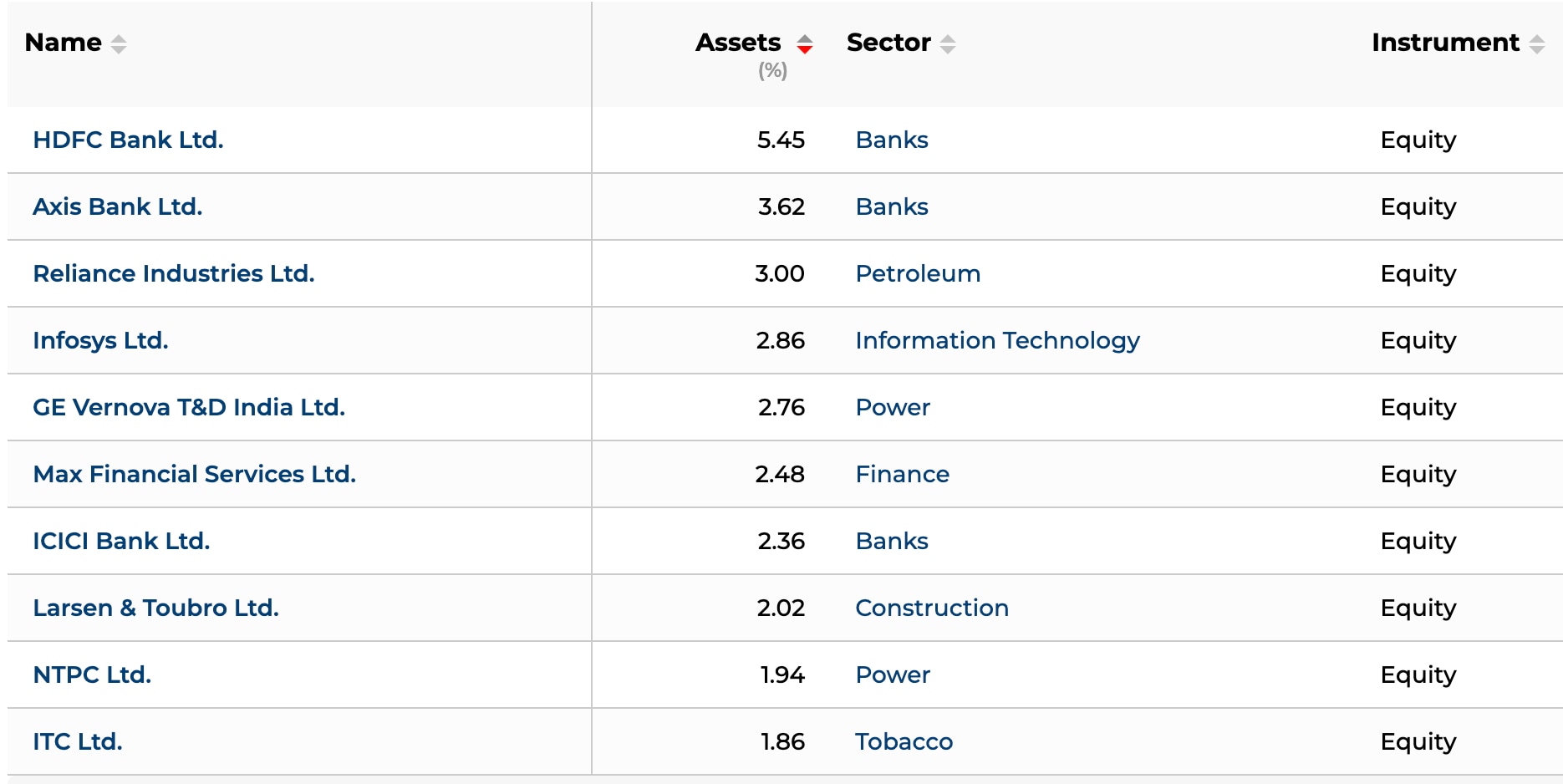
Source: Nippon India Multi Cap Fund’s Factsheet
The fund holds a very large portfolio of over 100 stocks. Currently, it has 131 stocks, and the top 10 stocks comprise 28.3% of the portfolio, making it well-diversified.
The portfolio is inclined to heavyweights and includes names such as HDFC Bank (5.4%), Axis Bank (3.6%), RIL (3.0%), etc. The emphasis is on market leaders, sustainable alpha creators, and emerging/niche themes.
Among a diverse range of sectors, the top 3 include banks (13.5%), retailing (7.9%), and pharma & healthcare (7.2%), comprising 28.6% of the portfolio.
The fund prefers to follow a buy-and-hold approach and does not indulge in aggressive portfolio churning. In other words, it avoids a momentum-driven approach.
Value Metrics and Portfolio Turnover: Nippon India Multi Cap Fund vs. SBI Multicap Fund
| Price-to-Book Value Ratio (x) | Price-to-Equity Ratio (x) | Portfolio Turnover Ratio (%) | |
| Nippon India Multi Cap Fund | 4.4 | 31.8 | 27 |
| SBI Multicap Fund | 3.7 | 25.5 | 26 |
Source: Respective Fund Factsheets
The SBI Multicap Fund, on the other hand, while investing across the market capitalisation spectrum, follows a bottom-up approach to pick stocks. It follows a growth style of investing with a focus on largecaps.
Each stock in the investible universe goes through a rigorous multi-step analysis or research process.
It also takes exposure (up to 50% of the total assets) to derivative instruments for hedging and non-hedging purposes.
In addition, the fund seeks to invest in foreign securities, including ADR/GDR/Foreign equity and overseas ETFs and debt securities, sighting investment opportunities.
For diversification purposes, it also invests in units of REITs and InvITs.
As per the November 2025 portfolio, 97.9% of SBI Multicap Fund’s assets are in domestic equities, and the balance is cash & cash equivalents, Government securities (G-secs), and treasury bills (T-bills).
Within equities, the fund usually holds 60-65 stocks. Currently, it has 63 stocks as per the November 2025 portfolio. Largecaps 39.5%, midcaps 30.3%, and smallcaps 28.1%.
The SBI Strategy: Why Concentration is the Secret to Its 16.7% Run
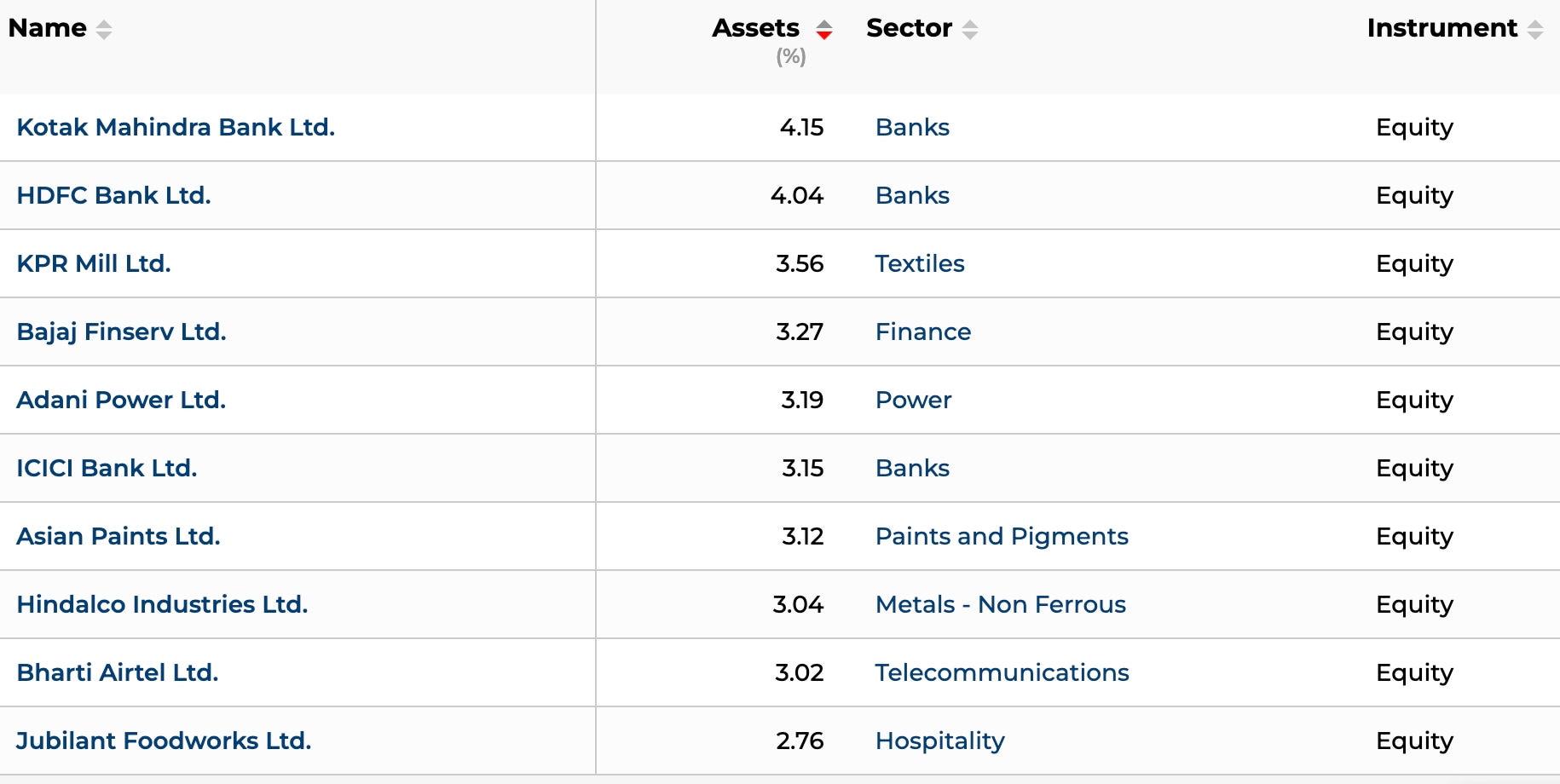
Source: SBI Multicap Fund’s Factsheet
The top 10 stocks comprise 33.3% of the total portfolio and include names such as Kotak Mahindra Bank (4.2%), HDFC Bank (4.0%), KPR Mills (3.6%), etc.
Banks & financial services (24.2%), consumer durables (10.5%) and consumer services (9.4%) are the top 3 sectors of the fund, comprising 44.4% of the portfolio, as per the fund’s factsheet as of November 2025 end.
The fund maintains a buy-and-hold approach following its conviction to reap benefits by focusing on the long-term returns.
Risk-Adjusted Realities: Decoding the CAGR
With the portfolio traits, over 5 years, the Nippon India Multi Cap Fund has clocked 26.0% CAGR (under the direct plan) as of 2 January 2026, ranking as the top performer in the category and outperforming the NIFTY 500 Multicap 50:25:25 TRI.
It has exposed its investors to risk (standard deviation of 13.0), almost in line with the category average over 3 years, but it has well compensated investors on a risk-adjusted basis.
Risk Ratios: Nippon India Multi Cap Fund vs. SBI Multicap Fund
| Standard Deviation | Sharpe Ratio | Sortino Ratios | |
| Nippon India Multi Cap Fund | 13.0 | 1.2 | 1.8 |
| SBI Multicap Fund | 12.0 | 0.9 | 1.4 |
Source: Respective Fund Factsheets
As regards, SBI Multicap Fund, it has clocked 18.0% CAGR in the last 3 years, lagging behind its category peers but almost on par with the benchmark. The lacklustre returns delivered by midcaps and smallcaps have weighed down on the performance of the fund.
The fund has exposed its investors to lower risk (standard deviation of 12.0) than the category average, but the Sharpe ratio, which reflects the risk-adjusted returns.
On the sortino ratio – which captures the downside risk while speaking about risk-adjusted returns – SBI Multicap Fund, however, has fared better than its category peers.
Fund Managers: Nippon India Multi Cap Fund and the SBI Multicap Fund
| Nippon India Multi Cap Fund | SBI Multicap Fund |
| Sailesh Raj Bhan (President & CIO – Equity Investments at Nippon India Mutual Fund) | Rama Iyer Srinivasan (Chief Investment Officer – Equity at SBI Mutual Fund) |
| Ashutosh Bhargava (Head Equity & Senior Fund Manager) | Saurabh Pant |
| Kinjal Desai – overseas investments |
These fund managers are veterans and have vast experience in fund management.
The Final Verdict
Nippon India Multi Cap Fund, despite its large AUM and key focus on largecaps, has been a top quartile performer; in fact, it is topping the returns chart in the category peers currently.
And what’s important is that it has taken risks almost in line with the category average, but on a risk-adjusted basis, has fared better. In other words, it is an average risk, higher performer. It is suitable for those looking to keep risk in check yet earn better returns than the category average.
SBI Multicap Fund, on the other hand, has been a low-risk risk-average average-return performer. The lower returns clocked by midcaps and smallcaps have weighed on the returns. If midcaps and smallcaps continue to be under pressure, it would weigh down on the fund’s decision.
Whichever fund you choose, it would be unwise to base your investment decision only on past returns, which may or may not be repeated in the future.
You need to consider your risk profile, broader investment objective and time horizon before investing. If you are not sure how to go about it, reach out to a SEBI-registered investment adviser.
Happy Investing.
Note: We have relied on data from www.valueresearchonline.com, financial express factsheets, and Nippon India Mutual Fund and SBI Mutual Fund factsheets throughout this article. Only in cases where the data was not available, have we used an alternate, but widely used and accepted source of information.
Disclaimer:
The above content is for informational purposes only. Mutual Fund investments are subject to market risks. Please consult your financial advisor before investing.
Rounaq Neroy has over 20 years of experience in the financial markets and investments. He is a close observer of the Indian economy and writes deeply on the capital markets, mutual funds, stocks, precious metals, asset allocation, wealth management, and investment strategy. His editorials provide interesting, actionable investment ideas to guide readers in the journey of wealth creation and make wise decisions. Rounaq was the Head of Content at PersonalFN (Quantum Information Services Pvt. Ltd.), which also owns Equitymaster.com – India’s oldest and trusted equity research house.