



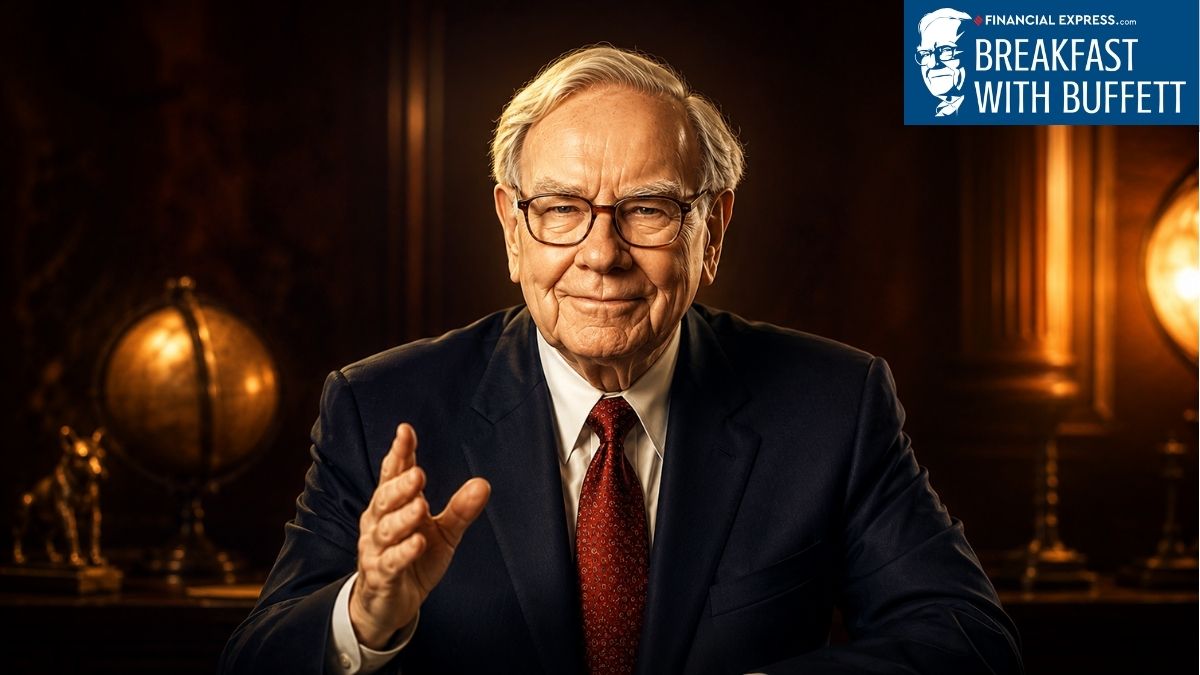
In his 1987 letter to Berkshire Hathaway shareholders, Warren Buffett retold a parable he had learned from his teacher, Benjamin Graham. It remains the most useful single image in investing, and one of the least applied.
Imagine, Graham said, that you own a stake in a private business along with a partner named Mr. Market. Every day, Mr. Market quotes you two prices: one at which he will buy your share, and one at which he will sell you more of his. The prices are not based on any change in the business. They are based on his mood. Some days he is euphoric and quotes very high numbers. Other days he is depressed and offers his stake for very little. He always comes back the next day, regardless of whether you do anything.
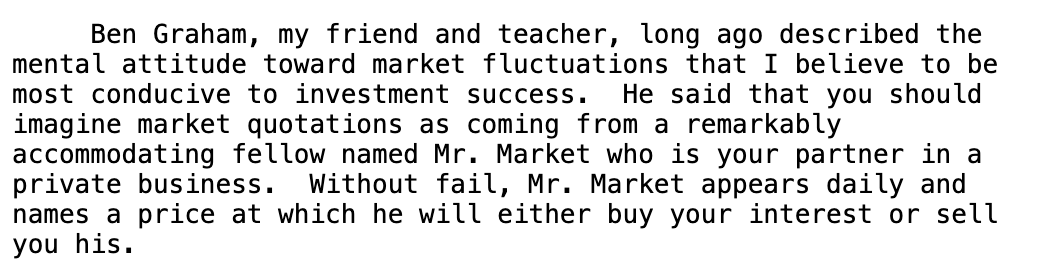
The instruction Graham drew from this was simple. The prices are useful only at the extremes, where they let you buy from a depressed Mr. Market or sell to a euphoric one. The rest of the time you should ignore them. Mr. Market’s quotes are not telling you what the business is worth. They are telling you how he feels.
This is the founding principle of value investing: price and value are different things. The market is a place to transact, not a measurement device.
Forty years later, the principle has not changed. The conditions under which an ordinary investor can actually apply it have changed enormously, and not for the better.
What has changed since 1987
In 1987, the stock market was open six and a half hours a day, five days a week. There were no smartphones, no trading apps, no real-time portfolio dashboards. To find out what your stocks were worth, you opened the newspaper the next morning or called your broker. Mr. Market came to your office once a day, did his routine, and left.
Three structural changes have removed that distance.
The first is access.
India had 21.28 crore demat accounts as of November 2025, up from around 14 crore four years earlier. Nearly two in five Indian investors are under thirty. The same pattern is visible in the United States, where commission-free apps have brought tens of millions of new participants into the market. Most of these investors check their portfolios several times a day on a device that is rarely more than a metre from their hand.
The second is the instruments themselves.
The fastest-growing product in global derivatives is the zero-day-to-expiration option, or 0DTE, which is an options contract on a stock index that is bought and sold on the same day, expiring at that day’s close. In 2022 these did not exist as a daily product on the S&P 500. By early 2026 they accounted for roughly 60% of all S&P 500 options volume, with a record 63% in a single month. Cboe, the exchange that lists them, estimates that retail investors place at least half of these trades. A 0DTE option allows you to take a leveraged bet on the direction of the entire US stock market that begins and ends inside one trading session.
The third is data.
Prices now update many times a second, and algorithmic systems trade on them in milliseconds. The number on your phone at 11:43 a.m. is not the considered opinion of long-term owners. It is the residue of millions of automated transactions, many of them placed by entities that intend to close their position before lunch.
The combined effect is that Mr. Market no longer keeps office hours. He is in the room continuously, with a new opinion every few seconds.
Why this matters for your decisions
The modern investor faces two separate problems where Graham’s investor faced one. The first is analytical: what is this business actually worth? The second, harder one in 2026, is behavioural: how do you avoid acting on Mr. Market’s quotes when you have agreed to see them several hundred times a day?
The evidence on the behavioural problem is unambiguous. SEBI has published studies showing that approximately 91% of active retail derivatives traders in India lose money. Between FY22 and FY25, that group collectively lost close to three lakh crore rupees. The pattern in the US is similar, with most active retail options traders underperforming the underlying market.
These losses are not mainly the result of bad forecasts. They are the result of trading too often, and reacting to short-term price movements. They are what happens when investors mistake Mr. Market’s quotes for information about value.
Three applications
First, separate volatility from risk.
Volatility is the size and speed of price movement. Risk is the probability of permanent loss of capital. They are related but not the same. Nvidia, the most widely held company on earth, traded between the mid-$90s and the low-$200s during 2025. The business did not change in value by that proportion four times in a year. Most of what you saw was mood, expressed in price.
Second, before any trade, identify the cause.
If you are selling because something has actually changed your view of the underlying business, a competitor’s product, a regulatory decision, a shift in pricing power, that is a value-based decision. If you are selling because the price has fallen and the chart looks ugly, you are acting on Mr. Market’s mood. The two feel similar in the moment. Writing down the reason in one sentence before placing the trade is one of the few reliable ways to tell them apart.
Third, accept that the architecture of modern markets is working against you. Trading apps are built to maximise the number of times you transact. Notifications, leaderboards, and leverage on tap with all of its points in the same direction. The patient investor of 2026 is not someone with better information. They are someone who has built routines by checking portfolios less often, turning off notifications, writing trades down before placing them that put friction back between themselves and Mr. Market.
Buffett’s 1987 letter is sometimes read as a folksy story. It is, in fact, a structural argument about how an investor’s relationship with price quotations determines their returns. Graham gave us the parable. Buffett gave us the discipline. The market has spent the decades since making that discipline harder.
Mr. Market is at the door, as he always was. The difference in 2026 is that he is also in your pocket.
Disclaimer: This article is for informational purposes only and does not constitute financial advice. Please consult a qualified professional before making investment decisions.
Note: This article relies on data from fund reports, index history, and public disclosures. We have used our own assumptions for analysis and illustrations.
Parth Parikh has over a decade of experience in finance, research, and portfolio strategy. He currently leads Organic Growth and Content at Vested Finance, where he drives investor education, community building, and multi-channel content initiatives across global investing products such as US Stocks and ETFs, Global Funds, Private Markets, and Managed Portfolios.