



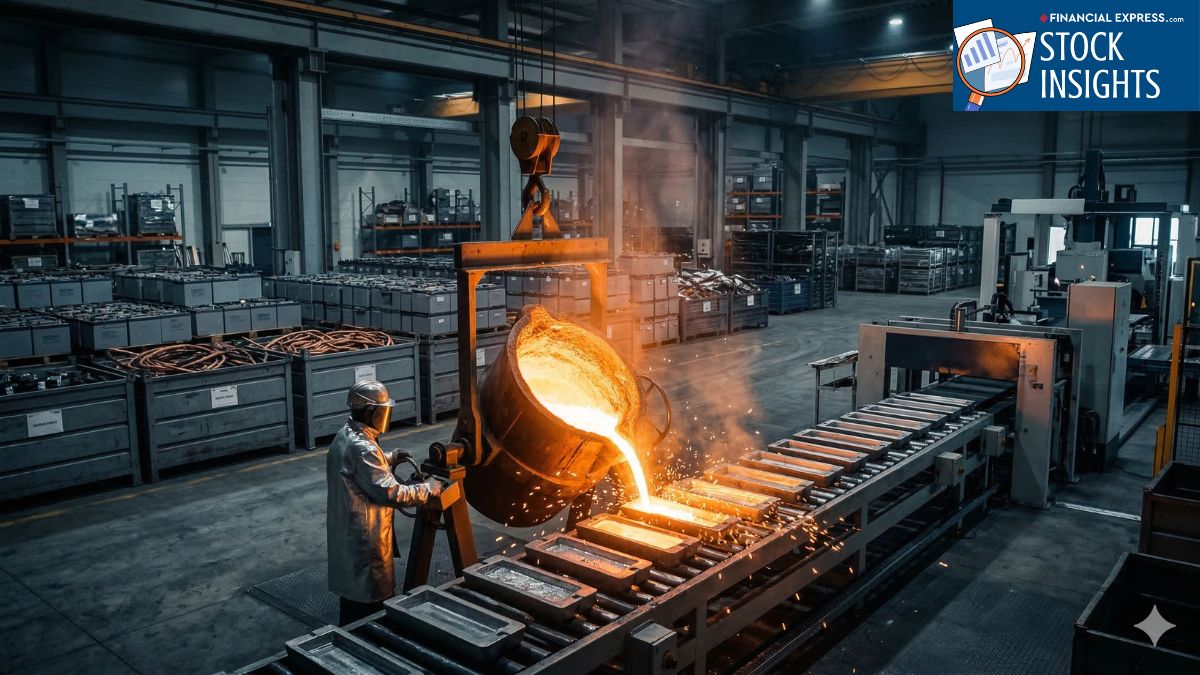
If you ever walked into one of Gravita India’s recycling facilities, the first thing you would notice is the smell of heat and metal.
Trucks unloading what looks like waste, used batteries, scrap metal, and discarded cables. Piles of dull grey material just lying on the floor waiting to be handled.
To most people, it looks like trash.
To Gravita, it looks like raw material.
Inside the plant, scrap is melted, processed, broken, and remade into industrial metals, silently powering the next cycle of manufacturing.
What enters as waste leaves as lead compounds, aluminium products, and recycled plastics that, in time, find their way into batteries, automotive parts, and industrial systems.
This is not glamorous work. But it is becoming increasingly significant.
Because as the world races toward electrification, energy storage, and circular manufacturing, the metals buried inside old products are suddenly becoming strategic again.
And companies like Gravita are sitting right in the middle of that shift.
Business before recycling became fashionable
Gravita India began operations in early 1992, long before recycling became a cool theme in corporate sustainability reports.
The company concentrated on something most metal producers overlooked: recovering lead from used batteries. At the time, India depended heavily on imported refined lead, even when millions of waste batteries already had the metal.
Gravita’s business model was simple but challenging to execute.
For a long time, Gravita’s business was simply: collecting scrap batteries, extracting the lead, refining it, and selling the metal to battery manufacturers. The model succeeded, but it rarely got much notice.
Recycling companies were usually considered a part of the broader metals cycle, useful but not very strategic.
Turning waste into gold
Over the past few years, however, the scale of Gravita’s processes has begun changing that perception.
Over time, the company expanded that idea into a broader recycling platform. Today, its operations span lead, aluminium, and plastic recycling, as well as engineering services that help clients set up battery recycling facilities.
As recycling volumes increased and global demand for secondary metals strengthened, the company expanded both geographically and operationally.
Factories across Asia, the Middle East, Africa, America, and Europe supply reused metals to 34+ countries worldwide.
The product basket has expanded beyond lead to include aluminium, lithium, steel, paper, and plastic recycling.
What once looked like a niche recycling operation began to resemble a broader industrial supply platform.
When the numbers began mirroring the shift
The financials also show this transition. On a twelve-month trailing basis (TTM), Gravita’s revenues were ₹4,130 crore, while net profit grew to roughly ₹381 crore, backed by strong return on capital employed and return on equity of ~21%.
In 3QFY26, the company’s revenue was ₹1,017 crore, rising 2% YoY. The net profit rose 25% YoY to ~₹97 crore, excluding exceptional items.
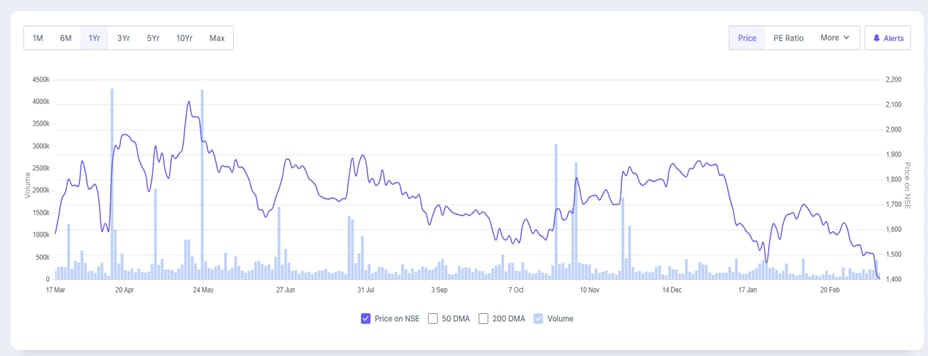
The company has not only grown in volume, but it has also increased in scale and profitability. The operating margins over the past three quarters have hovered between 10-12%. However, the stock price slipped 11% in a year because of profit booking, high valuation concerns, and broader market unpredictability.
Gravita India 1-Year Share Price Trend
Why lead recycling still matters
The nucleus of Gravita’s business is still recycling lead.
Lead may not sound as sensational as lithium or cobalt, but it is still one of the most recycled metals in the world.
Lead-acid batteries are still extensively used in cars, telecom towers, backup power systems, and industrial equipment. And every one of those batteries ultimately becomes scrap.
Instead of mining new lead, companies like Gravita salvage it from used batteries. This process consumes less energy, costs less, and prevents the environmental harm linked with fresh mining.
It is also why recycling is increasingly becoming controlled and structured.
Government policies such as Extended Producer Responsibility (EPR) rules require battery manufacturers to make certain that used batteries are collected and recycled properly.
As enforcement expands, scrap that once traversed via unofficial channels is steadily moving toward organised recyclers.
Companies like Gravita India will benefit from that structural change as they are ahead of the curve in this sector.
From scrap processor to circular-metals platform
For years, recycling companies were viewed as the final stop in the industrial chain — the place where trash landed after manufacturing was complete.
That vision is beginning to change.
Today, Gravita’s approach closely resembles what analysts describe as a circular metals platform.
Instead of simply melting scrap, the company gathers discarded equipment, extracts usable metals, processes them into industrial-grade compounds, and supplies them back into the manufacturing system.
This creates a circle.
Batteries become lead again.
Aluminium scrap becomes new industrial composites.
Plastic waste converts to battery casings and other products.
The advantage of this loop is that it decreases dependence on new mining and cuts down supply chains.
As environmental laws tighten and raw material costs increase, recycled metals are gradually becoming a crucial alternative source.
For Gravita, this suggests the business is steadily moving from a single-metal recycler into a supplier of secondary raw materials in multiple industries.
Expanding beyond lead
While lead remains the largest part of Gravita’s business, the company is firmly expanding into other materials.
Aluminium recycling is increasing as the demand from the auto and industrial sectors rises. Plastic recycling is becoming even more relevant for battery and consumer applications.
More recently, Gravita has begun exploring additional metals and materials that could become important in the future recycling economy.
Gravita has diversified into additional metals and materials that could become important in the future recycling economy.
Per its latest press release on 13th March 2026, the company plans to acquire 98.95% of Rashtriya Metal Industries for about ₹559 crore, signifying its foray into copper and copper-alloy recycling.
Instead of a lead recycler, Gravita is positioning itself as a multi-metal recycling platform.
The expansion roadmap
Gravita’s long-term growth plan revolves around increasing recycling capacity and the share of its value-added products.
The company will expect to operate a recycling capacity of roughly 4.66 lakh tonnes annually by the end of FY26, with plans to increase that significantly in the next few years.
The management is looking to expand capacity to 7 lakh tonnes per annum by FY28. It will also invest ₹352 crores in existing and ₹280 crores in new verticals by the end of FY28.
But the strategy is not just about processing more scrap.
The company’s goal is to expand its manufacturing of value-added compounds and specialised materials, beyond simply selling recycled metal.
These value-added products made up for 46% of the company’s revenue in FY25. High-value products usually bring greater margins and richer customer relationships.
A look at its P/E multiples shows the stock trades at a premium of 27x, nearly twice the sector median at 15x. The enterprise value/ earnings before interest, taxes, depreciation, and amortisation (EV/EBITDA) is 20.30x, a premium compared to the sector median of 7x.
The risks behind the opportunity
Recycling may sound simple: collect waste and process it, but the business has its challenges.
The availability of waste material and its pricing is the foremost risk. Scrap prices change with global metal market movements, which can affect margins.
Working capital needs are another risk. Recycling companies must buy scrap upfront, while finished metal is often sold later, which can create cash-flow cycles that need cautious management.
Finally, the industry still faces competition from informal recyclers in some regions where government enforcement is irregular.
For organised players like Gravita, the advantage lies in technology, scale, and regulatory compliance.
Why re-cycling Is becoming strategic
For years, reconditioning was treated mainly as a waste-management activity.
Today, it is progressively seen as part of the raw material supply chain.
As global demand for metals increases and mining becomes more ecologically and constitutionally complex, recycled metals are becoming a valuable secondary source.
Industries such as batteries, electric vehicles, and renewable energy demand large quantities of metals that must come from somewhere.
Recycling helps fill that gap.
That is why companies like Gravita are slowly being seen differently.
They are no longer just waste processors.
They are secondary producers of industrial metals.
Turning waste into infrastructure
Gravita India will probably never look like a glamorous technology company or a headline-grabbing defence manufacturer.
Its business begins with scrap.
But what it does with that scrap is really important.
In a world where metals are becoming more valuable and supply chains are shaky, recycling companies are turning into quiet infrastructure providers.
They recover materials that industries cannot function without.
Gravita’s story is not about a breakthrough invention or a single contract.
It is about building a system that turns yesterday’s waste into tomorrow’s industrial input.
And in an economy that is trying to grow while preserving resources, that system may matter more than it first appears.
If this story is interesting and you want to keep an eye on Gravita, then add it to your watchlist.
Disclaimer
Note: We have relied on data from www.Screener.in throughout this article. Only in cases where the data was not available have we used an alternate, but widely used and accepted source of information.
The purpose of this article is only to share interesting charts, data points, and thought-provoking opinions. It is NOT a recommendation. If you wish to consider an investment, you are strongly advised to consult your advisor. This article is strictly for educative purposes only.
Archana Chettiar is a writer with over a decade of experience in storytelling and, in particular, investor education. In a previous assignment, at Equentis Wealth Advisory, she led innovation and communication initiatives. Here, she focused her writing on stocks and other investment avenues that could empower her readers to make potentially better investment decisions.
Disclosure: The writer and her dependents do not hold the stocks discussed in this article.
The website managers, their employees (s), and contributors/writers/authors of articles have or may have an outstanding buy or sell position or holding in the securities, options on securities, or other related investments of issuers and/or companies discussed therein. The content of the articles and the interpretation of data are solely the personal views of the contributors/ writers/authors. Investors must make their own investment decisions based on their specific objectives, resources and only after consulting such independent advisors as may be necessary.