




Welcome to the latest edition of Hidden Gems Weekly. In recent weeks, we have explored opportunities across various sectors; an industrial player riding the mining & steel supercycle, a Birla lineage packaging company and ‘boring’ mineral company transforming into a specialty play This week, we turn to something even less visible, yet fundamental to the economy. Fertilisers rarely command attention, but without them, farm output falters, food inflation rises and the ripple effects are felt far beyond the fields
Some businesses move in straight lines. Fertiliser companies rarely do.
Southern Petrochemical Industries Corporation Ltd (SPIC) has spent time navigating forces that sit well outside management control. Government policy, subsidy timing, energy prices, the weather and the farm cycle all influence outcomes. When things go wrong, they usually do so at the same time. And when they improve, the upside rarely runs very far.
The latest numbers are a perfect example of this reality.
Revenue from operations in the first half of FY26 came in at about Rs 1,598 crore, flat compared with last year. Operating margins eased from 12% in Q1 to 9% in Q2, but were in line with year-ago levels. In a sector prone to sharp swings, this kind of outcome should ideally count as progress.
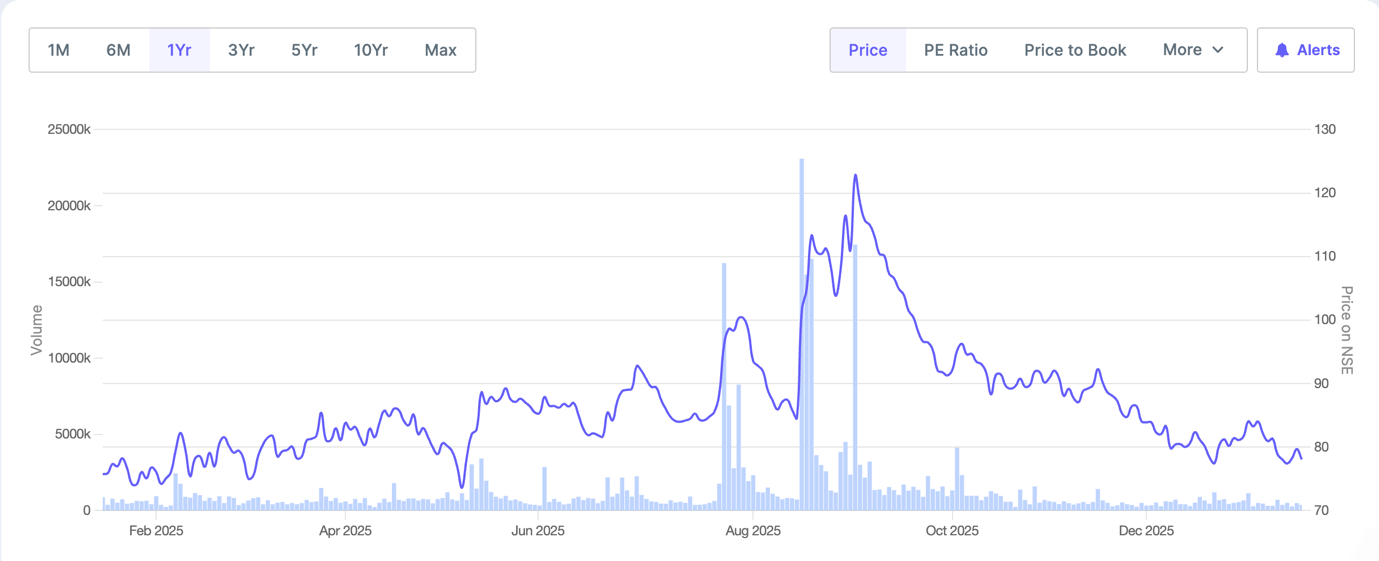
SPIC 1-Year Share Price Chart
What SPIC actually does
SPIC operates in the agri-inputs space, with fertilisers at the heart of its business. It manufactures and markets urea, complex fertilisers and other essential plant nutrients used across Indian agriculture. These are not products farmers choose based on preference or branding. They are the inputs crops require.
Demand is largely an outcome of acreage, cropping patterns and the timing of sowing. Pricing is not something SPIC can freely experiment with. In fertilisers, the government always plays a big role. They shape prices through subsidies and policy choices. That reality narrows the room for any kind of change.
SPIC’s operations are capital-intensive and process-driven. Plants need to run consistently to remain economical. When production stops, costs pile up.
In such situations, consistency is more important than growth. A plant that runs well, month after month, often creates more value than one chasing growth targets.
There are smaller streams of income that affect the margins. But fertilisers remain the fulcrum of the business. When that engine runs smoothly, the rest of the model falls into place. When it does not, very little else compensates.
Reading the recent numbers with that lens
A large part of the improvement in profit before tax in H1 FY26 came from other income. SPIC booked about Rs 43 crore under this line, compared with less than Rs 4 crore a year ago. This jump was driven largely by insurance claims related to flood damage and the shutdown of operations between December 2023 and March 2024.
The company had lodged claims of roughly Rs 85 crore. By September 2025, it had received Rs 55 crore, with another Rs 21 crore still under process. In addition, around Rs 20 crore was recognised towards compensation for loss of profits during the shutdown period.
Insurance receipts help fix cash flows, thereby cleaning up the balance sheet. What they do not do is redefine the earning power of the business. Once these inflows fade from the numbers, the spotlight inevitably shifts back to core operations.
Strip out this support and the operating picture becomes calmer, if less dramatic.
Q2 FY26 revenue came in at around Rs 817 crore, compared with Rs 760 crore in the year-ago period. Profit before tax stood at roughly Rs 81 crore, up from about Rs 48 crore last year. Some of this reflects better cost control. Some reflect the absence of last year’s disruptions. None of it points to a structural upswing.
Fertiliser demand in India is steady but not elastic. Volume growth rarely surprises on the upside for long. As a result, fertiliser companies do not benefit from growing fast. They win by avoiding mistakes.
Where SPIC really makes money
At first glance, SPIC looks like a plain-vanilla fertiliser producer operating in a tightly regulated market. That is broadly true, but incomplete.
SPIC does not make money by pushing through price hikes or chasing volume growth. Its economics are shaped far more by how it produces than by how much it sells.
In fertilisers, feedstock and energy costs matter more than pricing power. Margins are protected not by charging more, but by spending less. This is where SPIC’s recent operating focus becomes relevant.
Over the past few years, the company’s emphasis has shifted towards lowering costs. A large part of that comes from energy efficiency initiatives and the transition towards natural gas. The idea is to minimise the risks.
These changes do not transform profitability overnight. Lower and more predictable energy costs improve resilience, especially in a business where selling prices do not fully adjust to cost shocks.
Seen through this lens, SPIC is not a company to judge by how fast it grows. It is better judged by how rarely things go wrong.
What the balance sheet is telling us now
The balance sheet tells us how much room SPIC has to breathe.
After the flood-related disruptions of FY24, leverage was a concern. However, by FY25, that pressure had eased meaningfully. SPIC closed the year with a debt–equity ratio of 0.35, down from 0.49 the year before. This is not a debt-free balance sheet, but it is better than it was.
Even the debt servicing ability has improved. SPIC’s debt service coverage ratio rose to 2.51 in FY25 from 0.89 a year earlier. In simple terms, operating cash flows are now comfortably covering repayment obligations.
For FY25, SPIC declared a dividend of Rs 2 per share, a 20% payout. In a regulated and cyclical business, dividends act as signals. Thus suggesting that the management believes liquidity pressures have eased.
There is no aggressive capacity expansion cycle underway, with spending focused on maintenance, energy efficiency, and process reliability, spread over time.
What the boardroom mix signals
SPIC is chaired by Ashwin C Muthiah, with E Balu serving as the whole-time director responsible for day-to-day operations. The company is not run through a promoter-executive model. Operational control sits with professional management under board supervision.
As of FY25, SPIC’s board comprises 11 directors, of whom 6 are independent directors. The remaining members include the chairman, one executive director and non-independent nominee directors. In other words, independent directors form a clear majority of the board.
After operational disruptions and balance-sheet stress, the priority is control.
What valuation is really capturing
SPIC’s valuation suggests the market is watching, not yet convinced.
At around 9 times earnings, the stock is trading close to its own long-term average. That tells us the market isn’t worried about excess optimism. But for a business like fertilisers, earnings don’t always tell the full story.
This is a capital-heavy, regulated industry where large assets do most of the work and outcomes are shaped by policy and weather. In such cases, price-to-book is usually a better valuation metric. It reflects what investors think the asset base is really worth over a cycle, not what one good year might suggest.
SPIC trades at about 1.25 times book value, below its five-year median of around 1.6.
Despite a cleaner balance sheet and steadier operations, the market isn’t willing to pay up just yet. That hesitation is probably from the nature of the business.
Fertilisers are cyclical, tightly regulated and prone to shocks. Investors tend to look past short-term improvements and focus on what the business can earn through a full cycle.
There is also the question of earnings quality. Insurance-led profit recovery has helped the numbers, but the market seems to want proof that operating performance can hold at a higher level once those one-offs fall away.
In the end, valuation isn’t asking how good the next year might look. It’s asking how well this improvement will travel when conditions turn less friendly.
In conclusion
SPIC does not fit neatly into the stories that markets usually reward. It is not a classic turnaround, not riding a demand wave, and not a business with pricing power.
What it appears to be doing instead is quieter. Operations have steadied, costs are better controlled, insurance receipts have repaired past damage and dividends have returned. The business is no longer in survival mode, but returns are not yet structurally higher.
The valuation captures this shift. The stock remains at a discount to its historical book value, but it seems like the recent improvements are largely reflected in current multiples. What’s missing is the conviction that operating-led earnings can sustain, which is why a rerating still feels premature.
Disclaimer:
Note: We have relied on data from www.Screener.in throughout this article. Only in cases where the data was not available, have we used an alternate, but widely used and accepted source of information.
The purpose of this article is only to share interesting charts, data points and thought-provoking opinions. It is NOT a recommendation. If you wish to consider an investment, you are strongly advised to consult your advisor. This article is strictly for educative purposes only.
Manvi Aggarwal has been tracking the stock markets for nearly two decades. She spent about eight years as a financial analyst at a value-style fund, managing money for international investors. That’s where she honed her expertise in deep-dive research, looking beyond the obvious to spot value where others didn’t. Now, she brings that same sharp eye to uncovering overlooked and misunderstood investment opportunities in Indian equities. As a columnist for LiveMint and Equitymaster, she breaks down complex financial trends into actionable insights for investors.
Disclosure: The writer and her dependents do not hold the stocks discussed in this article. The website managers, its employee(s) and contributors/writers/authors of articles have or may have an outstanding buy or sell position or holding in the securities, options on securities or other related investments of issuers and/or companies discussed therein. The content of the articles and the interpretation of data are solely the personal views of the contributors/ writers/authors. Investors must make their own investment decisions based on their specific objectives, resources and only after consulting such independent advisors as may be necessary.