



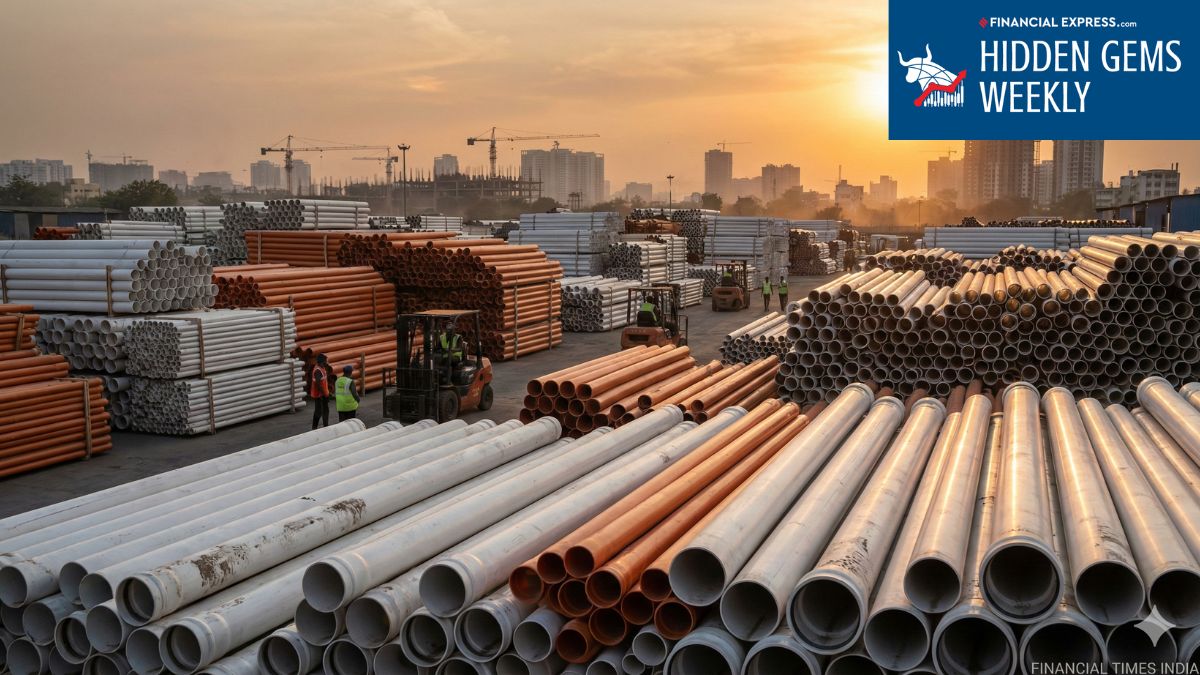
Welcome to the latest edition of Hidden Gems Weekly. In recent weeks, we have dug into opportunities across real estate, a soda ash player navigating a brutal commodity cycle, and a small-cap riding the mining and steel supercycle. This week, we turn to a business that sits quietly at the heart of India’s building and infrastructure economy. Plastic pipes rarely make headlines, but without them, housing slows, sanitation stalls and water networks never quite come together.
The Indian plastic pipes industry is an interesting mix of predictability and chaos. Demand is structurally strong, driven by housing, sanitation, irrigation and infrastructure. However, profitability remains volatile, fluctuating with resin prices, competitive intensity and regional execution.
Prince Pipes & Fittings sits right in the middle of this paradox.
Prince Pipes 1-Year Share Price Chart
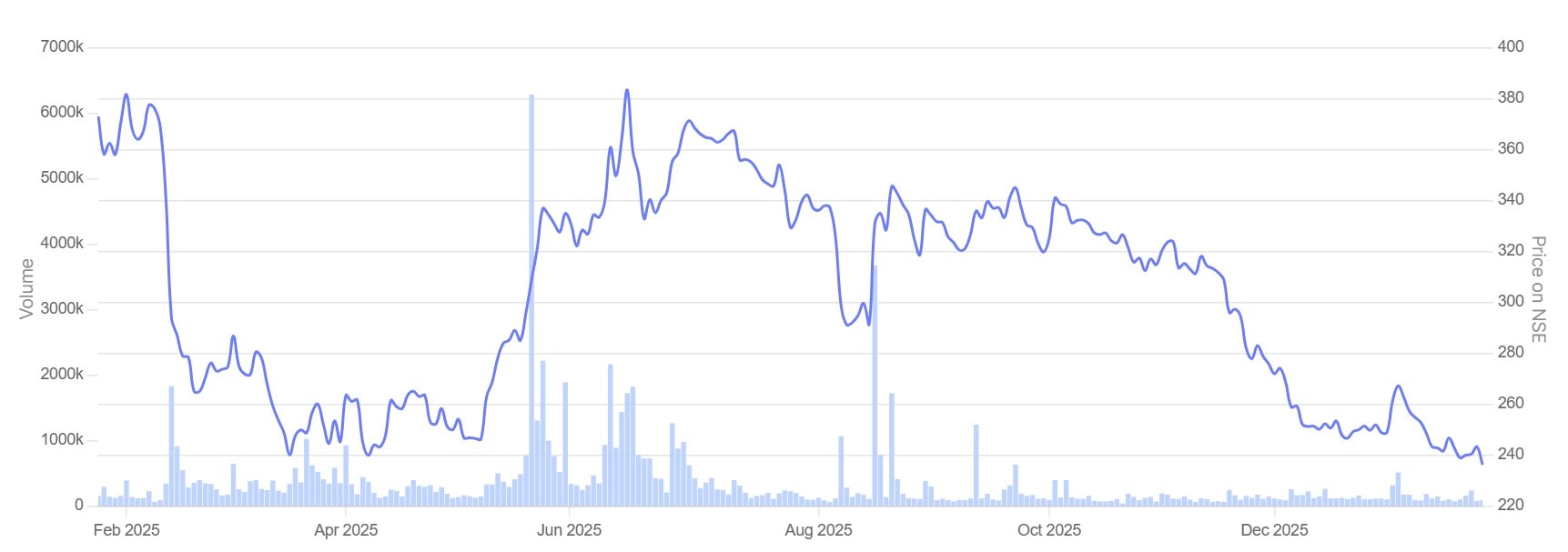
On paper, it has everything going for it: scale, brand recall, a national footprint, and a product portfolio spanning plumbing, agriculture, sewerage and now bathware. And yet, shareholder returns over the past few years have been underwhelming.
To understand why, it helps to separate what Prince controls from what it doesn’t.
A Scaled Platform Is Already Built
Prince Pipes is no longer a challenger brand.
With over 4.3 lakh tonnes of installed capacity, eight manufacturing facilities, 1,500+ channel partners, and a portfolio of more than 7,200 SKUs, the company has crossed the hardest part of the journey: building a national platform.
This matters because pipes are a distribution-heavy business. They don’t travel cheaply, service levels matter and when a contractor needs material urgently, local availability usually trumps brand strength. Prince’s spread across West, North, South and East India allows it to respond faster as demand shifts regionally.
The commissioning of Phase 2 at the Begusarai (Bihar) plant in September 2025 fits neatly into this strategy. The expansion is less about chasing headline growth and more about freight optimisation and deeper penetration in under-served eastern markets.
In short, the bulk of pipe-related capacity build-out is behind the company, setting the stage for operating leverage as utilisation improves.
But the Cycle Has Been Unforgiving
Despite this scale, recent financial performance tells a more muted story.
Revenues have been declining, volumes have grown only in low single digits, and margins have compressed. Earnings Before Interest, Taxes, Depreciation, and Amortisation (EBITDA) margins that once touched the low teens fell to around 6–7% in FY25, before recovering modestly to about 9% in recent quarters.
The primary culprit has been PVC (Polyvinyl Chloride) resin volatility.
PVC prices have swung sharply over the past few years amid global oversupply and delayed regulatory action. In a fragmented market, cost increases can be passed on with a lag, but price cuts tend to be immediate. That lag hurts margins.
What is notable, however, is that recent margin improvement has not come from pricing power, but from product mix. Higher contribution from Chlorinated Polyvinyl Chloride (CPVC) pipes has lifted EBITDA per kg even as overall volumes remained subdued.
Add to this aggressive pricing by unorganised players, intense competition among listed peers and patchy rural demand following an extended monsoon. The result is a business that grows in tonnage, but not always in profitability.
Working Capital: Quietly Improving, Not Yet Fixed
One positive that often goes unnoticed is improving working capital discipline.
Net working capital days have declined steadily from peak levels, driven by tighter inventory management and better receivables control. Inventory days and debtor days have both come off their highs, helping operating cash flows turn meaningfully positive again.
This matters more than it appears.
In a low-margin, capital-intensive business, cash flow quality often matters more than reported profits. Prince’s ability to generate operating cash through a downcycle suggests that balance sheet stress is largely behind it.
That said, this is still not a textbook negative working capital business. There remains room for further tightening.
The Bathware Bet: Optionality, Not Yet Earnings
Prince’s entry into premium bathware through Aquel is worth watching, but with restraint.
Bathware offers clear long-term advantages such as; higher gross margins, brand-led differentiation and lower raw material volatility. But it also demands sustained branding spends, showroom investments and patience.
At present, Aquel is still loss-making and remains a drag on consolidated profitability.
Management expects breakeven over the coming quarters as scale improves and distribution expands beyond North and East India.
For now, Aquel will not move the earnings needle. Over time, if executed well, it could help smooth the inherent cyclicality of the core pipes business.
Investors would do well to resist the temptation to overvalue this segment too early.
The Boardroom Mix: Promoter-Led, Professionally Anchored
Prince Pipes remains firmly promoter-led, but with a governance structure that has matured over time.
The company is led by Jayant Chheda, Founder, Chairman and Managing Director, who has been associated with the business since its inception and brings over four decades of experience in the plastics and piping industry.
The board comprises six directors, including three independent directors, with backgrounds spanning industry and finance. Promoter shareholding remains high at 60.9%, there is no pledging of shares and leverage is modest.
What Management Is Guiding For
Management commentary over recent quarters suggests that the operating environment may be turning.
Demand is expected to recover in the second half of FY26, with management guiding for high single-digit volume growth for the full year. October remained subdued due to festive disruptions and uncertainty around anti-dumping duties, but November has seen a pickup, indicating early signs of restocking.
Margins, which have already improved sequentially, are expected to recover further toward low double-digit levels by the fourth quarter of FY26, aided by operating leverage and a richer product mix.
The implementation of anti-dumping duties is seen as a key trigger that could stabilise pricing across the PVC pipes industry.
Within the portfolio, CPVC continues to grow faster than PVC, and management expects this segment to drive both industry and company growth going forward. The company is also working to diversify CPVC raw material sourcing and plans to introduce its own CPVC brand over time.
On the capacity side, Phase 2 of the Begusarai plant was commissioned in September 2025.
Capex during FY26 remains elevated, with spending split between operational capacity and the bathware business. The bathware segment, Aquel, is currently concentrated in North and East India, but distribution is expanding into Southern and Western markets. Management expects the business to break even within the next four quarters, with quarterly revenue run rates of Rs 220–250 crore over time.
What Needs to Go Right from Here
For Prince Pipes to meaningfully re-rate, three things need to fall into place:
#1 Margin Normalisation
Even a return to around 10–11% EBITDA margins, well below peak levels, would materially lift profits given the fixed-cost base and operating leverage.
#2 Volume Growth With Better Mix
High single-digit volume growth, led by plumbing, CPVC, sewerage and private-sector infrastructure projects, can improve realisations without aggressive pricing.
#3 Industry Discipline
The pipes industry does not need a boom. It just needs restraint. Stabilisation in PVC prices and better regulatory enforcement could reduce volatility and restore pricing confidence.
None of these are big assumptions. They are cyclical, not structural.
Valuation: Reflecting the Gap Between Reality and Normalised Earnings
Prince Pipes trades at around 112 times trailing earnings, a multiple that looks stretched in isolation but is heavily skewed by profits sitting near a cyclical low.
Return on net worth is just 2.7%, far below what the business has delivered in more normal conditions.
Over the past five years, the stock has typically traded closer to a 37 times earnings multiple, when margins were healthier and return ratios were closer to mid-cycle levels. The contrast highlights that today’s valuation is being driven more by depressed earnings than by elevated expectations.
With PVC prices stabilising, demand expected to improve, major pipe capacity additions behind the company and operating leverage beginning to show, earnings are expected to recover meaningfully over the next few years.
As profitability normalises, valuation comfort is likely to come from earnings growth rather than multiple expansion.
In businesses like this, returns tend to be earned through patience and execution, not quick re-rating.
Disclaimer:
Note: We have relied on data from www.Screener.in throughout this article. Only in cases where the data was not available, have we used an alternate, but widely used and accepted source of information.
The purpose of this article is only to share interesting charts, data points and thought-provoking opinions. It is NOT a recommendation. If you wish to consider an investment, you are strongly advised to consult your advisor. This article is strictly for educative purposes only.
Manvi Aggarwal has been tracking the stock markets for nearly two decades. She spent about eight years as a financial analyst at a value-style fund, managing money for international investors. That’s where she honed her expertise in deep-dive research, looking beyond the obvious to spot value where others didn’t. Now, she brings that same sharp eye to uncovering overlooked and misunderstood investment opportunities in Indian equities. As a columnist for LiveMint and Equitymaster, she breaks down complex financial trends into actionable insights for investors.
Disclosure: The writer and her dependents do not hold the stocks discussed in this article. The website managers, its employee(s) and contributors/writers/authors of articles have or may have an outstanding buy or sell position or holding in the securities, options on securities or other related investments of issuers and/or companies discussed therein. The content of the articles and the interpretation of data are solely the personal views of the contributors/ writers/authors. Investors must make their own investment decisions based on their specific objectives, resources and only after consulting such independent advisors as may be necessary.