



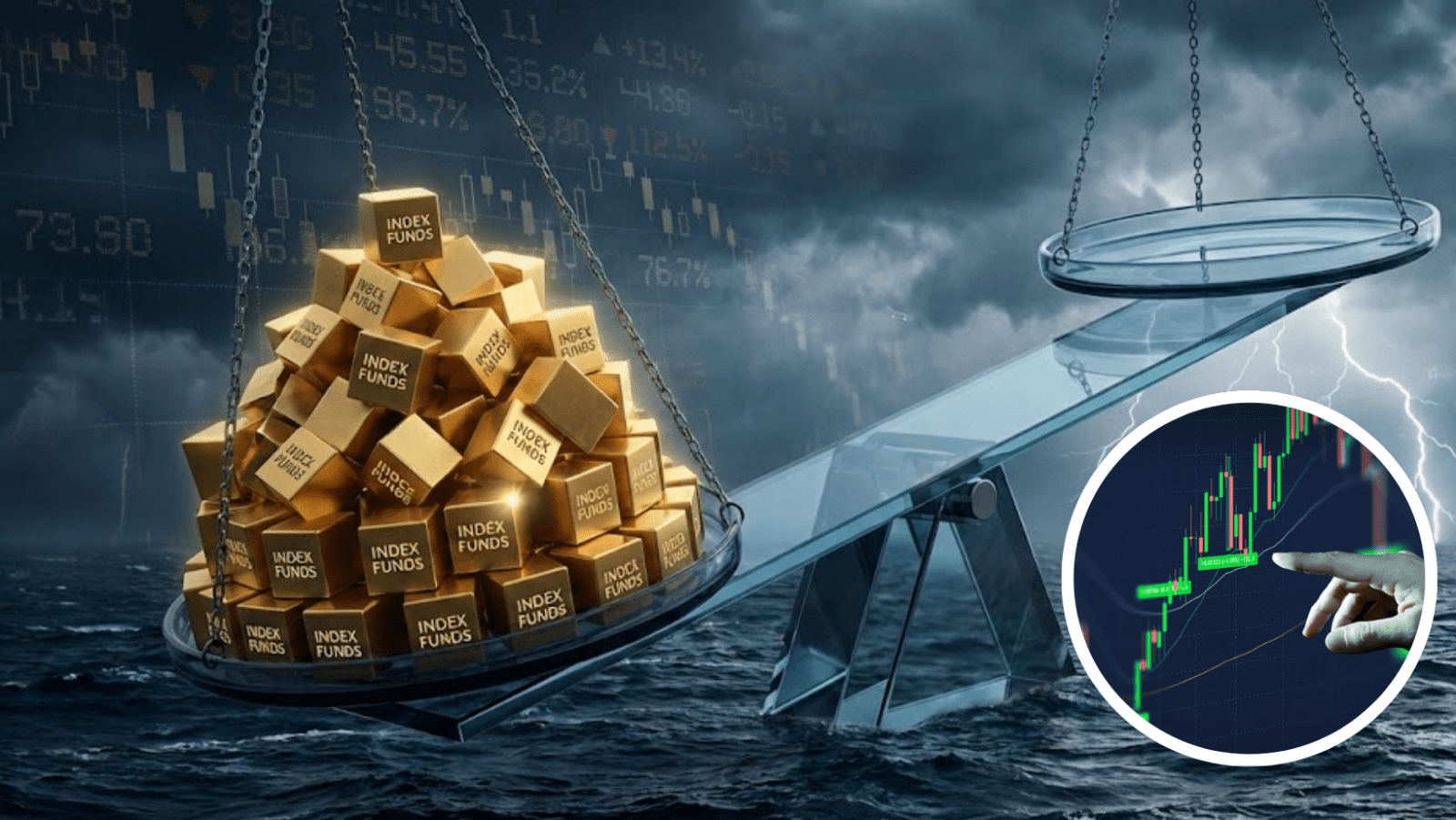
The world today feels more fragile than it looks.
Debt levels are high. Valuations are stretched. A small number of companies explain a large part of market returns. Geopolitics, climate risk, and politics refuse to stay quiet. And yet, financial markets behave as if none of this is urgent.
Part of the reason is in how we invest.
In the US, close to 55% of all equity fund assets now sit in index funds and ETFs.

Reference: Fundsmith Letter – Jan 2026
Ten years ago, that number was closer to 30%. In India, passive investing is still smaller in absolute terms, but it is growing much faster than active funds, driven by SIPs, retirement money, and institutional allocations. Passive equity AUM has crossed Rs. 12.5 lakh crore, roughly $150 billion, and continues to grow faster than active funds.
This matters because index funds do not respond to the world the way humans do.
They do not panic. They do not reassess valuations. They do not stop buying because something feels “messed up”. Money comes in, and it gets deployed automatically, mostly into the largest companies. Month after month, that creates a steady, predictable bid for markets.
At the same time, it concentrates risk in ways that are easy to ignore while things are going well.
This creates a strange situation.
Index funds can be blamed for building a system where things can go horribly wrong because too much money is sitting in the same trades.
And index funds can also be credited for creating a system where nothing seems to go wrong, because flows keep smoothing over every shock.
Both ideas sound reasonable. Both can be supported with data.
And that is the tension this piece is trying to explore.
The part we do not really see
There is another side to this that I do not think we talk about enough.
In a not-passive, heavy market (like a decade ago), prices used to react much faster. If something started going wrong, you would usually see it somewhere. A stock would fall. A sector would lag. Some fund managers would get uncomfortable and move money.
That feedback feels slower now.
One reason is simply how much of the market no longer reacts to prices in the traditional sense. In the US, more than half of equity fund assets are now passive. That means a large part of the market is buying and selling based on index rules, not judgement.
So prices do not always mean what we instinctively think they mean.
A stock going up does not necessarily mean confidence is rising. Often, it just means flows are strong. A stock going down does not always attract buyers who think it is cheap, because index funds do not step in that way. They just adjust weights.
You can see the effect of this in volatility itself.
Despite higher rates, geopolitical stress, and repeated growth scares, market volatility over the last few years has stayed well below long-term averages for long stretches. That is unusual given the macro backdrop.
It also shows up in capital allocation.
Large companies, especially those heavily represented in indices, have been able to raise capital and spend aggressively for longer.
In the US, a small group of technology companies now accounts for hundreds of billions of dollars in annual capital expenditure, particularly around AI, without the kind of sustained valuation pressure that would normally slow this down.
None of this feels dangerous while it is happening.
Markets still look orderly. Earnings are fine. Indices drift higher. From the outside, it looks like the system is absorbing stress well.
But it also means fewer early warnings. Fewer moments where prices force a rethink. Less friction overall.
And systems with less friction tend to carry problems for longer.
When adjustments finally happen, they rarely arrive in neat steps. They tend to show up all at once, which is why these moments feel sudden, even though they were building over a period.
That is one way things can go wrong.
Or maybe this is exactly why nothing breaks
Sometimes I wonder if we are overthinking this.
Maybe the reason things refuse to fall apart is not because risks are lower or fundamentals are stronger, but because money today behaves very differently from how it used to.
Think about where most money comes from now.
It is not traders reacting to news. It is not fund managers trying to be clever. It is monthly SIPs. Retirement money. Pension allocations. Mandates that have to deploy capital no matter what the headline of the day is.
That money just arrives…. No matter what…
In India alone, SIP flows are now north of ₹20,000 crore a month. In the US, retirement accounts push hundreds of billions of dollars into equities every year. That is a constant bid, whether anyone is optimistic or not.
So when something goes wrong, the reaction feels different.
Prices fall, but not freely. There is always something absorbing the move. Some money coming in; I am not trying to be brave, just doing what it is set up to do. You do not panic. You get inconvenienced. A few uncomfortable weeks. Then people move on.
And over time, that changes expectations.
Investors start assuming that drawdowns will be shallow. That volatility is temporary. That markets somehow know how to look past everything. It is not blind faith. It is learned behaviour.
Of course, this can be read in two ways.
One version says this is artificial. That we are smoothing over problems instead of dealing with them. That prices are no longer allowed to fully react, and that pressure is quietly building somewhere out of sight.
The other version says this is progress. That markets are finally dominated by patient capital. That we have replaced panic with persistence. That crashes are becoming less likely because fewer people are forced sellers.
I honestly do not know which version is right.
What I do know is that this does not feel like the markets most of us grew up understanding.
That could mean safety, or it could mean delay.
And delays have a way of making outcomes look sudden when they finally arrive.
Disclaimer: This article is for informational purposes only and does not constitute financial advice. Please consult a qualified professional before making investment decisions.
Note: This article relies on data from fund reports, index history, and public disclosures. We have used our own assumptions for analysis and illustrations.
Parth Parikh has over a decade of experience in finance, research, and portfolio strategy. He currently leads Organic Growth and Content at Vested Finance, where he drives investor education, community building, and multi-channel content initiatives across global investing products such as US Stocks and ETFs, Global Funds, Private Markets, and Managed Portfolios.