



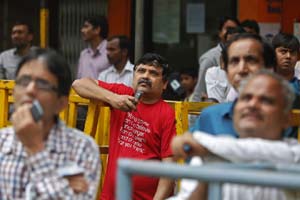
BSE Sensex and NSE Nifty closed more than 1% lower on Friday as the retail inflation data dampened hopes of a rate-cut by the Reserve Bank of India (RBI) in April and fear of a US Fed rate-hike in June put emerging market currencies under pressure.
“There are no key triggers for the markets, currently. While markets opened higher amid optimism from the passage of the insurance bill in the Rajya Sabha, it doesn’t come across as a great surprise as it was a long-pending issue. The retail inflation data has led to concerns that RBI may not cut the interest rates in its April monetary policy. Further, the fear of a rate-hike by the US Fed in its June Federal Open Market Committee (FOMC) has put currency markets under pressure,” said Andrew Holland, CEO at Ambit Investment Advisors.
On Friday, the BSE benchmark Sensex closed 1.5% or 427.11 points lower at 28,503.3 points, while NSE’s Nifty closed 128.25 points or 1.5% lower at 8,647.75 points. The Consumer Price Index (CPI) inflation for the month of February stood at 5.7% as compared to 5.1% seen in the month of January.
The Rupee closed 0.7% lower to 62.96 against the dollar. Among emerging market currencies, the Taiwan Dollar (-0.2%), Singapore Dollar (-0.5%), South Korea Won (-0.2%), South Africa Rand (-0.94%) and the Russian Ruble (-0.2%) were trading lower amid a fear of a US Fed rate-hike.
Asian markets showed a mixed trend. The Nikkei (1.4%), Hang Seng (0.1%), Kospi (0.7%) and Shanghai Composite (0.7%) ended in the green. Straits Times (-0.32%), Jakarta Composite (-0.25%) and Taiwan Taiex (-0.17%) ended in the red.
Back home, among sectoral indices, BSE Capital Goods (-2.6%), BSE FMCG (-1.9%) and BSE Bankex (-1.9%) were trading lower. Among individual stocks, Bhel (-3.4%), Larsen & Toubro (-3.1%) and Bajaj-Auto (-2.6%), were the top Sensex losers.
Rajesh Iyer, Head – Investment Advisory Services & Family Office, Kotak Wealth Management
Equity Markets traded weak on expectations of US Fed rate hike coming sooner than expected. Domestic equities further weakened on concerns regarding passage of pending bills in the parliament’s upper house. Weak earnings growth in the previous quarter and a budget that focused on longer term structural issues meant that there were no immediate triggers to take the equity market higher. Aggressive rate cuts from RBI can revive that sentiment.
Expect economy to consolidate on back of strong public spending while interest rate cuts and lower commodity prices should help in a gradual recovery for the corporates. (Brent crude after falling more than 50% in CY14 has recovered to USD 57.5/barrel as of now).
Equities have the potential to generate high double digit returns and beat inflation over a longer term. However, Equity investments have risks and need longer holding periods to generate the desired returns. Disciplined investments and asset allocation can help in long term wealth creation.
Market Outlook by Vinod Nair, Head-Fundamental Research, Geojit BNP Paribas Financial Services
Today we have seen India specific impact in the market. As we know, we have been outperforming for a longtime with reduction in country-risk, good global market and improvement in business environment. We have already seen a chunk of this benefit and key steps like Budget and RBI rate cut is behind us. The CPI number is not encouraging enough to expect more rate cut in the medium-term. Also Q4FY15 result expectation has been discounted lower due to poor -5% YoY in Q3FY15. We continue to believe that the important trigger for India will depend on budget session outcome. The immediate consolidation trend will depend on what can be accompanied in the first session of the parliament to be ended on 20th March, post which there is one month break. So it is fair to consolidate in the mean time.Market Wrap Up by Mr. Alex Mathews, Head Research, Geojit BNP Paribas Financial Services
After a positive opening, the markets came under pressure and slipped into the negative territory. The major technical indicators are still in the sell mode and today when markets opened with an upside gap, investors might have been booked profits, caused sell-off.
Nifty closed at 8647 down around 128 points. The market breadth changed to negative from positive as there were seen 915 stocks advancing against 1951 stocks declining. The Nifty volatility index, India VIX stood at 14.9650 up around 1.45%.
The Mid cap and small cap indices closed down around 1.37% and 1.54% respectively.
The entire sectors closed in red and the major losers for the day were Capital goods and FMCG which ended down around 2.57% and 1.94% respectively.
In the stocks’ front, the losers were Jindal steel and Cairn which closed down around 4.14% and 3.36% respectively and on the other end buying was seen in DLF and ONGC which closed up around 6.19% and 0.90% respectively.
The FIIs were buyers in the cash markets segment, bought shares worth Rs 733.09 crore on Thursday, 12 March 2015. On the other hand the DIIs were net sellers on 12 March 2014, sold shares worth Rs 381.94 crore as per the provisional data from the stock exchanges.
The European markets were little changed and the US index futures were trading higher.
On Monday, WPI inflation will be the major data for the Indian markets.