



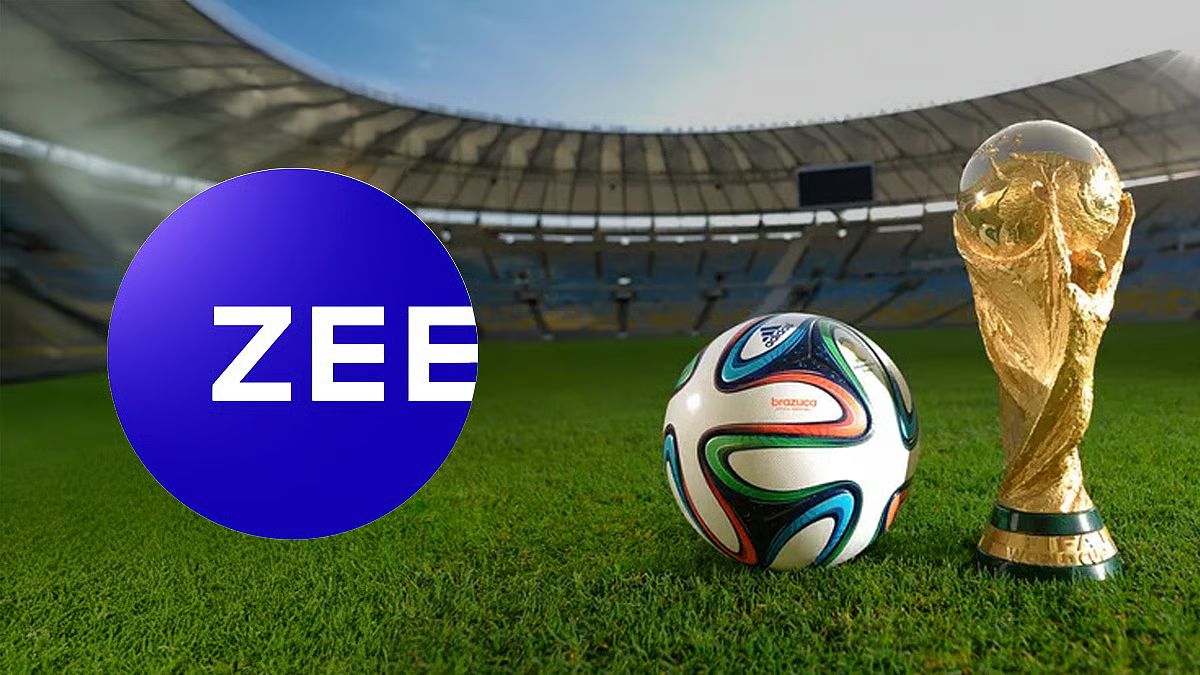
Zee Entertainment’s acquisition of FIFA tournament rights for the next eight years marks a significant addition to its sports portfolio. But media industry executives say the firm may need to balance prestige with profitability as it seeks to monetise football audiences in India.
The discussion inevitably turns to the FIFA World Cup 2022, which was streamed on JioCinema and broadcast on Sports18 channels, both owned by Viacom18 at the time. While the tournament delivered substantial reach and visibility, executives say the rights were deployed as a broader customer-acquisition and brand-building exercise rather than a conventional sports-rights investment aimed at immediate returns.
According to industry estimates, Viacom18 spent about Rs 480-500 crore ($60-62 million) to secure the FIFA World Cup 2022 rights. Advertising revenues, however, were estimated at nearly Rs 300 crore, leaving a sizeable gap between investment and direct monetisation.
While JioStar opted to stick to a valuation of $20-25 million for the 2026 FIFA World Cup, prompting the football body to go with Zee, who was willing to put a higher amount on the table ($30-35 million), executives argue that evaluating JioCinema’s 2022 World Cup bet purely through an advertising lens misses its strategic value.
2022 Playbook
JioCinema streamed the matches free of charge, dramatically lowering entry barriers for viewers and helping the platform attract millions of users at a time when India’s streaming market was becoming intensely competitive.
“The objective was never restricted to recovering the rights fee through advertising alone,” Sajal Gupta, chief executive officer, Kiaos Marketing, a Gurugram-based media marketing firm, said. “The FIFA World Cup 2022 became a testing ground for scale for JioCinema ahead of the IPL 2023-2027 media rights cycle which it had acquired for Rs 20,500 crore,” he said.
The football tournament enabled JioCinema to sharpen critical capabilities including live-streaming infrastructure, audience measurement tools, ad-serving technology and content delivery networks. These capabilities would later prove crucial as the company prepared for significantly larger sports properties including the IPL.
More than 110 million viewers watched the FIFA World Cup 2022 digitally, while the Argentina-France final that year attracted a record 32 million concurrent viewers on JioCinema. Combined watch time across digital and television crossed 40 billion minutes, demonstrating that large-scale live sports streaming in India could rival traditional television audiences.
Zee’s Strategic Void
For Zee, the challenge will be different. Unlike the acquisition-focused strategy pursued by JioCinema in 2022, the broadcaster is expected to pursue a more balanced monetisation model spanning television advertising, digital revenues, sponsorships and distribution partnerships.
“After the merger of Star India and Viacom18 under JioStar, there is room for a second player in sports broadcasting in India. While Sony Pictures Networks India is there, it tends to be selective with its choice of properties amid a heightened focus on profitability. Which leaves Zee who is willing to look at sports events with a broader lens,” Gupta says.
The FIFA property still offers considerable value. Global football events continue to attract premium advertisers and younger urban audiences, a demographic highly sought after by broadcasters and streaming platforms. But the timing of matches which stretch into the night may be unsuitable for Indian advertisers, experts said.
However, the experience of 2022 underlines a broader industry reality: in the streaming era, sports rights are increasingly being evaluated not just for direct revenue generation, but also for their ability to build audiences, strengthen technology platforms and create long-term ecosystem advantages.