



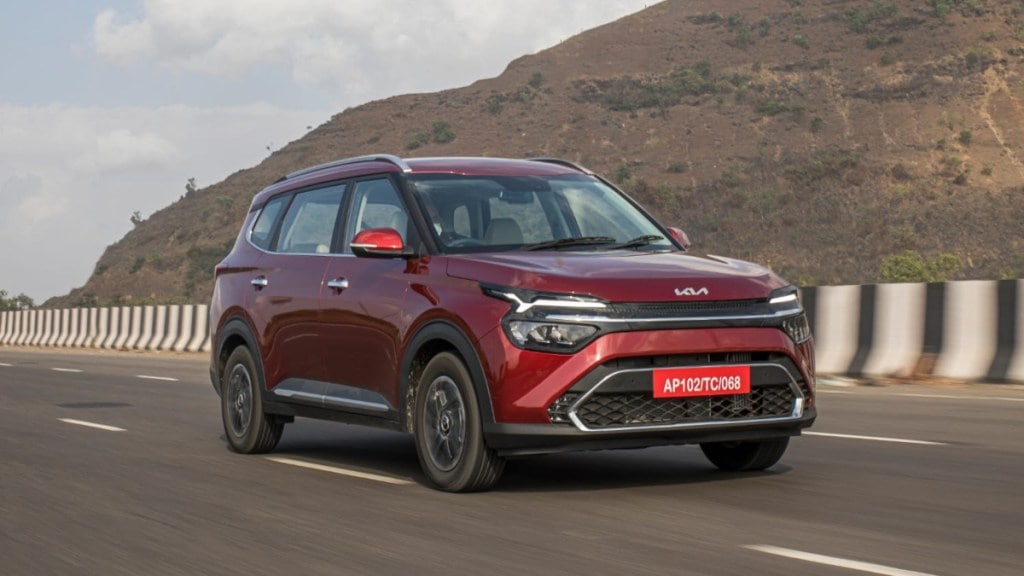
While cars longer than 4.5 metres can easily accommodate 6-7 passengers (such as Toyota Innova Crysta), on an off carmakers in India have experimented with 6/7-seater SUVs/MPVs in the entry-level and midsize space (shorter than 4.5 metres, and some even under 4 metres in length). These include Renault Triber, a couple of forgettable models by Mahindra and one by Datsun, Maruti Suzuki Ertiga and XL6, Honda Mobilio and BR-V, and some others. The latest is Hyundai Alcazar (launched last year), to be joined by Kia Carens (on February 15).
What is the Carens?
Kia India’s fourth model (after the Seltos, Carnival and Sonet), the name Carens is derived from ‘car’ and ‘renaissance’. It will be offered with both petrol and diesel engines combined with multiple transmission options, including the 7DCT and 6AT, and six airbags will be offered as standard. It will have connectivity features—the next-generation Kia Connect app—and flexible seating options.
What defines its design?
Unlike the Alcazar (with which the Carens shares engines and transmission) that has an SUV-like appearance, the Carens looks out-and-out an MPV. Kia India, however, is projecting it as an RV (recreational vehicle).
That’s a smart move.
A few years ago Honda India had a great vehicle called the BR-V, which was projected it as a seven-seater SUV. But the design was more MPV-like. That possibly confused customers.
Kia is calling the Carens an RV—and so a customer can make anything of it: sport, utility, multi, recreational—and in most of its communications it is focusing on the ‘utility’ aspect of the car.
The design is futuristic, too, especially the front closed grille (which makes it look like an electric car). To this reviewer, the angle the Carens looks the best is rear three-quarters—it’s simply neat.
How big is it?
The Carens (at 4,540-mm) is longer than the Alcazar (4,500-mm); its wheelbase of 2,780-mm is longer than that of the Alcazar (2,760-mm) and even than that of the Innova Crysta and XUV700 (2,750-mm for both). This is the reason why its cabin is so spacious.
How spacious is the cabin?
A 1,500-sq-ft apartment, if designed by a good architect, can offer more usable and living space than a 2,000-sq-ft apartment designed by a non-competent person. The same is the case with the Carens. Whatever living space is inside this car is all usable. The third row, for example, is not only spacious for two adults, but getting into it and getting out of it is almost as easy as front and second row (because there is a one-touch tumble second-row seat).
The top-end variant of the Carens I drove looks and feels like a mini-Carnival (Kia’s super-luxury MPV).
Which engines power it?
There are two petrol engine options and one diesel, and three gearbox options (7-speed DCT, 6-speed MT and 6-speed AT).
The acceleration of the turbo-petrol engine that I drove is intense—while Kia didn’t share its acceleration time, it feels like it can do 0-100 km/h in less than 10 seconds. The steering feedback—the mechanical signals the front tyres send to the steering wheel—is accurate, and you feel every bump and dip in the road through the steering wheel. In the short period I drove, however, I couldn’t measure the fuel efficiency figure. I didn’t drive 1.5-petrol or diesel.
How much will it be priced?
First impressions are great (like these have been for the Seltos, Carnival and Sonet). Its price will be announced on February 15, and if Kia is able to keep it marginally more expensive than the Seltos, this one MPV/RV can give many SUVs a run for their ‘sport’.