



Economic Survey 2020: Citing the trend length of business cycles in India, the Economic Survey 2019-20 tabled in Parliament on Friday hoped a resurgence in growth might commence in the second half of the current fiscal but chose to be more guarded than the previous (July 2019) survey as it pegged the FY21 real GDP growth at 6-6.5%. The lower end of that range was closer to 5.8% growth estimated by the IMF for the country recently.
In the previous survey, India’s economic expansion in FY20 was forecast to be 7%, but that proved to be widely off the mark. Even with the National Statistics Office revising FY19 GDP downwards on Friday, the FY20 growth would be just 5.7%, the slowest since FY13.
The survey’s forecast of FY21 GDP could mean Saturday’s Union Budget would assume a nominal GDP growth of 10% or thereabouts.
The survey admitted that counter-cyclical steps might have to be used to create additional fiscal room in FY21 but refrained from quantifying it.
The survey, lead-authored by chief economic adviser Krishnamurthy Subramanian, recommended that the government “must use its strong mandate to deliver expeditiously on reforms to enable the economy to strongly rebound in FY21”.
“The deceleration in GDP growth can be understood within the framework of a slowing cycle of growth. The financial sector acted as a drag on the real sector”, according to the survey.
Analysts say given the massive shortfall in tax and non-debt capital receipts, even a 0.6% of GDP slippage from the fiscal deficit target of 3.3% for the current financial year might indicate an expenditure compression, rather than stimulus. If expenditure equal to at least 1 percentage point of GDP that are being financed out of off-budget means too are shown on the government balance sheet, then the deficit would appear far higher than FRBM rule allows.
As for FY21, a headline deficit number of at least 3.5% (against 3% targeted) is required for stimuli efficacy. With the pace of recovery seen inadequate to boost tax revenues meaningfully, non-tax items are to be tapped to find the resources for pump-priming the economy. While a tidy sum could be collected from telecom companies as adjusted gross revenue (AGR), surplus transfer of about Rs 1 lakh crore by the Reserve Bank of India and a bolstered disinvestment programme (proposed big-ticket transactions like BPCL are slated to be consummated in FY21) could come to the government’s aid, analysts feel. The survey noted that revenue buoyancy with respect to the goods and services tax (GST) would be key to the resource position of Central and state governments. It also called for ‘rationalisation’ of food subsidy to find the requisite headroom for fiscal manoeuvre.
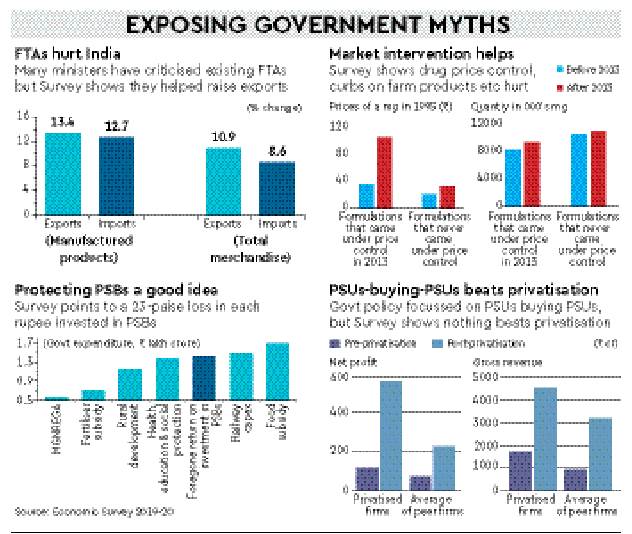
Noting that investments in the public sector might increase thanks to the National Infrastructure Pipeline of Rs 102 lakh crore, the survey cautioned that if this leads to an expansion of fiscal deficit, bond yields might increase, thereby crowding out private investment. If private investments seek external funding, then the current account deficit could widen and depreciate the rupee, upsetting investment, consumption and growth.
Explaining why the virtuous cycle of growth that was to be triggered by the rise in fixed investments proposed in the last survey hasn’t really materialised — the slashing of corporate tax cuts in September was in line with this concept — the survey pointed out that when such cycle rotates slowly, declining rate of fixed investment decelerates GDP growth with a lag (which is 3-4 years in India), eventually pulling down consumption too.
Despite the bolstering of banks’ capital base and considerable monetary easing, bank credit growth is now at a near 2-year low. The survey ascribed the decline in credit growth since H2FY19 to a growing risk aversion amongst banks which “continue to apprehend the build-up of non-performing assets” and an easier option they find of investing in G-secs. It noted that though scheduled commercial banks mobilised the same amount of deposits in the first eight months of this fiscal year as in the year-ago period, they chose to invest thrice the amount in G-secs in the current-year period, while reducing their credit off-take by more than four-fifth. “The drop in fixed investments by households from 14.3% to 10.5% explains most of the decline in overall fixed investment between 2009-14 and 2014-19,” said the survey.
Watch Video: What is Union Budget of India?
The survey listed continued global trade tensions and US-Iran tensions, which could increase the price of crude oil, among downside risks to its growth estimate.
India’s real GDP growth plummeted to 4.5% in Q2FY20, continuing with the deceleration trend over six quarters. Investment growth is seen to be nosediving to 1% in FY20 from about 10% in FY19 while private consumption, the chief pillar of the economy, is to grow at just 5.8% in the current year compared with close to 8% in FY19.