



Prime Minister Manmohan Singh on Thursday called upon state governments, teachers, parents and guardians to help make the Right to Education Act a success. The Right to Education Act, 2009 has come into force from April 1 this year making education a fundamental right for all children aged 6 to 14 years.
Describing education as the ?key to success? that empowers the individual and enables a nation, the Prime Minister said that the implementation of the fundamental right to education demonstrated the government?s ?national commitment to the education of our children and to the future of India?.
?To realise the Right to Education, the government at the Centre, in the states and union territories, and at the district and village level must work together as part of a common national endeavour. I call upon all the state governments to join in this national effort with full resolve and determination. Our government, in partnership with the state governments, will ensure that financial constraints do not hamper the implementation of the Right to Education Act?, the PM said in his address to the nation. He further elaborated on the key role that teachers have to play in the implementation of the Act.
?The success of any educational endeavour is based on the ability and motivation of teachers. The implementation of the Right to Education is no exception. I call upon all our teachers across the country to become partners in this effort. It is also incumbent upon all of us to work together to improve the working conditions of our teachers and enable them to teach with dignity, giving full expression to their talent and creativity. Parents and guardians too have a critical role to play having been assigned school management responsibilities under the Act?, he noted.
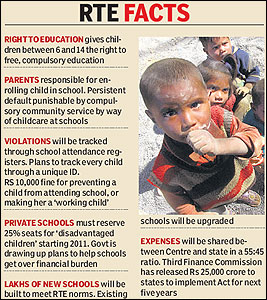 Emphasising the importance of education, he said it was education that had helped him travel the distance. ?I was born to a family of modest means. In my childhood, I had to walk a long distance to go to school. I read under the dim light of a kerosene lamp. I am what I am today because of education?, Singh said.
The PM added that India being a nation of young people, the health, education and creative abilities of children and young people will determine the well being and strength of the nation.
?We are committed to ensuring that all children, irrespective of gender and social category, have access to education. An education that enables them to acquire the skills, knowledge, values and attitudes necessary to become responsible and active citizens of India? I want every Indian child, girl and boy, to be so touched by the light of education. I want every Indian to dream of a better future and live that dream?, said the PM in his address.
He recalled the long history that has led to the implementation of the Act and noted that the great educationist and freedom fighter Gopal Krishna Gokhale was the first to raise the issue when about a hundred years ago he urged the Imperial Legislative Assembly to confer on the Indian people the Right to Education. Ninety years later, in 2002, the Constitution of India was amended to enshrine the Right to Education as a fundamental right. The PM said that government has now come forward to ?redeem the pledge of giving all our children the right to elementary education?.
Union human resource development (HRD) minister Kapil Sibal, meanwhile, said that there were a number of challenges ahead. ?We need to get many more teachers? estimates are that we are currently short of some 5 lakh teachers. States also need to define what will constitute a neighbourhood school. Then there is the question of getting children who are exploited back into schools. There are also less privileged private schools to look at. So there is a lot of decision-making to be done. We are coordinating closely with the states on all issues?, Sibal said.