



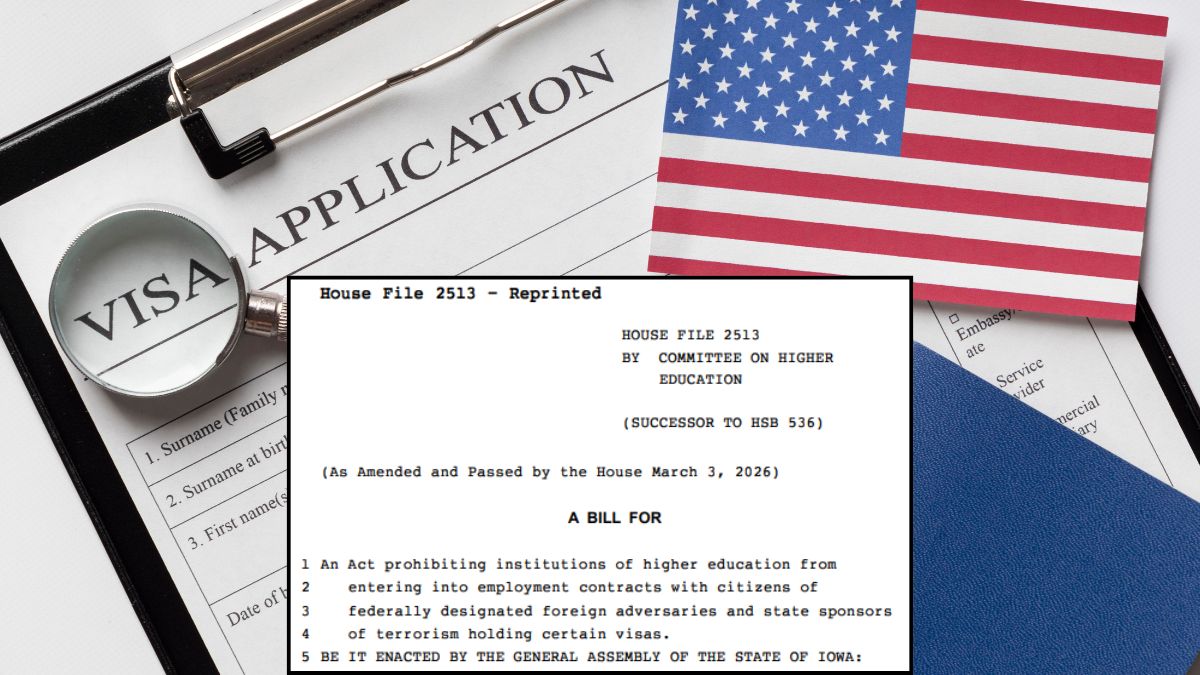
Multiple states in the US, including Texas and Florida, have banned public universities from relying on the H-1B work visa program to expand their workforce with foreign workers instead of Americans.
Amid the rising anti-immigration sentiment in the country, which the Donald Trump administration’s overhaul of the non-immigrant work visa program particularly empowered, Iowa has also joined the race to block the hiring of certain foreign workers in higher education. One such formal proposal gaining traction in Iowa is the House File 2513.
What is House File 2513?
Having already passed the Iowa House, the bill seeks to prohibit community colleges and public universities from “entering into employment contracts with citizens of federally designated foreign adversaries and state sponsors of terrorism holding certain visas,” according to the official document available online.
In early March, the House passed it with a landslide 68-27 vote, pushing it ahead to the Senate committees for further consideration. Now set to be a focus of a larger debate in the upper chamber, the legislation was introduced by Republican Congresswoman Taylor Collins, much like other Republican-led states charging forward to hit out against the H-1B program as well.
According to Iowa Public Radio, she disclosed that House File 2513 was prompted not only by the Trump admin’s policy changes focused on revamping the work visa program but also by potential espionage risks brought up by Iowans. “We don’t really want to roll the dice when it comes to that [espionage activities]. I think there’s honestly a case we made to not even have the H-1B visa program. Honestly, really, I would prefer that we’d be hiring Americans,” Collins told the radio.
Back in 2016, Chinese businessman Mo Hailong pleaded guilty in the Southern District of Iowa to conspiring to steal trade secrets from agricultural companies DuPont Pioneer and Monsanto.
According to a list from the Board of Regents, the University of Iowa, Iowa State University, and the University of Northern Iowa employ 117 people from the countries flagged in the bill. The list provided to WHO 13 (the NBC affiliate in Des Moines, Iowa) showed that the University of Iowa currently has 59 employees from China, 6 from Iran, 3 from Russia, and 1 from Venezuela. Meanwhile, Iowa State University has 41 Chinese and 1 Iranian workers. University of Northern Iowa, on the other hand, has 4 employees from China, 2 from Iran, and 1 “pending employment” from Russia.
Does Iowa’s ‘anti-H-1B’ bill target Indians?
If enacted, the bill would restrict new employment contracts beginning in mid-2026. A subsection included in HF2513 urges authorities to “Adopt a policy prohibiting the community college from entering into an employment contract on or after July 1, 2026, with an individual who is a holder of a valid federal H-1B visa and who is also a citizen of a nation designated as a foreign adversary by regulation of the United States secretary of commerce or designated as a state sponsor of terrorism by the United States secretary of state.”
Countries designated by the US as “foreign adversaries” or “state sponsors of terrorism” include China, Cuba, Iran, North Korea, Russia, Venezuela, and Syria. Therefore, India has not been impacted by this specific ‘House File.’
Nonetheless, since Indians have made up the largest group of H-1B approvals, American officials and the public have become severely frustrated with what they describe as the “Indian takeover” of numerous states.
Not all Iowans are against H-1B visa hiring
As always, there are two sides to a coin. In this H-1B debate raging on in Iowa, some have strongly come out against the bill in the Statehouse and criticised it for being “discriminative” in nature. There is even an online petition circulating that seeks to “Stop HF 2513.”
As highlighted on stophf2513.org, those opposing the bill argue that federal regulations already address university research security by operating under extensive laws governing visas and export control. They also believe that restricting employment based on citizenship from specific countries raises constitutional concerns, which, if challenged in court, could force Iowa taxpayers to shoulder the financial cost.
Restricting global talent will also damage university competitiveness and education quality, the petition states further. Additionally, the state depends heavily on international markets, especially for agriculture. Such a policy could be easily perceived as discriminatory internationally, thereby risking partnerships that Iowa’s farmers and exporters rely on for trade.
Meanwhile, Senator Thomas Townsend said at a committee meeting in March, “I just feel like it’s a discriminative practice to not allow the universities to hire them and [I] feel like that’s going to open up the regents and other universities to possible lawsuits for discrimination and country of origin.”
Zhengyuan Zhu, coalition spokesperson and a professor of statistics at Iowa State University, raised concerns about the bill violating the Equal Protection Clause of the 14th Amendment and immigration laws that prohibit discrimination on the basis of one’s nationality or birthplace. “If enacted, this law will drain Iowa of top–tier talent, weaken our universities’ research capabilities, and undermine the state’s reputation as a welcoming hub for global exchange, trade, and innovation,” the professor added, as quoted by Newsweek.
Similarly, Haipei Shue, president of United Chinese Americans (UCA), said in a press release, “Many Iowans are asking why politicians are pushing for a bill that brings obvious harm without any real benefit to Iowans. The answer is simple: it’s a performative gesture meant to signal ‘toughness’ on China to their political base. This bill is a troubling echo of the McCarthy era—ignoring Iowa’s proud tradition of fairness, openness, and inclusion. In short, it’s politics at its worst.”
ISU Engineering and Computer Science Professor Dr. Hongwei Zhang told WHO 13 Des Moines that the H-1B visa is “the only path for highly skilled immigrants to stay here and contribute,” as well as seek a pathway to citizenship.
Voicing their opposition to the bill, a group of professors, students, and community members sent a letter to the Iowa Senate with nearly 500 signatures. Urging authorities not to pass the legislation, their letter includes all the aforementioned arguments listed on the stophf2513.org platform as well.