



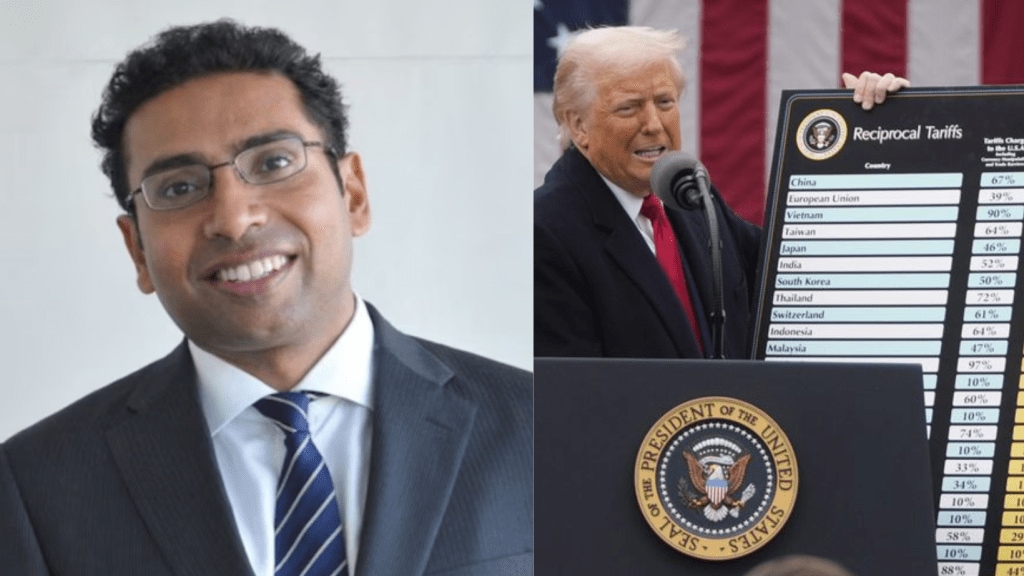
United States is unlikely to finalise a free trade agreement with India before the midterm elections in November. The grim assessment came from Marcellus Investment Managers’ Saurabh Mukherjea on Monday, even as US President Donald Trump teased the possibility of fresh tariffs.
The financial expert also noted that a delay would also work in favour of US domestic policies and put renewed pressure on the Indian rupee.
Mukherjea told CNBC that India had traditionally managed a current account deficit with the help of strong capital inflows. However, that balance has now shifted.
With the IPO window remaining open, private equity investors, both domestic and foreign, are steadily exiting Indian companies and repatriating funds to their home markets, including the US, the UK and South Korea.
This has resulted in a capital account deficit alongside the current account deficit, a rare situation in India’s economic history.
“The combined impact of this pushes the rupee downwards on a steady basis,” Mukherjea said, adding that markets currently view the rupee as a “one-way trade.”
FTA seen as key sentiment changer
According to Mukherjea, a comprehensive US–India FTA is the only development that could meaningfully alter investor sentiment on the currency. “For that to stop, I think we need that FTA with America,” he said on CNBC.
“Without it, there’s no reason for the market to change its point of view.” However, he cautioned against expecting a near-term breakthrough.
US domestic politics favour delay
Mukherjea argued that from a US political perspective, delaying the agreement may be more beneficial ahead of US midterm elections. “It’s not evident to me why the US president will sign this before the midterms,” he said on CNBC. “What incentive does he have?”
He noted that sectors critical to American interests, such as Indian IT services, generic pharmaceuticals and consumer electronics like iPhones, have largely been exempted from the FTA framework.
In contrast, sectors that India views as vital for employment generation, including textiles, gems and jewellery, footwear and sports goods, have been hit with tariffs of up to 50 percent.
“This feels like a very politically convenient construct for the US president,” Mukherjea told on CNBC, adding that prolonging negotiations plays well with American voters while preserving access to low-cost Indian services.
As a result, Mukherjea said expectations of a US- India trade deal before the midterm elections may be misplaced, with continued implications for the rupee and capital flows through the rest of the year.
Trump’s tariff warning to India
US President Donald Trump said on Monday that the United States could raise tariffs on Indian imports if India does not cooperate on the “Russian oil issue.” During his remarks, Trump also mentioned Prime Minister Narendra Modi, calling him a “good guy” and saying Modi was aware that the US President was unhappy.
“India wanted to make me happy. Modi is a very good guy and he knew I was not happy. And it was important to make me happy. We can raise tariffs on them very quickly,” Trump was heard saying in an audio while speaking to reporters.
Trump was referring to India’s oil trade with Russia, which his administration has opposed for a long time. This issue was earlier cited as the reason for doubling tariffs on India to 50% in August 2025. “We could raise tariffs on India if they don’t help on Russian oil issue,” the President was quoted as saying by Reuters.
The comments were made during a briefing where Trump spoke about the US government’s next steps after the capture of Venezuelan leader Nicolas Maduro. Oil was also a key issue in the recent US strikes on Venezuela.
Trump’s latest warning on tariffs comes at a time when trade talks between India and the United States are still ongoing.