



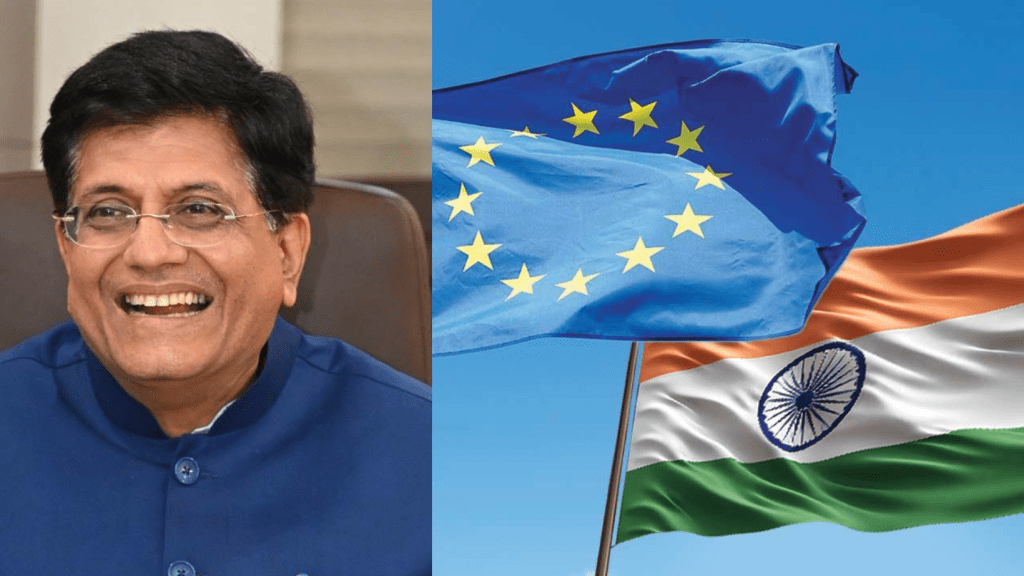
Union commerce and industry minister Piyush Goyal is in Brussels this week for high-level talks with the European Union as negotiations for the long-pending India-EU Free Trade Agreement (FTA) reach what officials describe as a “historic juncture”.
India and the EU will hold ministerial-level discussions on January 8-9, with Goyal meeting EU commissioner for trade and economic security Maros Sefcovic. The talks aim to bridge differences, provide direction to negotiators and push for an early conclusion of a “balanced and ambitious” trade pact.
“The primary objective of these interactions is to provide strategic guidance to the negotiating teams, resolve pending issues, and expedite the conclusion of a balanced and ambitious agreement,” the commerce ministry said.
The visit comes just weeks ahead of the India-EU Summit on January 27, and days before top EU leaders arrive in New Delhi as chief guests for the Republic Day celebrations. With political momentum building, here are the four major issues dominating the agenda.
Zero-duty access for India’s labour-intensive sectors
A central focus of India’s negotiating strategy is securing zero-duty access for sectors that employ millions and form the backbone of exports to Europe. “A central pillar of India’s negotiation strategy, guided by the vision of Prime Minister Shri Narendra Modi, is to secure an agreement that translates into tangible benefits for the common man,” the ministry said.
India is pushing for tariff-free access for labour-intensive sectors such as textiles, leather, apparel, gems and jewellery, and handicrafts. These sectors are expected to gain significantly if trade barriers in the EU market are reduced.Indian exporters believe that the FTA could sharply improve competitiveness for products like ready-made garments, pharmaceuticals, steel, petroleum products and electrical machinery.
Market access demands and tariff cuts sought by the EU
Though India is seeking wider access for its exports, the EU is pressing for deeper tariff reductions in several sensitive sectors. The bloc has been demanding significant duty cuts in automobiles and medical devices, along with tax reductions on products such as wine, spirits, meat and poultry. It is also pushing for a stronger intellectual property rights regime as part of the agreement.
These issues remain among the most difficult to resolve, with India cautious about opening up sectors that could impact domestic industry, farmers and MSMEs. Commerce secretary Rajesh Agrawal earlier acknowledged the challenge, saying negotiations with the 27-nation bloc had entered the “most difficult” phase.
Climate concerns and the EU’s carbon tax (CBAM)
Another major sticking point is the European Union’s carbon border adjustment mechanism (CBAM), which imposes a carbon tax on imports such as steel and cement. India has raised concerns that the EU’s carbon tax could hurt its exports and act as a non-tariff barrier. The issue has become increasingly important as climate-linked trade rules gain prominence in global negotiations.
Among the issues under discussion is the European Union’s carbon border adjustment mechanism (CBAM), which has implications for Indian exports, as per PTI. Steel, cement and other carbon-intensive products are key Indian exports to the EU, making this a critical area for resolution.
Pushing for closure before key political milestones
Beyond sector-specific issues, both sides are under pressure to conclude the deal quickly, with diplomacy and symbolism adding urgency.
“The visit underscores the intensifying diplomatic and technical engagements between New Delhi and Brussels, signalling a decisive push toward concluding the India-EU Free Trade Agreement (FTA),” the ministry said.
The ministerial engagement follows a week of intensive deliberations in Brussels, building on talks held on January 6-7 between Agrawal and the European Commission’s director-general for trade, Sabine Weyand. Both India and the EU have expressed strong political resolve to deliver a comprehensive agreement that reflects modern economic realities and strengthens global supply chains.
A deal years in the making
Negotiations for the India-EU FTA were first launched in 2007 but stalled in 2013 due to differences over market access. Talks were revived in June 2022 after a gap of over nine years, alongside negotiations on an investment protection agreement and a pact on geographical indications. Since then, the two sides have held 14 rounds of negotiations, with the 16th round concluding between December 3 and 9.
India’s bilateral trade in goods with the EU stood at $136.53 billion in 2024-25, making the bloc its largest trading partner. The EU accounts for about 17 per cent of India’s total exports, while exports to India make up around 9 per cent of the EU’s global shipments.