



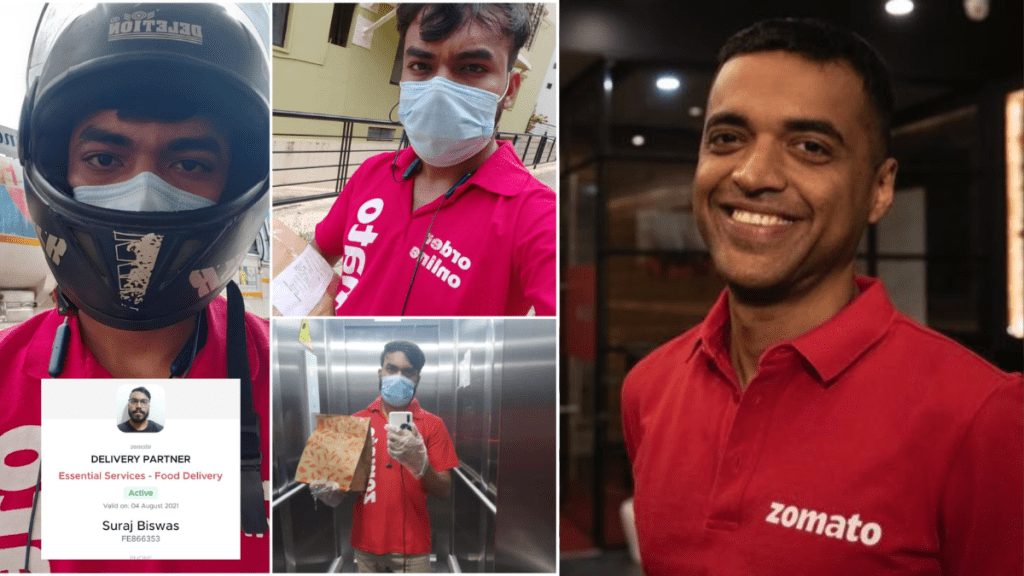
Suraj Biswas, founder and CEO of Assessli, has shared how his time as a Zomato delivery partner in Bengaluru helped him pay his college fees, remain financially independent, and eventually build his own company.
In a long post on LinkedIn, he reflected on his experience in the gig economy and explained why he opposes banning 10-minute deliveries or treating gig work as forced employment. He argued instead for tech-led job creation, flexible income models, and scalable solutions to unemployment, adding that he would not be where he is today without his stint at Zomato.
‘I stand with Zomato, Deepinder Goyal’
“I stand with Zomato. I stand with Deepinder. And I say this as someone who has lived this life. In 2020–21, before college really took off and before I started Assessli, I was a Zomato delivery partner in Bangalore,” he wrote on LinkedIn.
Biswas said that his story is not meant to evoke sympathy, but to highlight “independence, dignity, and opportunity”. He added, “I delivered to pay my college fees, support my early team, and stay financially independent. Today I run a Deeptech Startup Assessli as founder and employ 40+ techies operating from offices in Bengaluru and Kolkata.”
He said that he earned Rs 40,000 per month during his time with Zomato and personally knew delivery partners earning between Rs 80,000 and Rs 90,000 monthly. “No degree checks. No background privilege. Just effort + tech + execution.”
Biswas also recalled receiving medical insurance through Zomato and said the company supported him during difficult situations. “I faced food snatching and life-threatening moments. And when things went wrong, Zomato coordinated with the police and supported me.”
Biswas’ views on 10-minute food delivery
Addressing the ongoing debate around 10-minute food delivery, Biswas said his views were shaped by first-hand experience. “This was independent gig work, not forced labour. Most delivery partners are NOT full-time. More than 50%+ riders work on 2–3 platforms simultaneously (I’ve seen it, lived it)…Loyalty in gig work is flexibility-driven, not contract-driven,” he went on to say, before asking, “Now ask yourself honestly: If Zomato made it a fixed-salary, full-time job with exclusivity… how many riders would actually stay?”
He added that such a system would likely collapse and trigger further unrest.
Biswas argued that banning gig work is not a sustainable solution. He added, “Zomato didn’t just deliver food. It delivered economic mobility at scale. Deepinder Goyal built systems that allowed students to earn, migrants to survive cities, and millions to work on their own terms.”
Zomato founder Deepinder Goyal has since reposted Biswas’ LinkedIn post.
Here’s how others have reacted to his post:
While many enjoyed reading his first-hand experience, some disagreed with his views on gig work and delivery timelines.
“But this can not be the reason for exclusive exclusion of the wider topic and point of concern is there should be wider policy regarding wage security, health security and social security Gig can never become formal employment unless it is required by govt rule under minimum wage act now how will this be achieved either it can PPP or whatever. Secondly formal employment and job stability is another joke in this country unless you have state job everyone is just a moment away from getting unemployed and unfortunately there is no cushion provided even if you were tax payer earlier. Capitalist system is needed for wealth generation and we also need socialist system to take care of all,” said one LinkedIn user.
A co-founder expressed, “Great to see this perspective. There’s so much noise about 10-minute deliveries, but most people miss the point you and Deepinder have made, it’s about system design and store density, not forcing riders to speed. Your journey proves that when the tech is built right, it doesn’t just deliver food, it delivers a pathway to entrepreneurship.”
Another added, “Thank you for sharing this lived perspective. Ground realities matter. Systems that create choice, flexibility, and dignity can change lives in ways debates often miss. Listening to experience feels essential here, Suraj Biswas.”
“This perspective really matters, especially coming from someone who has lived this experience firsthand. Gig work means different things to different people and for many, it represents flexibility, dignity, and independence. The system isn’t perfect, but it has clearly created real opportunities,” commented a third.
A fourth shared, “Suraj, I had washed dishes, cleaned cars(which was my first part time for $50peanuts a full day), and many other gig part times all while i did my masters from one of the best universities in the world, to fund my studies abroad. Slept hardly 2-3 hours for many years. Only difference is, there it wasn’t uncommon and the world believed in independence. And those 20s hustle built me who I am to push through rocks while building my biotech ground up, day and night! Nothing big can be built with just clocked hours! Cheers man! All the best.”
“Your assumption that the system would collapse due to an insufficient number of delivery riders willing to work full-time is flawed. Several quick-service restaurants (QSRs), including Domino’s, successfully employ delivery personnel as full-time staff. The primary reason platforms like Zomato prefer not to adopt a full-time employment model is that it would convert variable labour costs into significantly higher fixed costs. Moreover, demand for food delivery is highly volatile, with pronounced peaks and troughs. Relying on gig workers provides the necessary flexibility to scale the workforce rapidly and ensure adequate availability during peak hours without incurring idle costs during off-peak periods. So the system will collapse if it shifts away from gig workers, but not due to a shortage of labour, but rather due to a substantial and unsustainable increase in fixed operational costs,” said yet another LinkedIn user.