



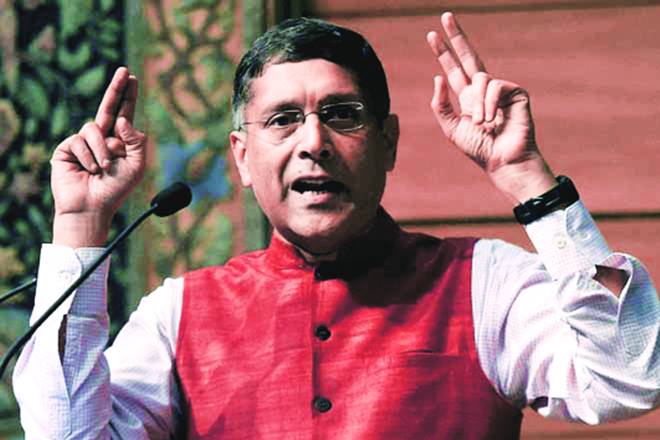
Noting that social welfare programmes of the government were not very effective in reaching the target citizens of the country, chief economic adviser Arvind Subramanian on Friday advocated a Universal Basic Income (UBI) for India. Delivering a lecture on the Economic Survey 2016-17 at the Indian Institute of Management, Ahmedabad (IIM-A), Subramanian said the idea had been gaining ground both in India and internationally, and the world was waiting to see how India would follow up on it.
“Ahead of the survey, we gathered data on about seven to eight major social programmes and tried to map where the funds were being spent, and found that government programmes were not very effective at targeting the right people. From data of different states, we found that in a sense, the greater the poverty, the greater is the inadequacy of spending there”, Subramanian said.
Speaking about the challenges in implementing UBI in the country, Subramanian said, “We have presented this to the highest circles, but it has to be discussed very carefully. A major advantage is that it will allow anyone to transfer money to the bank accounts or the mobile phones of the citizen anywhere. In India, the problem is that it is very easy to introduce new programmes, but difficult to withdraw existing programmes. And the cost of such a programme would be big enough that it cannot be added on to other programmes.”
You May Also Want To Watch:
Responding to questions on how it could be implemented in India, Subramanian admitted that “financial inclusiveness” was still a problem for the country. He said, “Despite Jan Dhan accounts and other programmes, we are far away from achieving financial inclusiveness, but there are possibilities of making strides there. About 35 crore people have no phone as of now, but we can make rapid progress in that over the next few years.”
The proposal of UBI suggests providing an estimated $150 to $220 yearly income for the majority of Indians, which could be equivalent to about 4% to 5% of India’s gross domestic product. UBI would replace several government social welfare programmes like the Mahatma Gandhi National Rural Employment Guarantee Act (MNREGA). Speaking about MNREGA, Subramanian admitted, “With MNREGA, the benefits don’t necessarily get through to the most deserving of the beneficiaries because the funds are mediated through multiple levels of government and there is leakage.”