



By Amitabh Kant & Ranveer Nagaich, respectively chairperson and managing director, Fairfax Centre for Free Enterprise
India’s success in manufacturing exports, particularly in electronics, autos, and renewables, depends on trade in intermediate and capital goods. Our trade data demonstrates this simple truth. Take for instance smartphone exports. In FY25, they totalled $25 billion, a 55% rise over FY24.
Smartphone parts (HS Code 851779) imports also grew from $11 billion to $15 billion. Over 50% of these imports come from China. Imports of integrated circuits (ICs) have also been rising steadily, as have the imports of displays, cameras, memories, and storage, all essential to modern electronic devices such as phones, laptops, tablets, and televisions.
The recent moves to abolish quality control orders (QCOs) across sectors such as steel, metals, chemicals, and machinery also reflect the understanding that to export, we must also import.
Chinese firms themselves embody this logic—China is the world’s largest semiconductor importer, with an estimated $250-300 billion in semiconductor imports alone, exceeding its oil imports.
India has built strong capabilities in design, talent, and large-scale manufacturing. Labour law reforms position the country well for the next wave of labour-intensive manufacturing growth. Achieving rapid scale in sectors such as electronics, batteries, and renewables will require completing our domestic strengths with global capital, technology, and know-how.
Deeper integration in global value chains will help Indian firms move into higher-value manufacturing and upskill our workforce. At the same time, specific sectors, such as infrastructure, banking, power, defence, etc. carry national security implications and require strong domestic capabilities as a non-negotiable foundation.
Global Investment Screening Models
Countries worldwide address similar concerns through structured, risk-based screening systems, offering valid reference points as India assesses how best to align openness with strategic priorities.
Globally, screening frameworks have balanced investment needs and national security concerns. The Committee on Foreign Investment in the US (CFIUS), Australia’s Foreign Investment Review Board (FIRB), the European Union’s Foreign Direct Investment (FDI) Screening Regulation, Japan’s framework, and South Korea’s system all share a common philosophy of applying risk-based, sector-specific scrutiny.
Clear trigger conditions are defined, and reviews start only if the conditions are satisfied. A structured review process allows for time-bound decisions and conditional approvals. These mechanisms ensure that security considerations are addressed without constraining capital flows.
For instance, most countries include defence, energy grids, and semiconductors, among others, as critical or high-risk sectors. Sectors are further categorised as moderate- or low-risk. The lower the risk, the more easily foreign investment flows in.
India issued Press Note 3 (PN3) in 2020, during the exceptional circumstances of the Covid-19 pandemic to prevent opportunistic takeovers. It adopts a geography-based approach, mandating government approval for all investments sharing a land border with India. India, too, has delineated strategic sectors.
For instance, India’s New Public Sector Enterprise (PSE) Policy identifies four strategic sectors—atomic energy; space and defence; transport & telecommunications; and power, petroleum, coal, and minerals. All other sectors are designated non-strategic. In strategic sectors, the public sector will remain present.
In the same vein, India’s FDI policy mandates government approval for investments in defence (above 74%), telecom (above 49%), and public sector banks (up to 20%).
However, over the past five years, markets have become more resilient and deeper. Domestic retail participation has increased, and growth prospects look solid. Given our investment and job-creation needs, can PN3 be reviewed? According to leading law firms, several gaps exist within the current framework.
First, there is no clear definition of who qualifies as a “beneficial owner”. Second, there is no standard threshold for when approval is required, and no fixed timeline for decisions. As a result, investments in areas with no security implications, such as consumer electronics, auto ancillaries, renewables, and other fast-growing manufacturing segments often face delays.
These delays slow expansion plans and discourage global firms from integrating India more deeply into their supply chains.
Investments thrive in environments with policy predictability and transparency. Rather than a blanket ban on investments, a structured, transparent approach can yield better results.
Our FDI policy already reflects this risk-based approach, which must be institutionalised. We must evolve a risk-based system that protects national security and keeps India open for business.
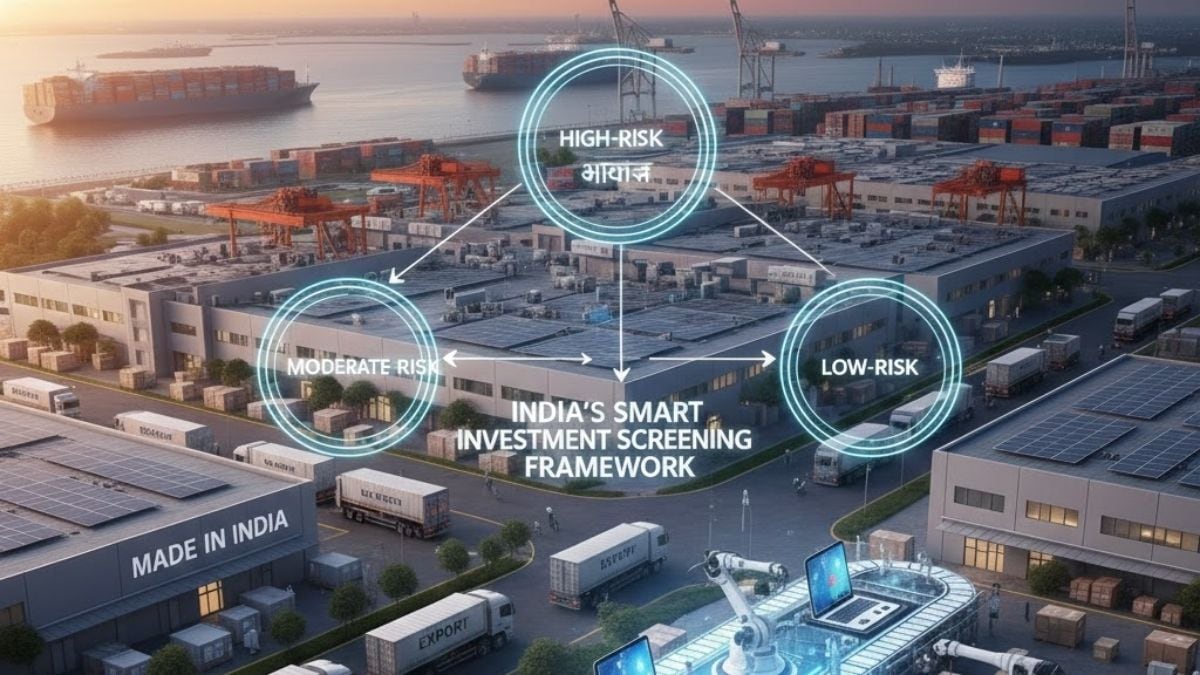
India could adopt a three-tier framework—high-risk sectors subject to full scrutiny; moderate-risk sectors reviewed only when specific, objective triggers are activated; and low-risk sectors placed under the automatic route.
A clearly defined beneficial ownership threshold, of say 10-25%, and a 60–90 day statutory decision period, would bring much-needed policy predictability and transparency.
Prioritizing Growth and Employment
We must also take an outcome-oriented view. Our goal is to raise our per capita income. Investments that create jobs and help India align with global value chains must be welcomed. Consumption accounts for ~60% of our GDP, with per capita income of $2,500 in nominal terms.
If we account for purchasing power, our per-capita incomes are closer to $9,000. Either way, our domestic market is sizeable. As our per-capita incomes grow, so will domestic consumption and savings. Our large domestic market and our high growth potential are also strategic advantages we must leverage.
In evaluating proposals, we must also keep in mind the potential for job creation. To start with, sectors such as electronics, renewables, and energy storage can be opened.
In the past weeks, the reform agenda has picked up significant pace. We have seen reforms in the Goods and Services Tax (GST), the abolition of several QCOs, and, most recently, the operationalisation of the new Labour Codes. A risk-based investment screening mechanism is the natural next step in this reform trajectory.
It would allow India to protect critical sectors while keeping the broader economy open to capital, technology, and global partnerships. Reform does not mean dilution; the most critical sectors would continue to receive the strictest scrutiny.