



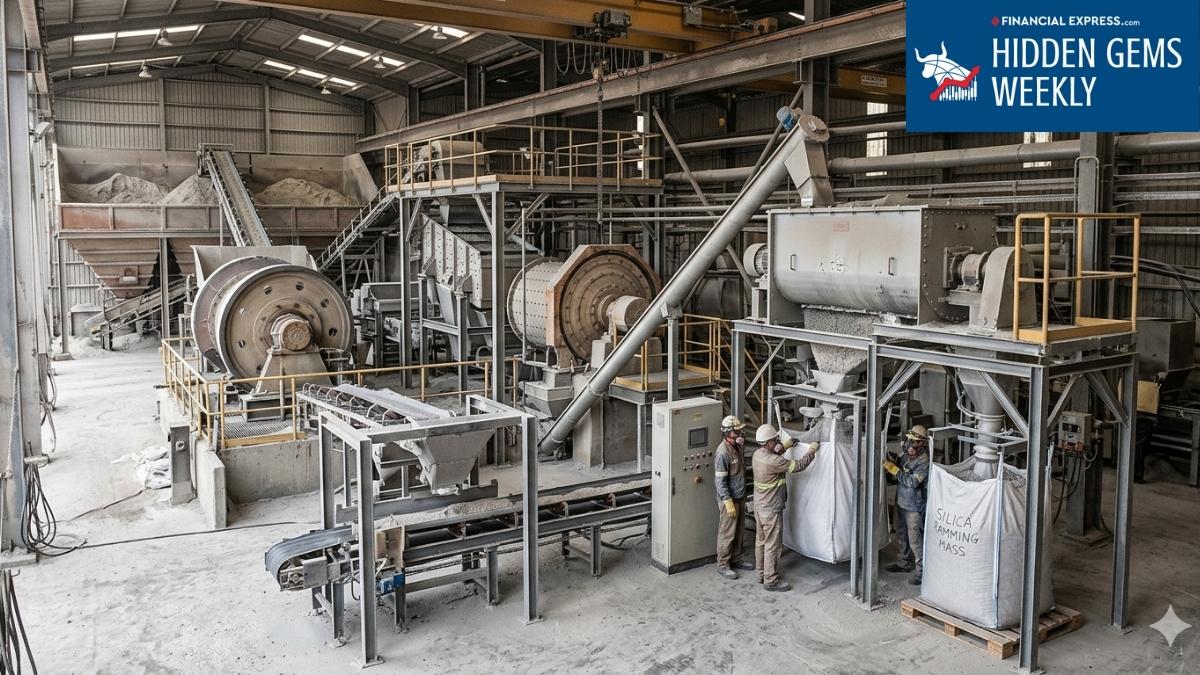
Welcome to the latest edition of Hidden Gems Weekly. In recent weeks, we covered India’s leading manufacturers of alternating current generators and industrial electric motors,a digital infrastructure company focused on data centres and a packaged food exporter building global brand buffers. This week, we turn to a company operating in one of the least glamorous but most critical corners of the steel industry, manufacturing silica ramming mass — a consumable material used to line induction furnaces and keep steel plants running efficiently.
Some companies become famous because consumers see them every day. And then there are companies buried deep inside industrial supply chains, making products most investors have never heard of.
Raghav Productivity Enhancers Limited belongs firmly in the second category.
The company makes silica ramming mass. That is a refractory material used to line induction furnaces in steel plants and foundries. It is not glamorous. Nobody discusses it on business television. No retail investor wakes up excited about furnace lining material.
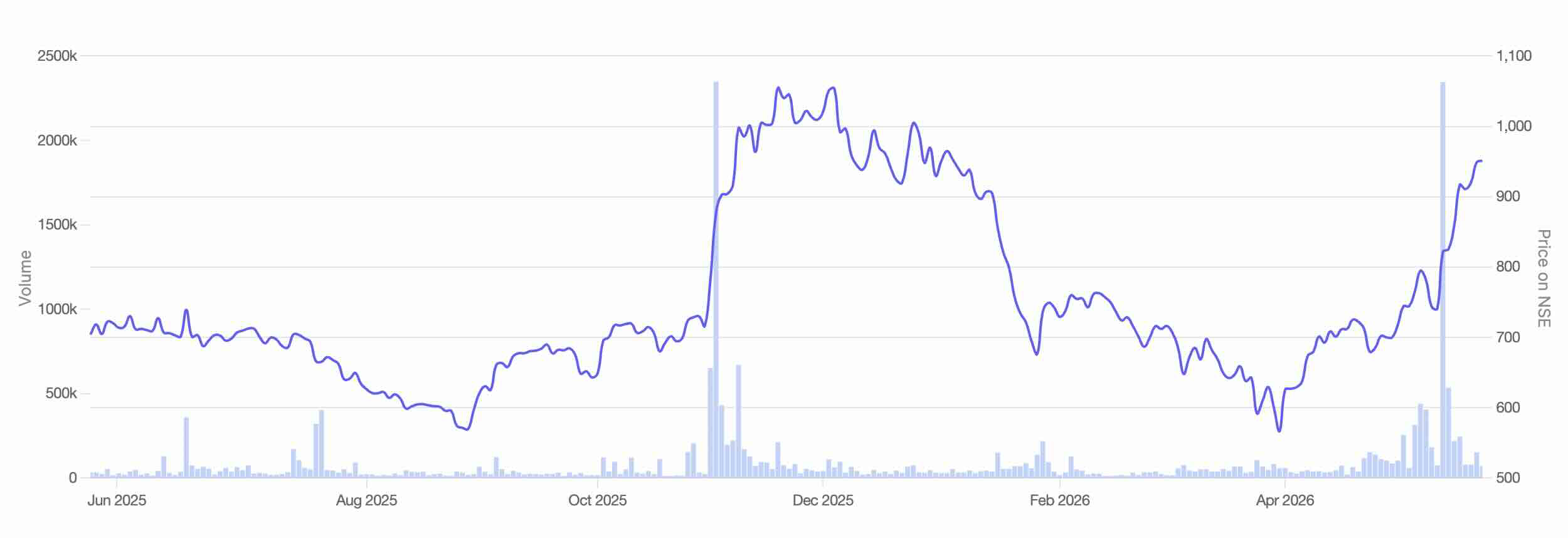
Raghav Productivity Enhancers Limited1-Year Share Price Chart
And yet, without it, induction furnaces would wear out rapidly, energy efficiency would fall and steel production costs would rise meaningfully. This makes the company one of those quietly important businesses that markets often ignore until the numbers become too large to overlook.
The World’s Largest Maker Of Something You’ve Never Heard Of
Ask most investors about silica ramming mass and you will probably get a blank stare. That is precisely the point.
India’s listed markets are usually obsessed with visible businesses. These are your banks, consumer brands, technology companies, quick commerce platforms and electric vehicle stories. Industrial consumables, such as the silica ramming mass, hidden inside manufacturing processes, rarely attract attention.
But economies are built on such products.
Raghav Productivity Enhancers (formerly Raghav Ramming Mass) makes refractory material from quartz minerals and binder chemicals. This material lines the inside of induction furnaces used in steel plants, foundries and casting units. It acts as a protective barrier and thermal insulator. Without it, the furnace walls erode rapidly.
A better-quality lining means longer furnace life, fewer shutdowns, lower replacement frequency and lower electricity consumption. For a steel plant running continuously, these savings matter far more than the freight cost of sourcing the material from Rajasthan instead of buying locally.
And that is where the economics become interesting. Because this is not a one-time product. It is a consumable that needs to be replaced regularly as furnace linings wear out during steelmaking operations.
Steel plants keep buying it repeatedly. Demand is recurring, predictable and structurally tied to steel production itself. Unlike discretionary industrial spending, furnace lining material cannot really be postponed indefinitely. If the lining fails, production stops. And when production stops, accountants stop smiling.
The result is a business that looks boring on the surface but quietly compounds underneath.
In FY26, RPEL reported revenue of ₹257 crore, Earnings before interest, depreciation and amortization (EBITDA) of ₹75 crore and PAT of ₹55 crore. More importantly, these are not one-year numbers inflated by a commodity cycle.
Over the last decade, the company compounded revenue at 32% annually, EBITDA at 32% and PAT at 45%. The ten-year average Return on capital employed (ROCE) stood at 24% and Retun on equity (ROE) at 19%.
For a small-cap industrial materials company, these are unusual numbers. Particularly in a segment most investors have never bothered to study.
The Decade That Built The Moat
RPEL was listed on the BSE SME platform in 2016. At the time, it was just another small industrial company operating in a niche product category that few cared about. What happened afterwards tells you a fair bit about management quality.
Instead of chasing growth through indiscriminate capacity addition, the company steadily invested in product development, process engineering, furnace performance optimisation and customer support.
That matters because refractory products are usually treated as commodity businesses. RPEL tried to avoid becoming one.
The company collaborated with IIT Bombay on research and development, secured government recognition for its in-house R&D capabilities and eventually became the operator of the world’s first fully automated silica ramming mass plant.
But perhaps the more important achievement was geographical. Heavy industrial materials are usually local businesses pretending to be scalable businesses. Freight costs see to that. Steel plants typically prefer nearby suppliers because transportation expenses can quickly eat into economics.
RPEL broke that assumption. Today, the company supplies customers across all 27 Indian states from a single plant in Rajasthan and exports to 39 countries.
That is not merely a logistics achievement. It is a product-quality achievement disguised as one. Customers are effectively willing to absorb higher freight costs because the product saves them more money elsewhere.
Why The Business Is Stickier Than It Looks
Commodity businesses are normally judged on pricing power. Can they raise prices? Can customers switch easily? Is there any meaningful differentiation?
RPEL’s answer to these questions is more interesting than it first appears. The company occupies the unusual position of being both a premium-priced and cost-efficient player simultaneously.
Its product costs more upfront than many regional alternatives. But customers often recover that difference through longer furnace life, lower downtime and reduced electricity consumption.
Which means the customer is not really buying silica. The customer is buying operating efficiency. Simply put, the customer saves much more money than the extra amount paid for the product. Now, that creates stickiness.
Once a steel plant calibrates furnace performance around a specific lining material, switching suppliers becomes operationally painful. Add to that the company’s on-site technical support and customised formulations, and customer retention improves further.
This also explains why the company has steadily improved realisations per tonne without meaningfully hurting volume growth. The R&D capability strengthens this moat further.
The Numbers That Quietly Stand Out
One of the more revealing things about industrial businesses is whether growth comes from temporary pricing cycles or genuine operational scaling. RPEL’s numbers suggest the latter. The company started FY16 with an annual capacity of 36,000 metric tonnes. Today, combined capacity across RPEL and its subsidiary stands at 414,000 MTPA, implying a 28% CAGR over ten years. The company has announced another expansion to 534,000 MTPA through brownfield additions.
A Decade of Operational Scaling: RPEL at a Glance
| Metric | FY16 | FY26 | 10-Year CAGR |
| Annual Capacity | 36,000 MTPA | 414,000 MTPA | 28% |
| Sales Volumes | 29,000 MT | 332,000 MT | ~28% |
| Export Volumes | 1,000 MT | 80,000 MT | 56% |
Source: Company filings / Investor presentations
Sales volumes increased from 29,000 MT in FY16 to 332,000 MT in FY26. Capacity utilisation in Q4FY26 touched 87%, indicating demand continues to absorb new supply reasonably well.
The export story is perhaps even more important. Export volumes compounded at 56% annually over the last decade, from just 1,000 MT in FY16 to 80,000 MT in FY26. This is important as global customers generally do not continue importing heavy industrial consumables unless the economics are compelling enough to justify freight costs.
Margins also remain unusually healthy for this kind of business. FY26 EBITDA margins stood near 29%, while PAT margins were roughly 21%. ROCE for the year came in at 28%, above the company’s long-term average.
Importantly, returns do not appear to be deteriorating as scale increases. That is often where the quality of a business reveals itself.
The Management Question
Small-cap manufacturing companies in India usually force investors to ask the same question repeatedly: Can management be trusted with capital?
RPEL, so far at least, offers a more reassuring answer than most. The founding Kabra family has spent three decades building the business steadily rather than aggressively.
Independent directors include Hemant Nerurkar, former Managing Director of Tata Steel and former Chairman of TRL Krosaki, as well as Rajni Sekhri Sibal, a former IAS officer. The advisory board includes global refractory and furnace industry veterans from Sweden and Australia.
That level of domain expertise is unusual for a company with a market capitalisation barely above the small-cap threshold. Of course, no management deserves the permanent benefit of doubt.
Industrial history is filled with companies that appeared disciplined during growth phases but later lost focus through unrelated diversification or excessive expansion. This is why the next few years matter.
The Next Phase — And The Risks Worth Watching
RPEL now wants to increase domestic market share from roughly 14% towards 30% over time. To achieve this, it plans multi-location manufacturing and deeper penetration into regional steel clusters. Moreover, it is also trying to move beyond steel furnace materials into other silica-based applications, including specialised refractory products, quartz crucibles used in semiconductor manufacturing and engineered stone products like artificial marble.
The semiconductor angle is interesting because it fundamentally changes the quality of the addressable market. So while steel industry consumables are good businesses, semiconductor materials can become exceptional businesses.
However, it is not as easy as it may seem. Because expanding into adjacent categories of businesses is where many otherwise disciplined industrial companies begin making mistakes.
There are also operational risks. Exports remain vulnerable to geopolitical disruptions, as seen during the Iran-related trade route issues in FY26. Regional competitors still retain freight advantages in local markets. And as the company grows larger, sustaining high growth rates inevitably becomes more difficult.
Valuation
A company compounding PAT at 45% annually while generating 28% ROCE does not remain undiscovered forever.
The stock market eventually notices, especially in the case of RPEL. The stock trades at a PE of 79 times, a premium to its historical median. And now that the stock is trading at these levels, expectations rise faster than factories can usually expand.
The Final Word
Nobody boasts at a cocktail party about owning a silica ramming mass manufacturer. Which is usually where interesting businesses begin.
Raghav Productivity Enhancers operates in an obscure corner of the industrial economy, supplying a product few people understand but one that steel plants cannot function without. Hidden inside that seemingly dull business is a combination investors spend years searching for: recurring demand, pricing power, high returns on capital and a long runway tied to industrial growth.
India’s steel industry is unlikely to disappear anytime soon. Induction furnaces are unlikely to disappear anytime soon. And as long as steel plants continue melting metal, somebody will need to line those furnaces repeatedly.
RPEL’s challenge now is no longer proving the business works. The numbers already suggest it does.
The real question is whether the future growth investors now expect can continue long enough to justify the price already being paid.
Disclaimer:
Note: We have relied on data from www.Screener.in throughout this article. Only in cases where the data was not available, have we used an alternate, but widely used and accepted source of information.
The purpose of this article is only to share interesting charts, data points and thought-provoking opinions. It is NOT a recommendation. If you wish to consider an investment, you are strongly advised to consult your advisor. This article is strictly for educative purposes only.
Manvi Aggarwal has been tracking the stock markets for nearly two decades. She spent about eight years as a financial analyst at a value-style fund, managing money for international investors. That’s where she honed her expertise in deep-dive research, looking beyond the obvious to spot value where others didn’t. Now, she brings that same sharp eye to uncovering overlooked and misunderstood investment opportunities in Indian equities. As a columnist for LiveMint and Equitymaster, she breaks down complex financial trends into actionable insights for investors.
Disclosure: The writer and her dependents do not hold the stocks discussed in this article. The website managers, its employee(s) and contributors/writers/authors of articles have or may have an outstanding buy or sell position or holding in the securities, options on securities or other related investments of issuers and/or companies discussed therein. The content of the articles and the interpretation of data are solely the personal views of the contributors/ writers/authors. Investors must make their own investment decisions based on their specific objectives, resources and only after consulting such independent advisors as may be necessary