



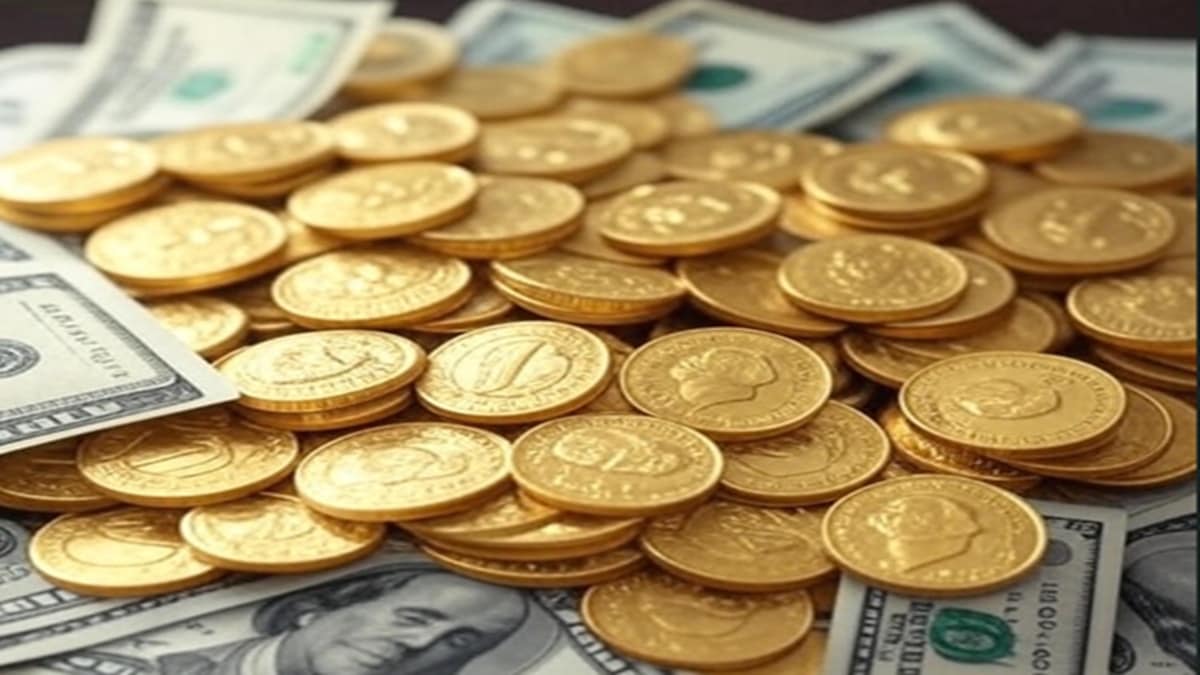
You must have often seen this headline in the media: ‘Gold falls on stronger dollar.’ If you are wondering what the relationship is between gold and the dollar, here’s what it is: Gold and the dollar have an inverse relationship.
A few days ago, gold prices significantly declined following the announcement that Russia would trade with the US in dollars. However, there has been no official response from Russia since then.
But the news brought the relationship between gold and the dollar to the forefront. Any such deal where Russia agrees to trade in dollars will make the greenback stronger. A stronger dollar means weakness in gold prices.
There’s another example of an actual event. The day US President Trump nominated Kevin Warsh as the next US Fed chair, after Powell retires as the chief in May, gold prices fell by 9%. This was because Warsh is seen to be making the US Dollar stronger. And, a stronger dollar means weakness in gold prices.
However, here’s a twist to the tale. Warsh is also known to be hawkish and will not want inflation to re-emerge. He may not be as aggressive in cutting rates as Trump wants him to be. Trump, on the other hand, also hinted at a weaker dollar that could keep US debt under control.
US Dollar index, which measures the currency’s strength against a basket of six other currencies, is down by 10% in the last 12 months; however, has shown some strength after Warsh’s confirmed nomination and the unconfirmed news.
When the dollar index strengthens, historical data indicate that gold prices fall, and conversely, when the dollar weakens, gold prices rise. This is because investors typically prefer dollar-denominated assets over non-yielding assets like gold when the dollar starts showing strength.
De-dollarization has become a buzzword in the financial world. The U.S. dollar serves as the primary reserve currency globally and much of the international trade is still settled in dollars.
However, the dollar’s dominance is leading to what the world is referring to as de-dollarization, where the dependence on dollars is less among investors and market participants. What it often leads to is the ‘Debasement Trade’, an investment strategy that involves transferring capital from fiat currencies ( US Dollars, Indian Rupee, etc.) to hard assets with a finite supply, like gold, silver etc.
The Debasement Trade is more pronounced in the case of central banks. Gold is the second most significant foreign exchange reserve asset held by central banks, accounting for 20%, surpassed only by the USD at 46% and exceeding the euro at 16%.
The dollar’s status as the global reserve currency is threatened by the US debt position and shifting geopolitical factors, making gold more appealing. The IMF notes a steady decline in the influence of the US dollar, despite it being the most widely used reserve currency.
Trump’s ‘One big, beautiful bill’ is likely to add $3.9 trillion in US debt, raising concerns over public debt and budget deficits, which have already resulted in a downgrade of the US credit rating by Moody’s Ratings.
As of January 2026, the U.S. national debt exceeds $37.64 trillion, compared to a Gross Domestic Product (GDP) of approximately $30.36 trillion, resulting in a debt-to-GDP ratio of 124 percent, raising concerns among economists regarding the nation’s ability to repay its debt.
Gold prices, therefore, depend on how the US Dollar index moves. A falling dollar index could negatively impact the US economy by diminishing trust in Treasury bonds, leading global investors to reduce their exposure.
This would result in costly borrowings for the US government as lower demand for treasuries drives up interest rates, exerting more pressure on the dollar index. If the dollar index starts showing strength, gold prices will be under pressure.
Beyond the dollar, gold prices are also supported by aggressive rate cuts from the US Federal Reserve, while a prolonged higher rate scenario exerts pressure on gold prices.