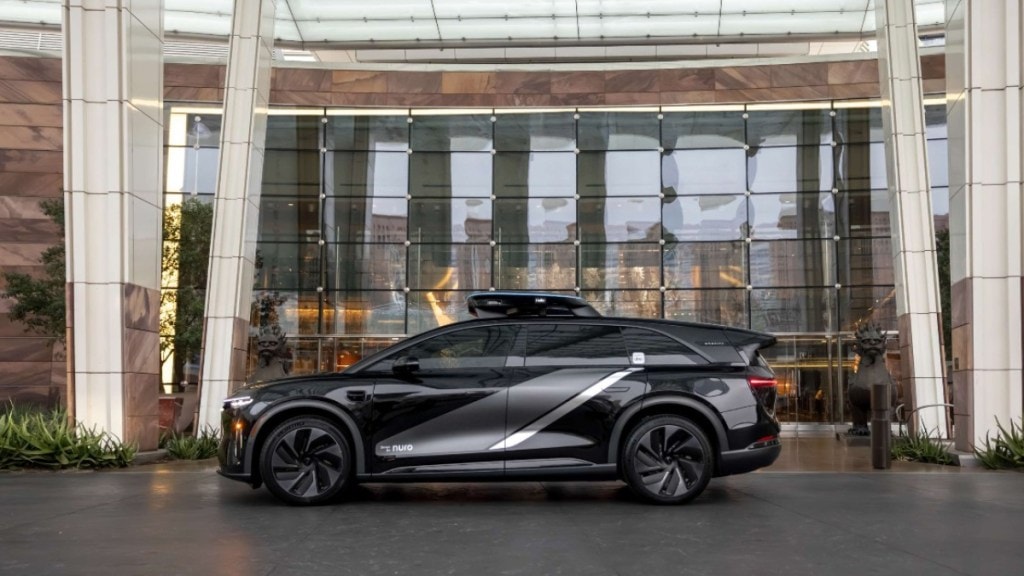
Uber wants to get into the autonomous taxi service and hence, it has partnered with electric vehicle maker Lucid Group and autonomy specialist Nuro to reveal their jointly developed ‘global robotaxi’ at CES 2026 in Las Vegas. As part of the demo, the trio showcases a feature-rich, production-intent vehicle equipped with cutting-edge 360-degree sensor technology developed to take on Tesla’s Robotaxi service.
As part of the collaboration, Uber will remain the operator of the upcoming driverless service, while Lucid provides the vehicle platform based on the Lucid Gravity SUV. Nuro will take care of handling the autonomous driving system and testing program.
At the CES, the trio announced that supervised on-road testing has already begun in the San Francisco Bay Area, thus marking a critical step toward a planned public launch later in 2026.
Uber’s autonomous taxi service: What’s in store for you
The robotaxi boasts a next-generation sensor array for full 360-degree environmental awareness, integrating high-resolution cameras, solid-state LIDAR, and radar seamlessly into the vehicle body. A distinctive roof-mounted “halo” module houses additional sensors and integrated LEDs, allowing riders to easily identify their vehicle, display personalised initials, and view real-time trip status updates.
Powered by NVIDIA’s DRIVE AGX Thor computing platform, the system undergoes rigorous safety validation through closed-track testing, extensive simulations, and public road trials to ensure reliable perception, planning, and behaviour in diverse traffic scenarios. Designed for up to six passengers with ample luggage space, the vehicle prioritises rider comfort and control with an Uber-designed in-cabin experience featuring screens for adjusting climate settings, heated seats, music selection, route monitoring, support requests, and emergency pull-over commands.
Roadmap to deployment
Production of the robotaxi is slated to begin later this year at Lucid’s manufacturing facility in Arizona, pending final validations. This partnership revives Uber’s ambitions in self-driving technology after previous setbacks, aiming to compete directly with leaders like Waymo in key markets, starting with San Francisco
Alphabet’s Waymo remains the current leader, operating fully driverless services in multiple cities, including Phoenix, San Francisco, Los Angeles, Austin, and Atlanta, with over 450,000 weekly rides reported late last year. Meanwhile, Tesla is gearing up for its dedicated Cybercab robotaxi, with production scheduled to begin in April 2026 at Gigafactory Texas.
Tesla’s current robotaxi service, launched in mid-2025 using modified Model Y vehicles, operates primarily in Austin and the San Francisco Bay Area. However, it remains supervised or limited in scale, with full unsupervised operations still pending broader regulatory approvals. CEO Elon Musk has emphasised 2026 as a crucial year for scaling the Cybercab and achieving widespread unsupervised autonomy.