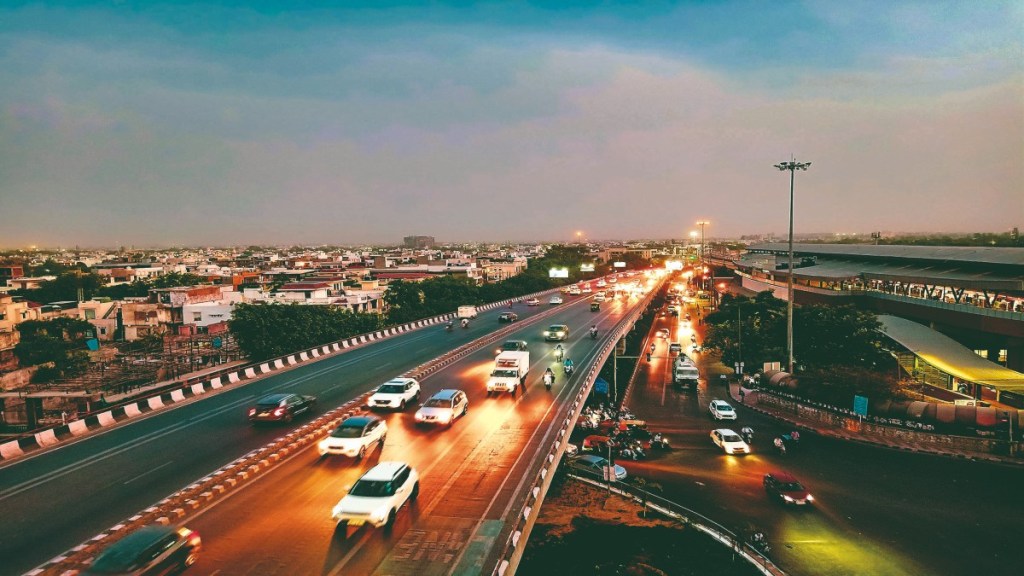
Urban mobility is a challenge of 21st-century cities. With swelling populations and rising vehicle ownership, traditional traffic control systems, especially traffic signals, are increasingly seen as bottlenecks rather than solutions. But does this mean we need signal-free cities?
Why India’s speciality chemical sector is ready for takeoff
Kota in Rajasthan has already entered the new phase of urban redesign. Instead of relying on electronic traffic lights, the city infrastructure is redesigned to let vehicles flow continuously, improving efficiency, safety, and environmental performance. This month, Kota became India’s first traffic light-free city. The removal of signals and a systemic redesign of the city’s road network under the leadership of the Urban Improvement Trust (UIT), Kota, the state’s statutory body created under the Rajasthan Urban Improvement Act, 1959, to promote and manage urban development and improvement within cities, has transformed the city.
Kota’s transformation lies in grade-separated infrastructure with flyovers and underpasses constructed at critical intersections, eliminating conflict points that would otherwise require traffic lights. Ring roads guide vehicles around the city rather than through congested junctions, and roundabouts and one-way corridors maintain a smooth, conflict-free flow. Clear signage, lane discipline, and road markings also support this design-driven mobility model, while traffic volunteers and the police help guide pedestrians during peak hours. All this will benefit the commuters in shorter travel times, reduced fuel consumption and fewer accidents.
Kota’s model is indicative of a new direction in Indian urban transport. However, it is not feasible for every city to go entirely signal-free due to size and density. Other cities in India include Indore, known as India’s cleanest city, a title it has held for eight consecutive years, which is working to become ‘signal-free’ through the deployment of an AI-powered intelligent traffic management system (ITMS), which uses adaptive signal control, real-time monitoring, and smart surveillance.
In Jharkhand, Bokaro Steel City has long operated with very few traffic lights. The city’s wide roads, self-regulated driving culture, and minimal traffic intervention have contributed to a near signal-free environment.
However, there are examples of cities that do not go entirely signal-free but efforts such as free-left turns at intersections, in Hyderabad, help reduce wait times and streamline flow.
Signal-Free vs. Smart Signals
But such signal-free cities represent a paradigm shift in designing urban mobility systems with reduced congestion and travel time, lower fuel consumption and emissions that contribute to better air quality and greater sustainability. In fact, well-designed grade separations, roundabouts, and conflict-free junctions reduce collision points.
Moreover, with predictable, continuous flow, the risk of rear-end crashes at signals decreases, and better estimated travel times can benefit public transport, logistics, and emergency services.
While fully signal-free cities are rare globally, news reports suggest Thimphu in Bhutan operates without conventional traffic signals. Traffic is often managed manually, and there is a strong reliance on roundabouts and human direction at busy junctions. Stevenage in UK is another town, planned with many roundabouts and very few traffic lights, minimising signalised intersections, using roundabouts for continuous movement along with segregated cycle paths. Many global cities have removed traditional signals.
Urban designer Ben Hamilton-Baillie has worked with cities like Amsterdam and Bern to showcase ‘shared space’ urban design principles, which prioritise human interaction over traditional traffic rules and signals. His work involves designing streets where drivers, pedestrians, and cyclists coexist, making streets safer by making people more cautious through subtle, human-centered design cues.
However, in India, Chandigarh is one city that has switched from roundabouts to red lights. Historically, the city’s design included many roundabouts, and in its early decades, the city had fewer traffic signals, giving it a quasi signal light–free feel in parts. Long-time residents recall when major roundabouts functioned without traffic lights, relying instead on disciplined driving, and the physical design of the city.
“Zero traffic lights, hardly any traffic …” remarked a Reddit user reflecting on Chandigarh’s early era. However, as the population grew and vehicle numbers surged, roundabouts began to become congested and unsafe. To manage this increasing complexity, red lights were gradually introduced at several junctions. In fact, every traffic light in Chandigarh now has CCTV coverage through its integrated traffic management system (ITMS), which enforces signal violations and tries to optimise traffic flows.
Thus, what works for a mid-size city like Kota may not translate to megacities with far greater traffic volumes and complex travel patterns. Even design-based systems need maintenance, signage, and enforcement, especially to prevent misuse or unsafe driving.