By Srinath Sridharan
Much of the conversation around artificial intelligence today is conducted at the extremes, with breathless warnings of mass job losses at one end and breezy dismissal at the other. The reality seems to be far more complicated, stuck somewhere no one can predict with any accuracy.
This is simply because AI is still being understood even as its development scales at astonishing speed. Despite its occasional missteps, the infamous hallucinations, the moments when it stumbles over context, intelligent systems are already quietly replacing human effort in areas once thought incomprehensible. The real question is whether we, as humans, can reinvent ourselves fast enough not just to cope with it, but to flourish alongside it.
The POSSIBLE framework and its promise
That reinvention feels urgent because AI is no longer confined to repetitive, mechanical tasks. It has ventured into decision-making, creative ideation, and even the subtle reading of human emotions. With each advance, it edges closer to matching, and sometimes surpassing human performance in both cognitive and emotional domains. The implications for employment are profound. Over the next decade and a half, between a third and half of existing jobs may disappear, with knowledge workers bearing the brunt. For younger demographic nations such as India, Africa, and those in Latin America, the scale of potential dislocation is staggering. In India, where nearly half the population is under 25, the government’s IndiaAI Mission and large-scale skilling programmes are trying to anticipate precisely the shifts Seth warns of. Disruption is certain, but so too is opportunity. Entire industries will be reshaped, creating room for new ideas, solutions, and ventures for those ready to grasp them.
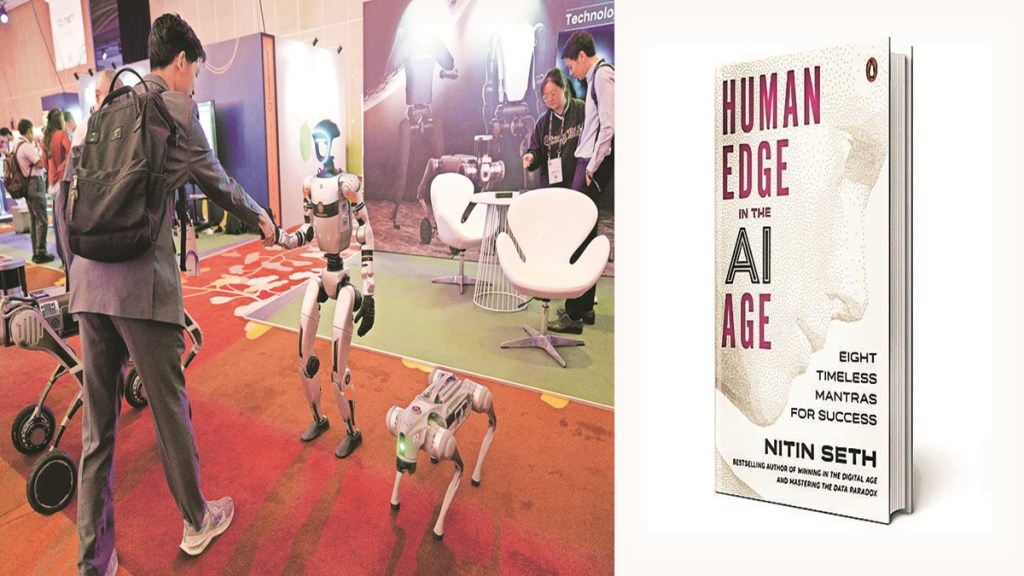
It is into this moment that Human Edge in the AI Age steps in, offering not just commentary but a way forward. Seth resists the temptation to see AI as a purely technological problem. Instead, he reframes it as a deeply human one, rooted in qualities no machine can replicate. His ‘POSSIBLE’ framework distils eight timeless capabilities: Problem-Solving, Openness, Spirituality, Sports, Impact, Balance, Leadership, Entrepreneurship. Each is explained with clarity, and, crucially, with reasons for its relevance in the AI era.
The breadth of the framework means it spans mindset, behaviour, and philosophy, more compass than checklist, yet it is grounded enough.
Seth’s arguments echo the concerns of global thinkers like Max Tegmark and Richard and Daniel Susskind, who have warned that the real challenge is not competing with AI but reshaping how we learn, work, and govern in its presence. What he adds, and this is the book’s strongest suit, is a deep faith in our capacity to adapt, provided we do so consciously and deliberately.
A hopeful but imperfect reflection
One of the most refreshing aspects in the book is Seth’s unselfconscious use of spirituality as a leadership anchor. It is rare to find a business book, particularly one on technology, that devotes so much space to the inner life without lapsing into abstraction. They remind us that in the race to stay ahead of machines, we cannot neglect the slower work of knowing ourselves. Here, it is woven through anecdotes from his own spiritual journey, offering a counterweight to the relentless pace of technological change.
Seth also draws liberally on Indic wisdom and traditions, weaving them into his reflections on how humans can retain their distinctiveness in an age of intelligent machines. For readers steeped in philosophy or spirituality, some of these parallels will feel familiar; for others, they may at times come across as esoteric, more meditative than managerial.
Equally engaging is his candid writing about personal missteps, including his later regret at not using his influence more forcefully in urban planning policy. In fact, many parts of Human Edge in the AI Age read almost like a memoir, with Seth revisiting moments from his own journey. These digressions expand the scope of the book away from AI itself, giving it an autobiographical feeling, that will either delight or distract, depending on what the reader picked the book for.
There is also playfulness in the way he borrows from sport. His analogies from cricket and football to illustrate teamwork, resilience, and adaptability are simple but effective. They work not only because they are familiar to most Indian readers, but because they bridge the gap between conceptual leadership traits and lived experience.
If there is a limitation, it lies in the scarcity of sector-specific examples. While the POSSIBLE framework can be applied to any profession, younger readers may wish for more concrete scenarios—say, how a young coder in Salem might approach it differently from a supply-chain manager in Surat. There are moments when the book feels as though it has been hurried to market to stake an early claim in this theme, rather than breaking truly new ground.
One of the book’s most resonant lines is Seth’s observation that “AI is challenging what is innately human. We are seeing a very important inversion: machines are growing and becoming more human, humans are becoming narrow and more machine-like.” It is a sobering thought, and one that crystallises the risk of letting our own adaptability atrophy even as technology races ahead.
Seth’s message is clear—the competitive edge in an AI-shaped economy will belong to those who can combine timeless human instincts with the best of machine capability. It shifts the conversation from whether AI will replace us to how we can nurture the qualities no machine can truly possess. At times, the book’s structure has the too-well-polished symmetry one has come to experience from a well-engineered generative AI prompt. To be fair to the author, this could be more a reflection of the content-saturated age we inhabit, where even human-authored work can carry the imprint of AI-like output. Yet it is precisely here that a firmer editorial hand could have injected more texture, nuance, and those productive surprises that keep a reader leaning in.
Ultimately, Human Edge in the AI Age is a hopeful book—a believer’s book. It believes in AI’s transformative potential, but even more in humanity’s ability to adapt, create, and lead. This book is part reflection, part rallying cry, part autobiography, with flashes of sales-pitch polish—more likely to spark conversations in influential IIT-IIM-ISB and consulting alumni circles, boardrooms, client pitches, and the PR-and-cocktail circuit.
Srinath Sridharan is author, corporate adviser and independent director on corporate boards
Disclaimer: Views expressed are personal and do not reflect the official position or policy of FinancialExpress.com. Reproducing this content without permission is prohibited.
Human Edge in the AI Age: Eight Timeless Mantras for Success
Nitin Seth
Penguin Random House
Pp 272, Rs 699