



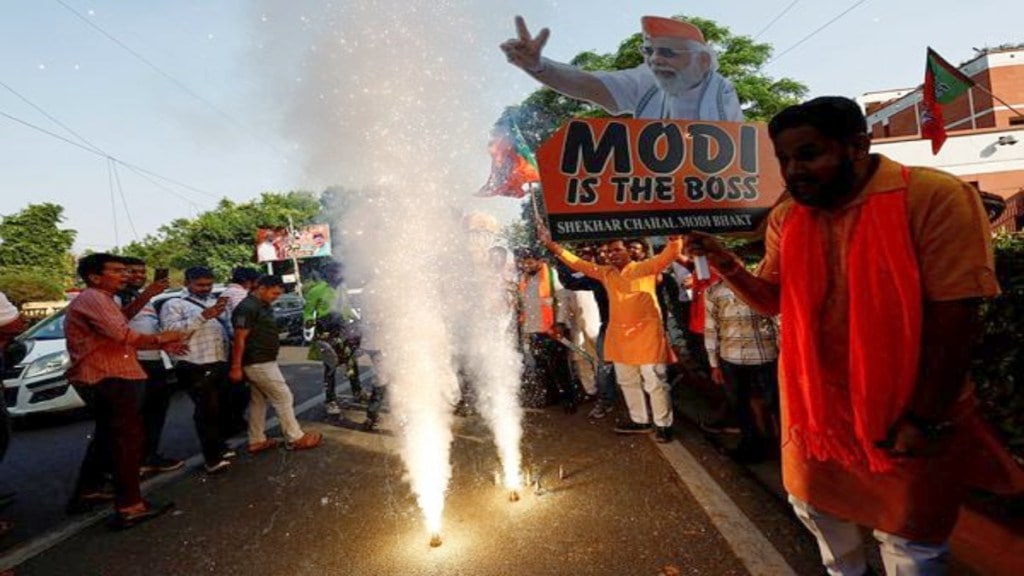
As the Bharatiya Janata Party (BJP) heads towards a historic third consecutive win in Haryana, it marks a crucial boost for the party, especially after falling short of a majority in the 2024 Lok Sabha elections. This victory, coming just ahead of a series of Assembly elections, solidifies the BJP’s dominance in the Indian political landscape. Despite challenges in various states and stiff competition from Congress, the BJP’s resilience in Haryana signals its continuing relevance and strength at the national level, reaffirming its position as a key player in Indian politics.
Haryana: A historic win amid anti-incumbency
Haryana, traditionally a challenging political battleground, has seen the BJP overcoming significant obstacles to stay on top. Facing anti-incumbency, dissatisfaction among farmers and wrestlers over prolonged protests, and widespread discontent over the Agniveer scheme, the BJP had to recalibrate its strategy. Prime Minister Narendra Modi’s rallies, though fewer in number compared to 2019, were impactful. However, the focus of the campaign was on local leaders, and the party successfully consolidated anti-Jat votes in the state.
The Congress, relying heavily on the Jat vote bank, found itself alienating other communities. The Dalit vote, which the Congress hoped to gain after their relative success in the Lok Sabha elections, did not entirely desert the BJP. The BJP’s narrative, centred on Chief Minister Nayab Singh Saini, was designed to counter the fatigue of a decade of BJP rule by promoting his relatively fresh tenure of less than six months.
Additionally, the BJP’s decision to drop several senior leaders in favour of new faces paid off, while the Congress’s decision to repeat its sitting MLAs didn’t generate the expected enthusiasm. One of the key promises that resonated with voters was the BJP’s assurance of “bina parchi, bina kharchi naukri” (employment without bribery or recommendation), directly challenging the alleged corrupt practices under the Congress government led by Bhupinder Singh Hooda.
A resilient strategy
The BJP’s core campaign team, led by Union Minister Dharmendra Pradhan (election in-charge), Biplab Kumar Deb (co-in-charge), and Haryana Chief Minister Nayab Singh Saini, crafted a well-calibrated strategy. Senior leaders such as former CM Manohar Lal Khattar and BJP state chief Mohan Lal Badoli played vital roles, along with Haryana BJP organisation in-charge Faninder Nath Mishra.
Despite internal challenges, including resignations and dissatisfaction after the party’s Lok Sabha performance (where it won only five out of ten seats), the BJP’s top leadership, including Union Home Minister Amit Shah and party president J P Nadda, managed to unite various factions within the party. They ensured that the concerns of senior leaders were addressed, creating a sense of cohesion within the state unit.
The BJP’s success in consolidating non-Jat votes and its careful selection of candidates helped mitigate the impact of anti-incumbency. The party’s focus on issues such as employment, backward class welfare, and its criticism of the Congress for alleged nepotism and corruption resonated with voters.
Implications beyond Haryana
A decisive win in Haryana not only reaffirms the BJP’s foothold in the state but also boosts its prospects in neighbouring Delhi, where elections are approaching. Despite not winning Delhi in over 25 years, a strong showing in Haryana could give the BJP much-needed momentum in the national capital, where it faces stiff competition from the Aam Aadmi Party (AAP).
Moreover, the Haryana victory is likely to strengthen the BJP’s position in Maharashtra, where it is currently locked in a tough seat-sharing battle with its allies. With upcoming elections in Jharkhand, where the BJP has already launched a full-scale campaign, a win in Haryana could give the party the bargaining power and morale it needs to mount effective campaigns in these states.
The BJP’s likely third win in Haryana is more than just a state-level victory; it is a crucial symbol of the party’s resilience and adaptability in Indian politics. Despite facing challenges such as anti-incumbency and social unrest, the BJP’s strategic focus on local leadership, targeted voter consolidation, and organizational unity has enabled it to overcome obstacles. While the Congress remains a formidable opponent, especially with its strong Jat support base, the BJP’s ability to outmanoeuvre it in Haryana strengthens its position ahead of key upcoming elections in Delhi, Maharashtra, and Jharkhand.
This victory in Haryana reaffirms the BJP’s status as a dominant force in national politics, while simultaneously setting the stage for future electoral battles across the country.