



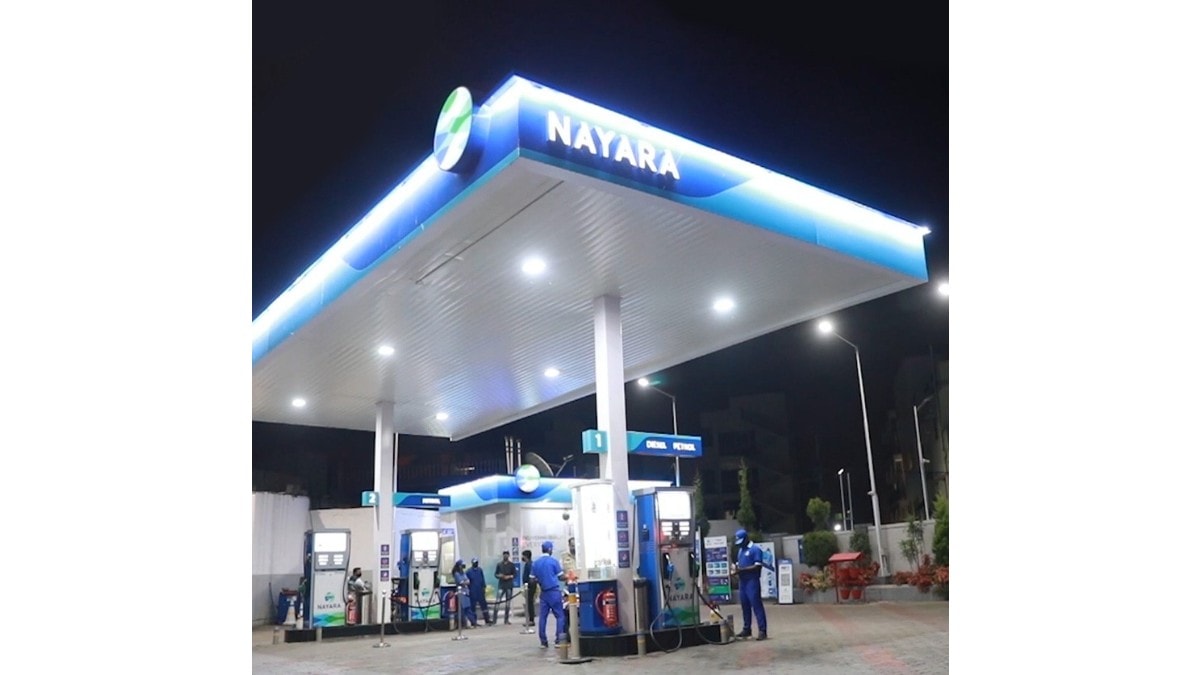
As India steadily recalibrates its oil sourcing away from Russia under growing geopolitical and trade pressure from the West, private refiner Nayara Energy is aggressively expanding its downstream footprint, preparing to add around 300 new fuel retail outlets across the country this year to strengthen margins and domestic market presence.
The move comes at a time when India’s refining sector is navigating a delicate balancing act between cheap Russian oil, shifting global diplomacy, and rising pressure to diversify crude supplies — a transition that is already reshaping procurement strategies across public and private refiners.
A senior company official, speaking on condition of anonymity, said Nayara is pushing retail growth even as it reassesses crude sourcing.
“The refinery is running at optimum utilisation. We are pushing retail growth aggressively and at the same time evaluating alternative crude sources wherever it makes commercial sense,” the official said.
Retail Sprint
According to recent data from the Petroleum Planning and Analysis Cell (PPAC), India’s fuel retail network stood at 100,266 petrol pumps as of end-November 2025, making it the third-largest globally after the United States and China.
Despite the scale, the sector remains dominated by public oil marketing companies, with over 90% of outlets operated by Indian Oil, Bharat Petroleum and Hindustan Petroleum.
Private retailers account for just 9.3% of the network — but are expanding steadily. Nayara leads the private segment with 6,921 outlets, followed by the Reliance Industries–BP joint venture with 2,114 stations and Shell India with 346 outlets.
Nayara’s planned addition of 300 pumps signals a strategic attempt to lock in downstream scale as India’s fuel market crosses a structural threshold.
However, the retail push contrasts sharply with the company’s upstream positioning.
Nayara’s Vadinar refinery in Gujarat — a nearly 400,000-barrel-per-day (bpd) facility and India’s second-largest single-site refinery — continues to operate largely on Russian crude even as most Indian refiners trim Moscow-linked purchases.
Shipping data from analytics firm Kpler show that between November 2025 and January 2026, the refinery imported over 36 million barrels of Russian oil, averaging 390,000-400,000 bpd. While inflows dipped briefly in December, they rebounded in January, underscoring how deeply embedded Russian feedstock remains in Vadinar’s operations.
Complexity of the Pivot
Industry executives say the dependence is not merely opportunistic.
The refinery is configured to process heavy, high-sulphur crude grades, making a rapid pivot to lighter Middle Eastern or African supplies costly and technically complex.
“Switching feedstock is not plug-and-play for a refinery of this scale and complexity,” said a senior refining executive. “Blending economics, logistics realignment and margin trade-offs all come into play.”
Nayara’s ownership structure further complicates its position. The company is majority-owned by Rosneft, leaving it more exposed than peers to sanctions-linked challenges in shipping insurance, financing and trade flows.
Queries sent to Nayara Energy remained unanswered till the time of going to press.
Meanwhile, the broader Indian refining sector is moving decisively to dilute Russian exposure. Overall Russian crude inflows into India have already eased from nearly 2 million bpd last year to about 1.2 million bpd in January, according to Kpler, with refiners increasing purchases from the Middle East, Africa and South America — including recent Venezuelan cargoes by public sector firms.
“For Nayara, the strategy now appears two-track: preserve refinery throughput anchored on Russian barrels while rapidly scaling fuel retail to secure stable domestic revenues amid upstream uncertainty,” said an energy expert.
The company is also advancing longer-term diversification through a 1.5-million-tonne-per-year ethane cracker and downstream petrochemical complex at Vadinar, aimed at tapping India’s growing chemicals demand and insulating earnings from volatile transport fuel cycles.