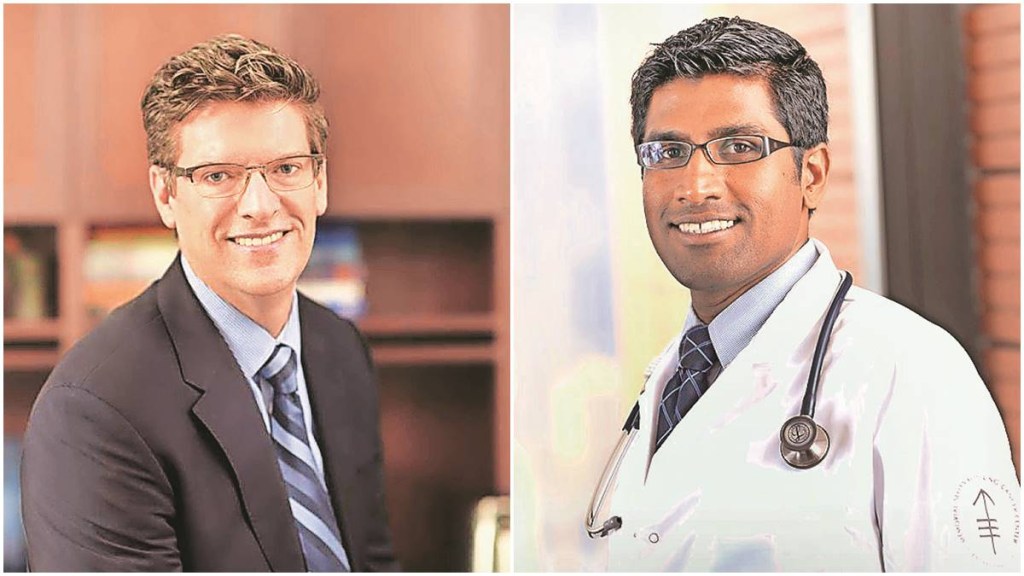
With a strong focus on next-gen technologies, New York-based Memorial Sloan Kettering Cancer Centre (MSK) brings new advances more quickly from the laboratory to patient care. In this interview, two of its senior physicians — Mrinal M. Gounder, sarcoma oncologist & early drug development specialist and physician ambassador to India and Asia and Peter D. Stetson, chief health informatics officer and hospitalist — spoke to Sudhir Chowdhary on MSK’s digital strategy and the latest advances in cancer research, detection and treatment.
What are some of the new technologies that are used to detect or treat cancer?
Gounder: The biggest technological revolution that is happening in cancer care is the ability to rapidly sequence the DNA of each cancer and use this information to tailor precise therapies for each patient. MSK developed MSK IMPACT – a next generation, DNA sequencing test and the first test approved by the Food and Drug Administration (FDA) for routine clinical use. We can now rapidly check for mutations in the cancer with the goal of choosing the right drug for each cancer patient. Further, we are exploring how to take this to the next level by leveraging the technology to identify people who are at an increased risk of developing cancers through blood tests called germline testing. We are finding that as high as 20% of patients with cancer may be born with a gene that predisposes them to cancer.
Tell us about your area of expertise – sarcoma of soft tissue and bone. How have these cancers traditionally been treated and how are new treatments based on new technologies making a difference?
Gounder: Sarcomas represent hundreds of different cancers and treatments include surgery, radiation, chemotherapies and/or targeted therapies. Their diagnosis can be very challenging, because they are rare cancers.
MSK led an international study of more than 7,000 patients who underwent genomic mapping and we found that these tests help rectify or refine initial diagnosis in nearly one in 10 patients with sarcomas. We offer MSK IMPACT and MSK-ACCESS, a comprehensive liquid biopsy test that offers noninvasive cancer genomic profiling and disease monitoring, to our sarcoma patients for precise diagnosis that then informs precise prognosis and tailored treatments.
Additionally, MSK is a pioneer in CAR-T cell therapies and currently leading clinical trials with engineered immune cells – where a patients’ immune cells are removed, gene edited to improve recognition of cancer, and re-injected to the patient.
How is AI being used in cancer research?
Stetson: AI in oncology is getting actively explored in cancer detection, early drug development, tumour evolution prediction, and clinical trials matching. It is being explored at all levels of cancer biology from subcellular to population level analyses. It is an exciting time. On a more mundane but critical foundational level, AI has the potential to enrich the very datasets used to develop AI/ML models.
Both oncologic treatment and research are considered poor data environments. What are your thoughts on this?
Stetson: It is true that access to high-quality data is an ongoing challenge to the promise of AI/ML model development. Therefore, it is critical that organisations develop strategies as part of their AI programs to allocate incremental resources to clinical and operational data enrichment. More specifically, it is critical to develop gold-standard training sets that support model training and validation. The great news is that the modern AI/ML tools that are emerging today can be part of the solution to this very constraint — tagging and linking data can be done via augmented intelligence with human expert curation in the loop, thus enabling scaling what was once too manual to a full-blown production capability.
Can AI, nanotech make cancer treatment affordable for all?
Stetson: AI-enabled front and back-office capabilities have the potential to unlock knowledge workers and reduce the cost of care as well as cost of research. This then has the potential to significantly improve the value of care and research in oncology, to the direct benefit of the patients we treat at MSK. By virtue of this cost-containment through automation, we have the potential to get the care and trials to all patients who deserve access to them.