



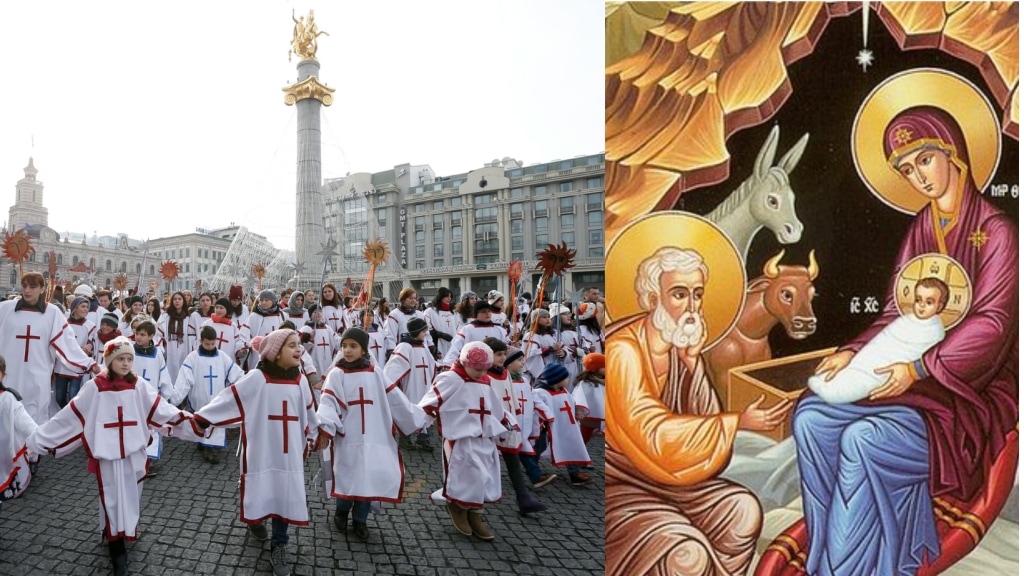
By the time January arrives, most of the world has moved on from Christmas. Trees are packed away, schools have reopened, and festive food is only a memory. But for millions of Christians around the world, Christmas is only just beginning.
On January 7, churches fill up again, homes glow with candles, and families gather to celebrate the birth of Jesus Christ. This is Orthodox Christmas, observed by around 250 million Christians, mainly in Eastern Europe, Africa, and the Middle East.
What is Orthodox Christmas?
Orthodox Christians do not believe Jesus was born on a different day. The reason for the later celebration lies in the calendar they follow. Most of the modern world uses the Gregorian calendar, introduced in 1582. However, many Orthodox churches still follow the Julian calendar, which dates back to 46 BC, when Roman ruler Julius Caesar reformed the calendar system. At the time, the Julian calendar was considered advanced.
It measured a year based on the Earth’s movement around the Sun. But there was a small mistake, it overestimated the length of the solar year by about 11 minutes. Over centuries, those minutes added up.
Because of this miscalculation, the Julian calendar slowly drifted out of sync with the seasons. By the 16th century, the gap had grown too large to ignore. In 1582, Pope Gregory XIII introduced the Gregorian calendar, which corrected the error. To fix the problem, 10 days were skipped overnight.
The new calendar was far more accurate, losing just one day every 3,236 years, compared to one day every 128 years under the Julian system. While most countries adopted the Gregorian calendar, many Orthodox churches chose to keep the Julian calendar to preserve tradition. Today, the Julian calendar is 13 days behind, which means December 25 on the Julian calendar falls on January 7 on the Gregorian one.
Importance of Orthodox Christmas
For Orthodox Christians, January 7 is not a delayed celebration, it is Christmas Day itself. Communities across Russia, Serbia, Georgia, Egypt, Ethiopia, Eritrea, and parts of the Middle East, including Palestine, mark this day with deep religious devotion.
The Russian Orthodox Church, the largest Orthodox body, continues to follow this tradition. In some countries, both dates are officially recognised. Belarus and Moldova celebrate Christmas on both December 25 and January 7.
How is Orthodox Christmas celebrated?
If Orthodox churches continue using the Julian calendar, Christmas will eventually shift again. In the year 2101, Orthodox Christmas will fall on January 8, as the gap between the two calendars increases from 13 to 14 days. Orthodox Christmas is not just about one day, it is the end of a long spiritual journey.
All Orthodox Christians observe a 40-day fasting period before Christmas. During this time, meat is avoided, and the focus is on prayer, simplicity, and self-discipline. After Christmas Eve mass on January 6, families gather for a large feast, marking the joyful end of the fast.
In Ukrainian and Russian Orthodox traditions, Christmas Eve dinner includes 12 dishes, symbolising the 12 apostles. These dishes are usually meat-free and can include cabbage soup, vegetable stews, baked apples, bread, and grains.
One of the most important foods is kutia, made from wheat or grains mixed with honey and poppy seeds. It represents family unity, hope, and a good harvest in the coming year. Homes are also decorated with a didukh, a sheaf of wheat brought in from the autumn harvest, symbolising gratitude and remembrance of ancestors.