



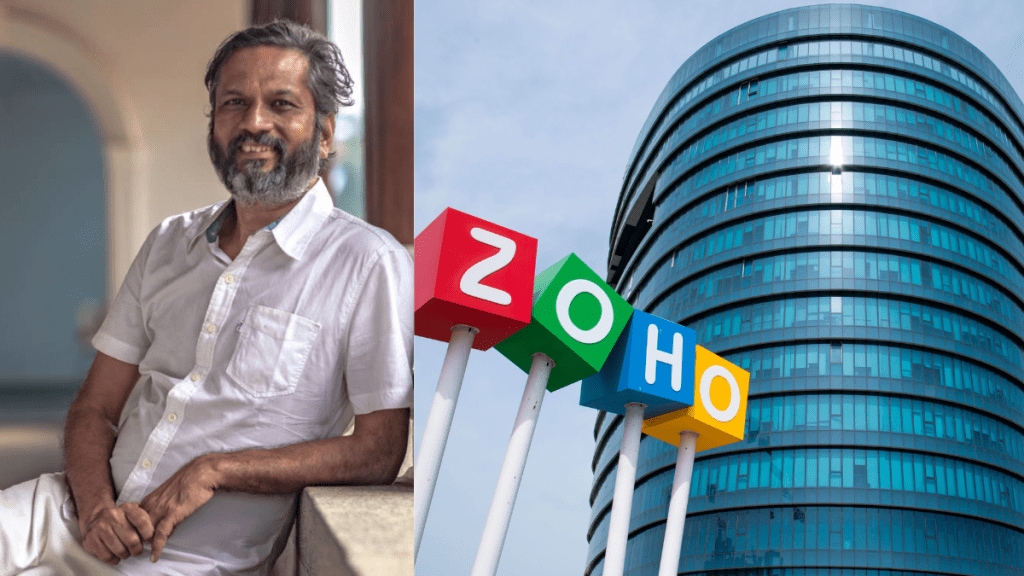
Zoho Corporation today is a name businesses across the world recognise. From startups to large enterprises, millions rely on Zoho’s software to run their daily operations.
Founded in 1996, Zoho builds cloud-based business tools ranging from email and CRM to finance, HR, and project management. With over 55 software products, operations across continents, and a strong presence in the US, its largest market, Zoho has grown into a global SaaS powerhouse. Yet, at its heart, the company remains deeply Indian, proudly saying, “Made in India. Made for the world.”
What makes Zoho different?
What makes Zoho’s story remarkable is not just its scale or revenue, but the philosophy of its founder, Sridhar Vembu. A Princeton graduate, Vembu never believed success had to follow the Silicon Valley playbook. To him, chasing customer satisfaction mattered more than chasing investors. Building sustainable, profitable businesses without venture capital was not a risk, it was freedom.
The journey began as AdventNet, a network management company founded by Sridhar’s brothers Kumar and Shekhar, along with Tony Thomas.
The technology was strong, sales were weak. At the time, Sridhar was in the US and not deeply involved. But when his brothers asked him to step in and lead sales, he agreed, printing business cards, calling himself VP of Marketing and Business Development, and learning on the job.
Sridhar managed to sign big US clients, but at low margins. Still, the company survived by reinvesting every rupee back into product development instead of paying themselves salaries. By 1998, AdventNet crossed $1 million in revenue and finally began to stabilise.
Turning point of the company
In 1999, the company crossed $10 million in revenue, Sridhar became CEO, and a $10 million venture capital offer at a $140 million valuation was rejected. Then came the dot-com crash of 2000.
Companies collapsed overnight, clients stopped paying, and fear gripped the tech world. Zoho survived because it had cash in the bank, no investors to answer to, and low operating costs driven by its India-based workforce.
In 2002, Zoho launched ManageEngine, an IT management software that would become a major revenue driver. But behind the scenes, disagreements over strategy led to a painful split.
Sridhar’s brothers and Tony Thomas exited the company. Sridhar was left alone at the top. It was a turning point that could have broken the company.
The birth of Zoho cloud
Instead of retreating, Sridhar doubled down. In 2005, he launched a cloud software division called Zoho. The idea was bold, build an entire suite of business applications, word processors, spreadsheets, CRM, and more all online.
As the cloud wave gained momentum, Zoho kept adding products, slowly building a tightly integrated ecosystem. By 2008, Zoho had crossed one million users.
That year, AdventNet was officially renamed Zoho Corporation, which led to a complete shift to cloud-first thinking. The company embraced the SaaS subscription model, making enterprise-grade software affordable for small and medium businesses worldwide.
As Zoho scaled, a serious challenge emerged. Hiring top engineers in the US would destroy Zoho’s low-cost model. India, meanwhile, lacked enough industry-ready talent. Sridhar’s solution was not to complain, it was to build his own system.
Zoho University, later renamed Zoho Schools of Learning, was launched as a free, two-year program for students from rural India. No fees. A monthly stipend. Training in English, maths, and computer science. And a guaranteed job at Zoho after completion. The results were transformative.
Thousands of young people found tech careers, including Abdul Alim, who rose from being a security guard to a software engineer. Today, a large portion of Zoho’s 10,000+ employees come through this program.
Perhaps the most radical part of Zoho’s story is where it operates from. Sridhar chose to move away from cities, running the company from a remote village in Tamil Nadu, nearly 300 miles from the nearest major city. He believes village offices are the future of work, places where talent can thrive without the pressures and costs of urban life.
Zoho’s product suite expanded rapidly, covering CRM, email, finance, HR, collaboration, and more. The company crossed $1 billion in revenue, registering a sharp jump since 2020.
In FY23 alone, Zoho reported consolidated revenue of Rs 8,703 crore and net profits of Rs. 2,836 crore, even as the global software industry slowed.
Zoho today ranks among India’s most valuable unlisted companies. With a valuation of over Rs. 1 lakh crore, it stands alongside Zerodha as a symbol of India’s bootstrapped success.
US contributes nearly half of Zoho’s revenue, which shows its global reach. Sridhar Vembu has since stepped down as CEO to focus on deep research as Chief Scientist, once again choosing long-term thinking over titles.
Vembu’s journey proves that world-class companies don’t need Silicon Valley addresses or billions in funding. They need conviction, patience, and relentless focus on customers.