



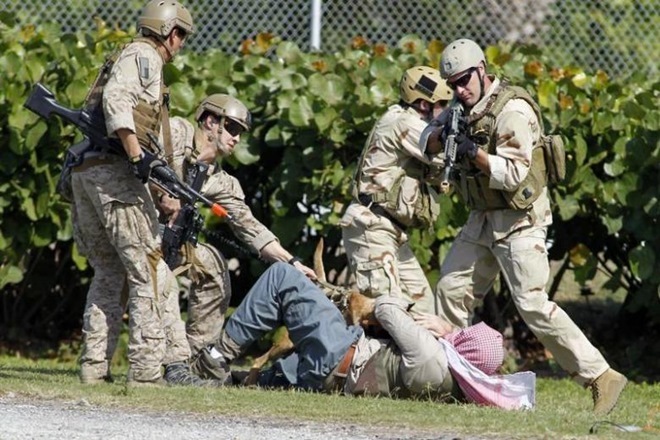
In an act straight out of top Hollywood war flicks, US Navy’s “Sea, Air, and Land” Teams popularly known as the Navy SEALs, have conducted a deadly pre-dawn raid on the al-Qaeda militant group in Yemen. The raid, which a defense official said was planned by the Barack Obama administration but authorized by Donald Trump, could signal a new escalation against extremist groups in Yemen. The US military has said 14 militants were killed in the raid in Al Bayda province on al-Qaeda in the Arabian Peninsula (AQAP). Medics at the scene, however, have said around 30 people, including 10 women and children, were killed. A US Navy Seal was also killed in the raid, the first military operation authorised by Donald Trump as commander in chief. Notably, It was the Navy Seals set up which had killed dreaded Al Qaeda chief Osama Bin Laden.
The American elite forces did not seize any militants or take any prisoners offsite, but White House spokesman Sean Spicer said on Wednesday the raid yielded benefits. “Knowing that we killed an estimated 14 AQAP members and that we gathered an unbelievable amount of intelligence that will prevent the potential deaths or attacks on American soil – is something that I think most service members understand, that that’s why they joined the service,” Spicer said.
Watch this video
A senior leader in Yemen’s al Qaeda branch, Abdulraoof al-Dhahab, and other militants were killed in the gunbattle, al Qaeda said. One of the three US officials said on-the-ground surveillance of the compound was “minimal, at best.” “The decision was made … to leave it to the incoming administration, partly in the hope that more and better intelligence could be collected,” the official said.
Trump approved his first covert counter-terrorism operation without sufficient intelligence, ground support, or adequate backup preparations, according to Reuters report. As a result, three officials said, the attacking Seal team found itself dropping onto a reinforced al-Qaeda compound defended by landmines, snipers, and a larger than expected contingent of heavily armed Islamist extremists. White House officials were not immediately available to comment about the officials’ characterisation of the raid, Reuters said.
Watch this video
As Sunday’s firefight intensified, the raiders called in Marine helicopter gunships and Harrier jump jets, and then two MV-22 Osprey vertical takeoff and landing aircraft to extract the SEALs. One of the two suffered engine failure, two of the officials said, and hit the ground so hard that two crew members were injured, and one of the Marine jets had to launch a precision-guided bomb to destroy it.
All three officials said “a brutal firefight” took the lives of William “Ryan” Owens and at least 15 Yemeni women and children. One of the dead was the eight-year-old daughter of the late militant Anwar al-Awlaki, who was killed by a 2011 US drone strike. Some of the women were firing at the US force, Pentagon spokesman Captain Jeff Davis told reporters. Trump travelled to Dover Air Force Base in Delaware in an unexpected visit to meet with Owens’ family. The remains of the serviceman, reportedly a member of Seal Team 6, were sent to Dover, home to the largest US military mortuary. Most of the visit was closed to the media.
Read US Central Command’s statement on Yemen raid
A team designated by the operational task force commander has concluded regrettably that civilian non-combatants were likely killed in the midst of a firefight during a raid in Yemen Jan. 29. Casualties may include children. The ongoing credibility assessment seeks to determine if there were any still-undetected civilian casualties in the ferocious firefight that also claimed the life of Navy Seal Team Chief Special Warfare Operator William “Ryan” Owens and wounded three other U.S. service members.
The known possible civilian casualties appear to have been potentially caught up in aerial gunfire that was called in to assist U.S. forces in contact against a determined enemy that included armed women firing from prepared fighting positions, and U.S. special operations members receiving fire from all sides to include houses and other buildings. This complex situation included small arms fire, hand grenades and close air support fire. Analysts are carefully assessing whether additional non-combatant civilians that were not visible to the assault force at the time were mixed in with combatants.
The raid resulted in the seizure of materials and information that is yielding valuable intelligence to help partner nations deter and prevent future terror attacks in Yemen and across the world. “Al-Qa’ida in the Arabian Peninsula has a horrifying history of hiding women and children within militant operating areas and terrorist camps, and continuously shows a callous disregard for innocent lives,” said Col. John J. Thomas, U.S. Central Command spokesman. “That’s what makes cases like these so especially tragic.”
(With agency inputs)