



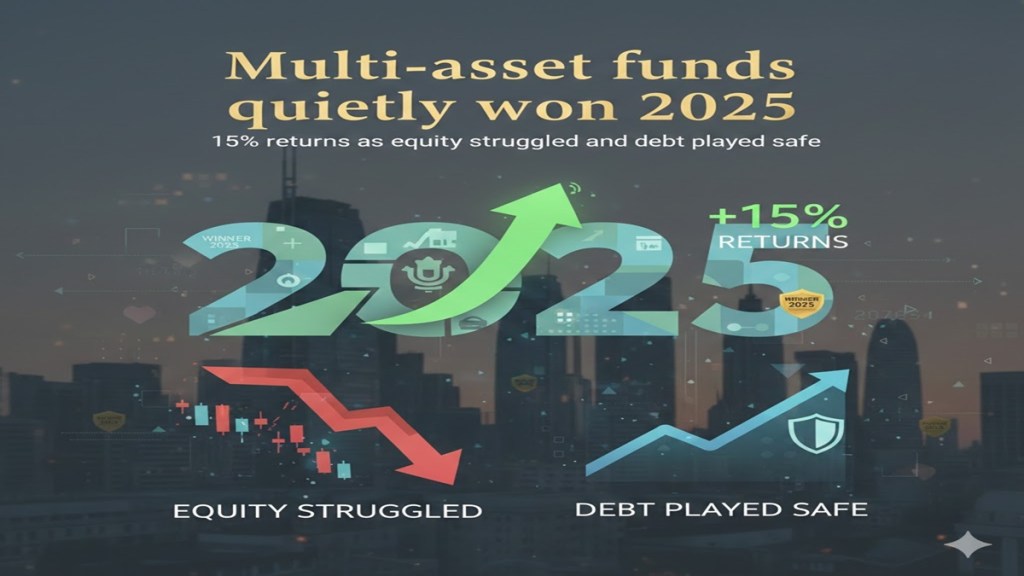
As 2025 is about to end, most mutual fund investors would be asking a simple question: What actually worked this year? 2025 has been a year marked by sharp market swings, sell-offs, prolonged periods of uncertainty and then a decent recovery in the last quarter of the year. Equity mutual funds—especially mid- and small-cap schemes—struggled to stay afloat amid relentless volatility, while debt funds offered some stability but limited upside. In the middle of this chaos, multi-asset allocation funds quietly did their job and did it well.
Multi-asset allocation funds emerged as the clear winner among mutual fund categories in 2025 (as of December 15), delivering around 15% year-to-date (YTD) returns. This performance stands out not just because of the returns, but because it came in a year when most investors found it difficult to stay invested with confidence.
A turbulent year for most subcategories of equity funds
The challenges for equity investors in 2025 were many. Fresh US tariff hikes and protectionist trade measures hurt export-linked sectors such as IT, pharma, metals and chemicals, especially during February–April. At the same time, uncertainty over US Federal Reserve rate cuts kept investors away from risk assets through Q1 and early Q2.
Persistent foreign institutional investor (FII) selling between January and May, rising crude oil prices and geopolitical tensions added further pressure on Indian equities. The biggest blow came from a sharp correction in mid-cap and small-cap stocks during March–April, with many stocks falling 30–45% from their peaks.
The impact was clearly reflected in mutual fund returns. Large-cap funds managed just about 8% YTD, while popular categories like flexi-cap, ELSS, multi-cap and large & mid-cap funds remained stuck in the 1–3% range. Mid-cap and small-cap funds are all set to end the year in mild gain to negative territory, making 2025 a tough year for investors who chased high-growth themes.
Even thematic and sectoral funds, which had been star performers in previous years, struggled to deliver. Themes such as infrastructure, PSU, technology and consumption remained flat or negative for most of the year. Only a few pockets—like international equity funds and select sectoral categories such as banking and auto & transportation—managed relatively better returns, but still could not match the consistency of multi-asset allocation funds.
Why multi-asset allocation funds stood out
Against this backdrop, multi-asset allocation funds quietly stood apart. While equities swung wildly and debt remained subdued, these funds benefited from their built-in diversification.
The equity portion allowed participation in market rallies. The debt allocation helped contain volatility during sharp corrections. And crucially, exposure to gold and silver—both strong performers in 2025—helped cushion downside and lift overall returns.
It is worth noting that gold and silver funds themselves delivered exceptional gains this year, as investors globally sought safety amid tariff tensions, geopolitical risks and volatile equity markets. Gold funds clocked 71.56% returns YTD, while silver funds witnessed a whopping 120% jump in returns so far in 2025.
Central banks continued aggressive gold buying, while silver benefited from both safe-haven demand and strong industrial usage in areas such as solar and electric vehicles. However, for this year-end comparison, commodities have been kept out to ensure a like-for-like comparison across mutual fund categories.
Even then, multi-asset allocation funds clearly outperformed most equity, hybrid and debt categories, proving their strength in a difficult market environment.
Strong one-year returns and low costs
The category’s resilience is also visible at the scheme level. Several multi-asset allocation funds delivered strong one-year returns in the 17–20% range, with top performers including:
DSP Multi Asset Allocation Fund (Direct Plan): 20.19%
Mahindra Manulife Multi Asset Allocation Fund (Direct Plan): 18.70%
Sundaram Multi Asset Allocation Fund (Direct Plan): 17.27%
WhiteOak Capital Multi Asset Allocation Fund (Direct Plan): 17.04%
Kotak Multi Asset Allocation Fund (Direct Plan): 16.85%
Another positive is cost. Most leading multi-asset funds have expense ratios below 0.5%, with some as low as 0.23%, making them relatively economical options for long-term investors.
Investors followed the performance
Investor behaviour in 2025 reflects growing confidence in the category. Multi-asset allocation funds witnessed steady and rising inflows throughout the year:
January–March: Rs 6,021 crore
April–June: Rs 8,242 crore
July–September: Rs 14,707 crore
October: Rs 5,344 crore
November: Rs 5,315 crore
Taken together, multi-asset allocation funds saw total net inflows of around Rs 39,630 crore during 2025 (January to November). This strong flow of money—nearly Rs 40,000 crore in just 11 months—highlights how investors steadily increased allocations to the category as equity volatility persisted through the year.
The bulk of inflows came in the second half of 2025, indicating a clear shift in investor preference towards diversified, lower-volatility strategies as market uncertainty deepened.
This strong demand led to a 55% year-on-year jump in assets under management (AUM) for the category, taking total AUM to around Rs 1.57 lakh crore by the end of November 2025. In comparison, the overall mutual fund industry saw a 19% rise in AUM over the same period, from Rs 68 lakh crore to nearly Rs 81 lakh crore.
How multi-asset allocation funds work
Many investors hold separate equity, debt and gold funds but struggle to rebalance them when markets move sharply. Multi-asset allocation funds simplify this process within a single scheme.
By regulation, these funds invest in at least three asset classes, with a minimum 10% allocation to each. Most follow a structured approach, typically maintaining:
Equity for long-term growth
Debt for stability and income
Gold for diversification and downside protection
Fund managers rebalance portfolios within defined ranges, trimming assets that have run up sharply and adding to those that have corrected. This rules-based approach helps investors stay disciplined without having to time the market.
The year-end takeaway
If 2025 delivered one clear investing lesson, it is this: diversification works best when it is built into the portfolio, not added later. In a year when equities disappointed and debt offered limited returns, multi-asset allocation funds struck the right balance—delivering better YTD returns, lower volatility and rising investor trust.
As markets head into 2026 with global risks still lingering, multi-asset allocation funds have firmly established themselves as a go-to option for investors looking to grow wealth without taking excessive risk.
Returns change with cycles — stay focused on the long term
While multi-asset allocation funds delivered an impressive performance in 2025, it is important for investors to remember that past returns do not guarantee future returns.
Market conditions that favoured this category, such as strong commodity performance and equity volatility, may not play out in the same way every year.
Returns can vary across market cycles depending on asset allocation, rebalancing strategy and broader economic trends. Investors should view multi-asset funds as long-term portfolio solutions rather than short-term return chasers, align investments with their risk profile and goals, and avoid assuming that one strong year will automatically be repeated going forward.
Disclaimer: The above content is for informational purposes only. Mutual Fund investments are subject to market risks. Please consult your financial advisor before investing.