



India’s Electric Vehicle (EV) story is no longer just about selling more electric cars and scooters.
The Macro Catalyst: Why Battery Demand Will Explode 10x
The bigger opportunity is quietly shifting to batteries, components, and the supply chain behind them. A new Indian Energy Alliance report estimates that India’s EV battery demand could jump 10-fold from 20 gigawatt hour (GWh) in 2025 to 200 GWh by 2032.
That changes the scale of the opportunity completely. As battery demand rises, India is pushing to reduce its dependence on imports and build a localised ecosystem covering cells, chemicals, pack assembly, power electronics, and recycling.
Companies with manufacturing capabilities, backward integration, and exposure to battery materials are likely to be at the centre of this shift. Against this backdrop, three stocks stand out.
Each is building a different piece of India’s domestic EV battery supply chain. And as localisation becomes the industry’s next growth driver, these companies could be well-positioned to benefit from the next phase of India’s EV transition.
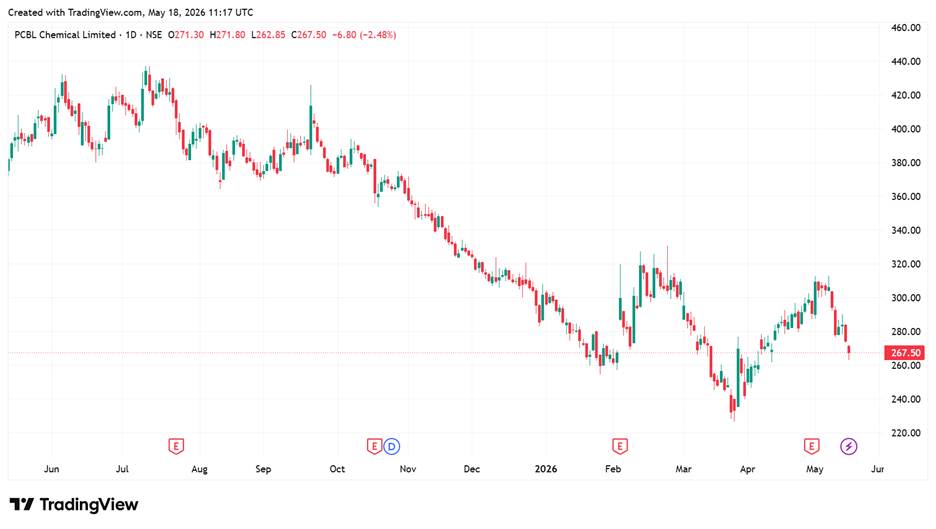
#1 PCBL Chemical: Moving Beyond Traditional Carbon Black
PCBL Chemical, a part of R P Goenka Group, is a global specialty chemical company and is the largest carbon black and specialty black producer globally. The core of PCBL’s operations is the production of various grades of carbon black, which are vital to both automotive and industrial manufacturing.
Beyond Carbon Black: Inside the Nanovace Battery Chemicals Pivot
PCBL is developing next-generation battery materials through its dedicated battery chemicals platform, Nanovace. The company is currently developing three advanced technologies for this segment: nanosilicon, conductive carbon, and acetylene black. The plant is located in Paleg, Gujarat. The company expects to commission operations within the coming weeks.
PCBL aims to complete customer qualifications within this year. Following a successful validation period, PCBL plans to construct a commercial plant with additional capacities. Management expects the company to start seeing commercial volumes from the battery segment, with ramp-up continuing through FY28.
The highly specialized materials are primarily used in Lithium-ion batteries, Energy storage and EV (Electric Vehicles) charging systems, Portable and mobile batteries, High voltage power cables, and semiconductor packaging. It is prioritising its capital investments toward it.
Securing the Moat: Patent Portfolios and Global Market Capture
The company is aggressively building a strong patent portfolio to secure its technological edge. It has secured a US patent for a proprietary nanomaterial process that enhances its energy storage IP. PCBL has filed multiple patent applications across various geographies, with some approvals already received and others remaining in process.
Simultaneously, to capture this market, PCBL has expanded its business development teams in key markets globally, mainly strengthening its footprint in Europe and South Korea. The company is already engaging with major battery manufacturers to validate product properties.
It has applied for specific patents for bio-sourced carbon-silicon composites and battery-grade graphite. Management views the battery materials industry as a high-margin, high-growth segment with long-term potential.
The Fiscal Crunch: Navigating Supply Chain Headwinds and Margin Erosion
From a financial perspective, consolidated revenue declined to ₹8,190 crore in FY26 from ₹8,404 crore in FY25. EBITDA fell 22% to ₹1,081 crore, while margin fell 330 bps to 13.2%. As a result, net profit declined significantly to ₹198 crore in FY26 compared to ₹435 crore in FY25.
Supply chain disruptions, rising input costs, and other factors impacted businesses.
Nevertheless, the company expects the short-term recovery to gradually consolidate over the next 2-3 quarters, creating strong momentum for both volume growth and margin expansion. To support margin expansion, PCBL is aggressively pursuing cost and operational efficiencies. US Tariffs (if any) could pose a challenge.
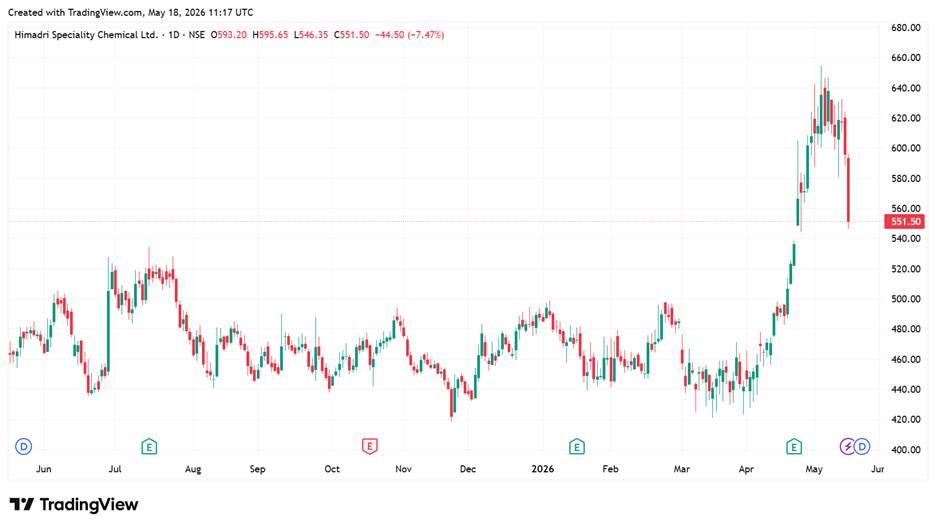
#2 Himadri Speciality Chemical: Forging a Cost-Efficient Cathode Ecosystem
Himadri Specialty focuses on high-value specialty chemicals and advanced materials. It operates across the carbon value chain, advanced material chemistry, and battery materials. The company’s traditional strengths are in coal tar processing and carbon-based chemicals.
Advanced Materials: Entering the Global Lithium-Ion Value Chain
Himadri is now entering the global lithium-ion battery value chain. In April 2026, Himadri commissioned its first commercial anode material manufacturing facility at Mahistikry, West Bengal, with an initial capacity of 200 metric tons per annum (MTPA).
The primary goal of the initial 200 MTPA capacity is to expedite the material validation process with customers. The company has already sent “Sample A” to leading domestic and global cell manufacturers. Management stated that it received encouraging responses regarding quality validation, with plans to send subsequent samples soon.
The entire process, from raw material processing to the finished anode active material, was developed fully in-house. A key differentiator is the company’s use of a high-purity coal tar pitch produced internally, the primary raw material. This backward integration provides a highly self-reliant and cost-efficient manufacturing ecosystem.
Scaling LFP Cathode Capabilities: The Phased Roadmap to FY29
Further, Himadri is establishing the world’s first commercial-scale Lithium Iron Phosphate (LFP) Cathode Active Material (CAM) manufacturing facility outside of China. Its long-term vision is to produce 200,000 MTPA of LFP CAM. This would provide around 100 gigawatt-hours (GWh) of Li-ion battery capacity, rolled out in phases over the next 5-6 years.
Phase 1 targets a total capacity of 40,000 MTPA with expected asset turnover of 2x. To ensure prudent capital deployment and maintain a robust Return on Capital Employed (ROCE), Himadri is taking a calibrated approach. The first 2,000 MTPA is targeted for commissioning by Q3FY27, with the remainder coming online progressively by FY29.
To secure the supply chain for this project, Himadri is exploring strategic interests in phosphate mines. Discussions are also ongoing with lithium miners for the supply of lithium concentrate. It has made three strategic investments to accelerate the development of battery technologies.
Technology Ecosystem: Strategic Allocations in Sikona, IBC, and Invati
Himadri invested around ₹138 crore for a 19-22% stake in Sikona Battery. It secured an exclusive technology agreement to commercialize Sikona’s silicon-carbon anode technology in India. Sikona’s materials offer a 20% increase in energy density compared to conventional graphite cells and reduce charging times by over 40%.
Capacity expansion at Sikona’s pilot plant is underway and is expected to be completed by Q2FY27. Further, Himadri acquired a 17.3% stake in International Battery Company (IBC), a US-based developer of prismatic lithium-ion cells. IBC operates a 50 MWh facility in South Korea and is developing a Gigafactory in Bengaluru (with Mahanagar Gas).
The plant is targeted for commercialisation by Q4FY27. This partnership allows Himadri to test and validate its LFP cathode and anode materials in real-world commercial cells. Another acquisition of Invati (40% stake) focuses on engineering new lithium-ion electrode materials to achieve higher energy density and longer battery life.
Financial Performance: Operational Efficiencies Offset Flat Revenue
From a financial perspective, revenue was flat at ₹4,661 crore in FY26, up 1% year-on-year. However, operating profitability strengthened. EBITDA rose 19% to ₹1,006 crore, while margin expanded by 322 bps to 21.6%. Net profit increased by 36% to ₹755 crore in FY26.
Focusing on high-value-added products has improved operational efficiency and positively impacted the business.
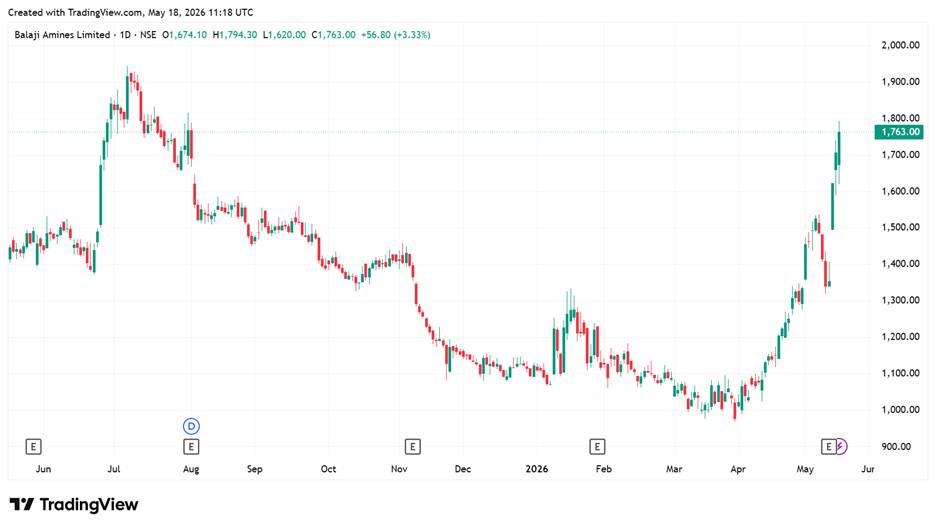
#3 Balaji Amines: Establishing Near-Monopoly on Additive Chemistry
Balaji Amines is well-positioned to meet the needs of the rapidly growing EV battery industry by supplying electronic-grade chemicals. The company has configured its manufacturing facility to produce several critical chemical components specifically designed for EV batteries.
Balaji has invested in new equipment for its existing Electronic-Grade Dimethyl Carbonate (DMC) plant specifically to manufacture electronic-grade DMC for EV batteries. This upgraded facility was successfully commissioned on 28 May 2025.
Monopolizing DMC: Serving India’s Domestic EV Value Chain
Notably, the company is currently the only manufacturer of DMC in India, boasting a substantial installed capacity of 15,000 MTPA. It is equipped to produce electronic-grade Tri-Ethyl Amine (TEA), a crucial chemical used in the EV battery industry. In addition, Balaji supplies the electronic-grade N-Methyl-Pyrrolidone.
Management anticipates big future potential and strong market demand for these products in the coming years. By investing in these electronic-grade fuel additives and EV battery chemicals, it aims to be a front-runner and primary supplier for this fast-growing industry.
Capacity Infrastructure: The DME and Acetonitrile Roadmaps for FY27
Beyond battery chemicals, the company is setting up a substantial new plant with a capacity of 1,00,000 TPA. DME is a new-age gas that can act as a direct replacement for LPG in industrial, commercial, and fuel applications, as well as an aerosol propellant. This plant is currently under erection and is expected to be commissioned in Q1FY27.
A dedicated manufacturing facility for N-methylmorpholine (NMM) with a capacity of 5,000 TPA is currently under construction. This plant will primarily supply the pharmaceutical and oil and gas sectors and is expected to be operational in FY27. An Acetonitrile plant with 9,000 TPA capacity (bringing the total to 18,000 TPA) is expected to go live in Q2FY27.
Apart from this, Balaji Speciality Chemicals is carrying out an expansion project worth ₹750 crore in Maharashtra. Phase one (Unit I) is expected to be commissioned in H1FY27. Phase one (Unit II) is slated for commissioning by Q4FY27.
Financial Review: Value-Added Derivatives Protect Operating Margins
From a financial perspective, revenue grew by around 2% year-on-year to ₹1,454 crore in FY26. EBITDA rose 11% to ₹294 crore, while margin expanded by 174 bps to 20.2%. Net profit grew by 7% to ₹169 crore in FY26. Focusing on high-value derivatives and specialty chemicals to move up the value chain has sustained healthy margins and profitability.
Evaluating the Financial Landscape: Return Profiles and Multiples Compared
In the carbon black industry, Himadri Speciality’s return ratios, including return on capital employed (ROCE) and return on equity (ROE), are the strongest. while PCBL’s return profile remains muted with an ROCE of 7.8% and an estimated ROE of 5.6%
Valuation-wise, Balaji and PCBL both are now trading at a premium to both the industry and 5-year historical median. While Himadri is trading in line with its historical median, it trades at a discount to the industry.
| Valuation Comparison (X) | |||||
| Price-to-Earnings Multiple | Return Ratios | ||||
| Company | Company | 5Y Median | Industry | ROCE (%) | ROE (%) |
| Balaji Amines | 34.2 | 29.2 | 28.2 | 11.0 | 8.6 |
| Himadri Speciality | 37.0 | 37.2 | 45.1 | 22.2 | 17.8 |
| PCBL Chemicals | 50.2 | 18.4 | 7.8 | 5.6 | |
Localisation could be the biggest theme as EV battery demand is expected to rise from 20 GWh in 2025 to nearly 200 GWh by 2032. PCBL, Himadri, and Balaji Amines are each positioning themselves at different points in this value chain.
This becomes even more critical considering the ambition of reducing dependence on imports and strengthening its EV manufacturing ecosystem. But they are still in the early stages, and it’s yet to be seen how their commercialization pans out. But it’s worth keeping these stocks on your watchlist.
Disclaimer
Note: Throughout this article, we have relied on data from http://www.Screener.in and the company’s investor presentation. Only in cases where the data were unavailable have we used an alternative, widely accepted, and widely used source of information.
The purpose of this article is only to share interesting charts, data points, and thought-provoking opinions. It is NOT a recommendation. If you wish to consider an investment, you are strongly advised to consult your advisor. This article is strictly for educational purposes only.
About the Author: Madhvendra has been deeply immersed in the equity markets for over seven years, combining his passion for investing with his expertise in financial writing. With a knack for simplifying complex concepts, he enjoys sharing his honest perspectives on startups, listed Indian companies, and macroeconomic trends.
A dedicated reader and storyteller, Madhvendra thrives on uncovering insights that inspire his audience to deepen their understanding of the financial world.
Disclosure: The writer and his dependents do not hold the stocks discussed in this article. The website managers, its employee(s), and contributors/writers/authors of articles have or may have an outstanding buy or sell position or holding in the securities, options on securities, or other related investments of issuers and/or companies discussed therein. The articles’ content and data interpretation are solely the personal views of the contributors/ writers/authors. Investors must make their own investment decisions based on their specific objectives, resources, and only after consulting such independent advisors as may be necessary.