



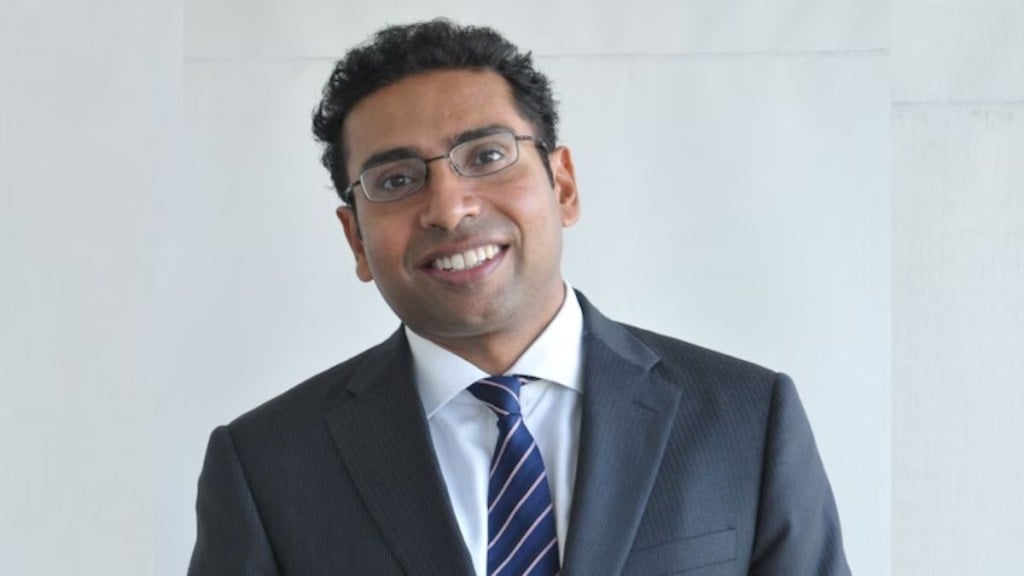
Increasing retail interest in small and mid-cap stocks is similar to what happened in Indian real estate from 2004 to 2014 when retail real estate investors had lost the sight of fundamentals, believes Saurabh Mukherjea, founder and CIO of Marcellus Investment Managers. He tell Ananya Grover in an interview that investors should increase allocation to large-caps, stop doing F&O, and consider investing globally. Excerpts:
How do you see 2025 and what is your expectations in 2026?
The GST revamp and the income tax cuts that the finance minister had announced in the Budget in February 2025 were clearly effective. Add to that the 125-bps rate cut by RBI and the real money gaming demand. There has been a discernible improvement in consumption which is being reflected in two-wheeler and small car sales.
The quarter to December in terms of Nifty earnings growth will be the first quarter after two years where we are likely to see a double-digit EPS growth. I am hopeful that in the next Budget, more income tax cuts will be announced. The RBI may cut rates by another 75-odd bps. In the absence of more interest rate cuts, we could once again go back to consumption stagnation like the one happened in the run-up to Diwali 2025.
There are challenges around consumption, which is why these stimuli are required. We need a repeat of those in 2026.
How do you see all of it playing out in stocks and how much of it is priced in?
In small- and mid-caps, almost all good news is priced in. Valuations at which small- and mid-caps are trading, I haven’t seen that in the last 20 years. So, it is difficult to believe that small- and mid-caps have got further upside on the PE multiple side.
In terms of large-cap quality, which is the playground for our consistent compounders’ product, there is room for both PE expansion and earnings growth improvements. We are seeing that in spite of the EPS growing at single digits for the last two years, our large-cap portfolio, which is quality-centric, is being able to grow earnings at 12-13%.
So, if we get more rate cuts and income tax cuts in 2026, we will see high-quality large-cap companies pushing the earnings growth into the high teens, and that should trigger a PE re-rating of these stocks.
Shift in strategy
Your AUM had fallen from what it was three years ago. What are the changes that you had to make in terms of strategy?
Our AUM is growing in the GIFT City – the global product is on track to hit Rs 500 crore early next year. Our AUM in India has shrunk, we began the year with around Rs 6,000 crore and are ending the year at around Rs 4,000 crore. The earnings growth in the global compounders’ product, in rupee terms, is north of 20%. I hope it continues to garner more AUM in 2026, given the dramatically superior earnings growth in Europe, Canada and America. Compared to India, the earnings growth is two-three times in Europe and America and valuations are half of what they are in India.
Our local products have seen outflows over the last four years. To be fair, I think all our other quality-centric competitors have also been severely punished. In a bull market, usually when the economy does really well, quality gets punished. When India gets into difficult economic times, as we have done over the last year or so, quality starts coming back into fashion. The quality revival should sustain through 2026, but for that, we need both the government and the RBI to be constructive about supporting consumption, rather than throwing more money at capex.
In 2025, what worked for the portfolios at Marcellus?
Let’s start with what hasn’t worked. I think we took a view that light industrial exporters to America will do well. So, we loaded up on manufacturing companies who have good return on capital and have successful export franchises in America. Because of Trump’s 50% tariffs, that trade hasn’t worked for us. The second view was that FMCG will do well in India. Even that trade hasn’t worked. IT services as a trade also did not work for us. What worked for us in India was financials and healthcare; we have been able to make money on hospitals, diagnostics and pharma.
On the American-European side, our team has done a tremendous job on small- and mid-caps, especially industrial companies in the developed world. Tech has worked for everybody. The third sector which worked for us is the global compounders portfolio.
Financials in 2026
What is your view on financials in 2026?
The Indian middle class is now the world’s most indebted middle class and every time I read the RBI’s Financial Stability Review, I ask myself how will they repay the debt. As per RBI data, one in four middle class families now has a home loan, car loan, multiple credit cards, multiple unsecured loans, and education loans. If you have this sort of loans, your weighted average interest rate is easily 12% and nobody that I know is getting pay hikes in double digits. So, if your interest rates are higher than your pay rises, it’s not evident to me how a big segment of the middle class will be able to repay debts. Hence, we need to temper our enthusiasm in this rate-cutting cycle with the cognizance that a big chunk of the middle class is likely to end up with debt repayment problems.
The dynamic of FII-DII ownership of Indian market has changed. Has it changed how you look at markets also?
What’s clear is that the domestic investor has an obsession for small- and mid-caps. So, their valuations have bubbled up and private equity firms and promoters are capitalizing on this by encashing and then taking their money out of the country. This is pushing the rupee lower. If the rupee keeps falling, the foreign investor stays away. So, unless Trump signs a trade deal with India sooner rather than later, I think this dynamic will keep pushing the rupee lower.
Do you think big announcements on markets did not have the usual impact because of this?
What is happening in the Indian stock market is very similar to what happened in the domestic housing market from 2004 to 2014 – retail real estate investors had lost all sight of fundamentals and lost themselves in a false narrative. They put more money in because their friends had put money in and prices had gone up; the rise in prices then persuaded more middle-class people to invest in real estate. Then in 2014, when the government changed, people realized that real estate is crazily overpriced. And for seven years, there was no movement in real estate prices across most large cities. I think we are likely to go through a similar cycle in Indian equities.
At the moment, I don’t think there’s that much thinking going on among retail investors as they pile into small and mid-caps on the back of false narratives. Some sort of catalyst will be required for retail investors to become more conscious of the risks they are taking.
What would be your advice to investors?
You need to lower your allocation to small- and mid-caps and increase that to large-caps. Secondly, one should stop doing the F&O trading. Thirdly, given that the Indian stock market is only 4% of the world’s market cap, you should consider investing globally. Most trading apps in India are now giving global access. The Nasdaq looks expensive, but much of the rest of the Western equity market does not look expensive. For example, the S&P mid-cap is trading at 16 times forward. So consider investing at least a third of your money outside India.