



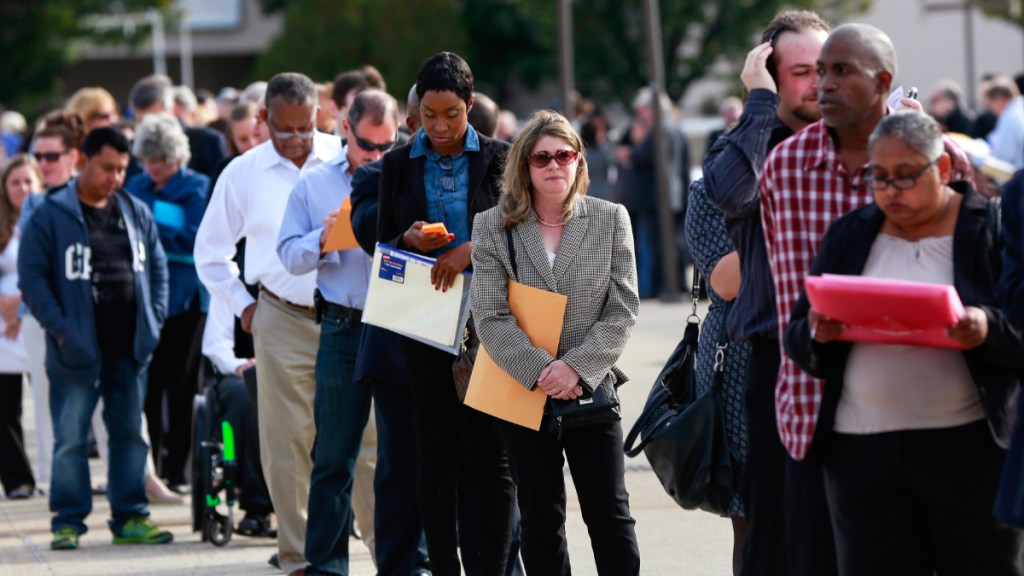
The US Bureau of Labor Statistics (BLS) will release its jobs data for the month of November on Tuesday. However, the reports is expected to be incomplete because the government shutdown led to incomplete data collection. One major piece of missing data is the unemployment rate for October, marking the first time this figure has not been reported.
Unemployment rate to clock at 4.5%, says survey report
Bloomberg survey of economists has estimated that around 50,000 jobs were added in November. The unemployment rate, as per the report, can be seen clocking in at 4.5%, which is historically low, but continues its upward climb over the past several months and hitting its highest level since 2021.
Still economists have said that the report may be confusing and unclear this time.
Daniel Zhao, chief economist at Glassdoor told BBC that government shutdowns are uncommon and when they do happen, they always lead to some kind of uncertainty.
In addition to the shutdown, job numbers for October were likely affected by more than 150,000 federal workers leaving their jobs after accepting delayed buyout offers, a Reuters report said. This was part of Trump’s effort to reduce the size of the federal government. Most of these workers were removed from government payrolls at the end of September. According to a Reuters survey, economists expect about 50,000 jobs were added in November. By comparison, job growth in September was much higher, with 119,000 new jobs reported.
No employment report for October
The shutdown, which lasted longer than any other in US history, also caused the Bureau to skip the October Consumer Price Index report.
Since the household survey could not be carried out in October, the unemployment rate for that month will not be released. This is the first time the government has missed reporting this figure since it began keeping these records in 1948. Other information normally collected from households will also be missing, such as labour force participation, how many are working part-time, how long people have been unemployed, and breakdowns by age and other groups.
Consumer price report
The Bureau of Labor Statistics normally gathers consumer price data throughout the month by visiting stores in person and making phone calls. For some price indexes, it also relies on data from other sources instead of surveys. However, the agency said it was not able to recover most of this non-survey data for October.
The BLS plans to release October 2025 figures for some price series at the same time as the November 2025 report, but only when it can do so reliably, reported Reuters. It is still deciding which data meet its standards, and expects that only a small number of price indexes will be published for October. The agency confirmed that it will not release the main inflation number or the core CPI for October, which normally excludes food and energy prices. It also said it cannot give clear advice on how users should deal with the missing October data.
Although the November inflation report will still be released, it will not show month-to-month percentage changes where October data are missing.
Goldman Sachs warned that inflation data may be more unstable because prices were collected mainly in the second half of the month. Prices often fall during that period as holiday sales begin, which could make inflation appear lower than it really is. The firm estimated this could reduce November’s core inflation by as much as 0.15 percentage points. However, because there is no October data for comparison, this effect may seem smaller when looking at two months together, and any weakness in November prices could show up as higher inflation in December instead.
US economy
According to CNN, economists have said that looking beyond the main job numbers and the unemployment rate for November may give a better picture of how the US economy is really doing. Details from the employer and household surveys can reveal important changes beneath the surface.
Dean Baker, senior economist at the Center for Economic and Policy Research, told CNN that it will be especially important to see which industries are adding or losing jobs. He said that job losses are expected to continue in industries that produce goods, while areas like health care and possibly restaurants are likely to keep adding workers.
Pay increases are also expected to slow down, which could reduce how much people are able or willing to spend in the future.
Cory Stahle, economist at the Indeed Hiring Lab told CNN that even if jobs continue to be added each month, rising unemployment or people giving up on looking for work could eventually weaken the labor market.