



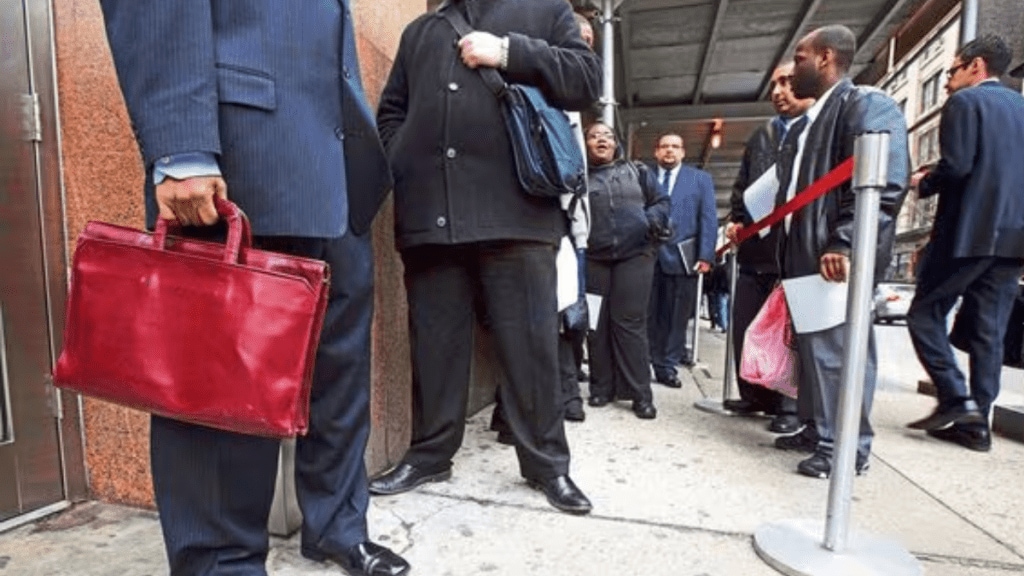
US unemployment rate rose to 4.6% in November, its highest level since 2021, as the labour market weakened amid economic uncertainty linked to President Donald Trump’s trade policies.
The higher unemployment rate came even as job growth rebounded modestly in November, following a sharp decline in October that was largely driven by government spending cuts and federal job losses.
According to the Labour Department’s Bureau of Labor Statistics (BLS), non-farm payrolls increased by 64,000 jobs in November. This followed a loss of 105,000 jobs in October, when more than 150,000 federal employees left government payrolls after accepting deferred buyouts under the Trump administration’s push to reduce the size of the federal workforce during the government shutdown.
Impact of government shutdown
Most of those workers dropped off payrolls at the end of September. Payroll figures were not affected by furloughed workers during the 43-day government shutdown, as those employees were later paid retroactively. The unemployment rate had stood at 4.4% in September. The BLS did not publish an unemployment rate for October because the shutdown prevented the collection of household survey data.
It also adjusted labour force weights due to the missing data. Ahead of the report, the BLS warned that November labour force estimates “will have slightly higher variances than usual,” adding that the weighting change “will not be needed for the December estimates, which will return to the usual composite weighting methodology.”
BLS said that twice as many new households participated in the November survey than in a typical month, others returned after a break in the middle of their enrollment period.
Hiring slows as employers turn cautious
Households’ views of the labor market worsened in November, according to economists, who say employers have become more cautious about hiring. Many businesses have pulled back because of what some describe as a shock from Trump’s sweeping import tariffs.
The duties have raised prices for many goods, forcing consumers, especially lower, and middle-income households, to cut back on spending. Federal Reserve officials last week cut the central bank’s benchmark interest rate by 25bps to a 3.5%–3.75% range, but indicated that further cuts were unlikely in the near term.
Fed Chair Jerome Powell said the labour market “seems to have significant downside risks,” referring to a preliminary benchmark revision released in September. That estimate showed 911,000 fewer jobs were created in the 12 months through March than previously reported, about 76,000 fewer jobs per month. The BLS is expected to release the final payroll benchmark revision in February, alongside January’s employment report.
Job market remains sluggish and uncertain
US economy added 64,000 jobs in November, hiring momentum has slowed sharply. Since April, job creation has averaged less than 40,000 jobs a month, and Powell has warned that future revisions could show even weaker numbers.
“It’s a labour market that seems to have significant downside risks,” Powell told reporters during the press meet after Fed rate cut announcement.
Economists say uncertainty over trade policy, high interest rates, and the growing use of artificial intelligence are all weighing on hiring decisions.
“We’ve seen a lot of the businesses that we support are stuck in that stagnant mode: ‘Are we going to hire or are we not? What can we automate? What do we need the human touch with?’” said Matt Hobbie, vice president of staffing firm HealthSkil to AP. With delayed and incomplete data due to the government shutdown, policymakers and jobseekers alike are struggling to get a clear picture of the labour market’s true health.