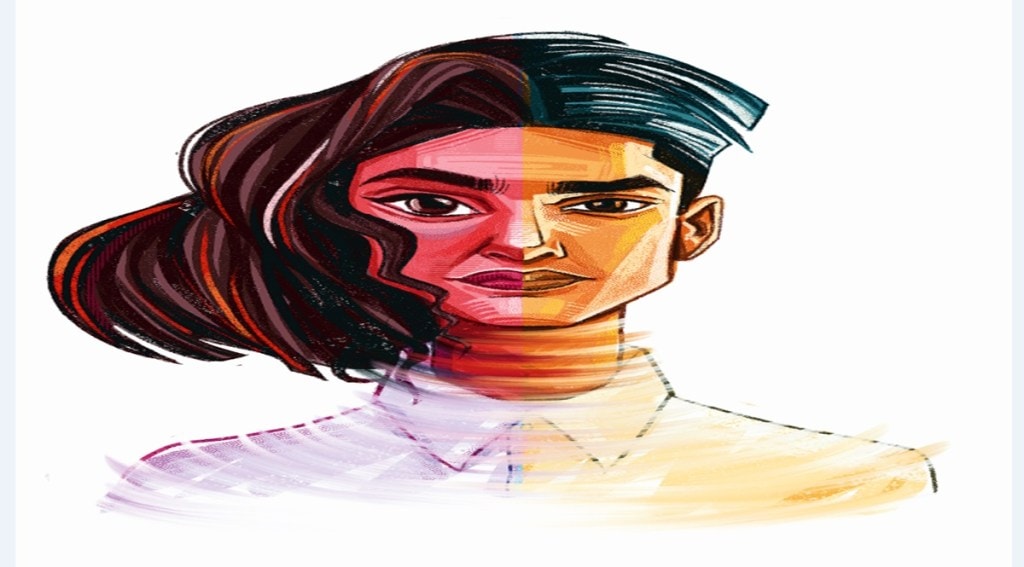
The United States became the first country in the world to issue a gender-neutral ‘X’ passport in October last year. Simply put, the passport holder can now opt for ‘X’ in the gender box which documents that a person does not want to be identified as male or female. While the US took a pioneering step, more than 10 countries, including Canada, Germany, Australia, and even India, have already moved in that direction by offering a third gender as an option on various documents, as per reports.
Last year, six-year-old US-based Teresa Manimala became a viral sensation when she indignantly questioned her mother Sonia John on why books use man-made instead of the gender-neutral ‘people made’ or ‘human made’. Elsewhere, too, there has been a gradual move away from the gender binary such as Open Barbers in the UK, a hairdressing service for all genders, and Cafe Guftagu, an inclusive cafe in Gurugram. Several fashion houses like Louis Vuitton, Gucci, Tommy Hilfiger, H&M and Zara are also positioning their brands to design clothing free from any sex categories. The idea of gender is undergoing a transformation around the world, as conversations are going beyond ‘he’ or ‘she’ to include more of ‘they’ or ‘them’. Clearly, the stereotypes and parameters set by society are gradually being slammed.
But can a world really exist as individuals beyond gender? Poet and professor Ashwani Kumar, dean, School of Development Studies, Tata Institute of Social Sciences (TISS), Mumbai, says there is nothing fixed about gender identity. “The idea of gender as a binary of male or female represents a ‘caste system or hierarchy’ with two positions: masculinity above femininity. Aristotle regarded the female as being ‘afflicted with natural defectiveness’, and Italian philosopher St Thomas Aquinas saw woman as ‘imperfect man’ and a ‘misbegotten male’. In contrast to this socially regressive concept of gender binary, people now recognise a new range of gender identities,” says Kumar.
“So, we have people referring to themselves as ‘genderqueer’ or ‘non-binary’ or ‘pangender’ or ‘polygender’. Sexual desire or gender behaviour—its fantasies are shaped by prevalent forms of oppression, dominance, or submission. Under patriarchy, gender becomes a site of politics of the body, inherently violent, and exploitative. No wonder, traditional heterosexual has become outmoded. In the emergent genderless world, sexual orientation has become non-binary, liberating us from shame, stigma, coercion, and abuse (sexual and political),” adds Kumar.
However, there are different parameters attached to one’s identity. Some people feel the decision should be made by each individual as to whether they wish to have these parameters or want to go without them. “Nobody should intervene in this decision of identity. Gender identity, fluidity, and distinctive choices are real. They cannot be termed a trend. As a society, we have understood this notion and are striking a conversation about genderless people,” says Sumit Pawar, founder and CEO of The QKnit, an LGBTQIA+ collaborative aimed to facilitate conversations about queer life in India through social media, youth leadership, and advocacy. Pawar has been working on various projects, which include Cafe Guftagu, an inclusive cafe that welcomes all genders and sexuality.
An inclusive world
Studies suggest that young people are moving away from a binary conception of gender. “Half of all millennials believe that gender exists on a spectrum and shouldn’t be limited to the categories of male and female, according to Fusion’s Massive Millennial Poll in the US. It’s no surprise then that Facebook offers more than 50 custom gender options for users who don’t identify simply as ‘male’ or ‘female’,” says Kumar of TISS.
Gender neutrality and non-branding so to speak in society is growing. It came about due to multiple factors—the courage of people who came out, awareness movements and untiring efforts of individuals and organisations, and support of the Indian judiciary. As the idea spreads, companies are also making their employment policies more inclusive. Corporate law firm Khaitan & Co celebrated the Month of Pride in 2021 and bolstered efforts with an initiative called Arise—Diversity and Inclusivity. Arva Merchant, partner, Khaitan & Co, says, “Social media has provided a platform for free speech, discussion and far outreach. Why did we think about a genderless world in the first place? Because some of us realised that acceptance and self-respect are essential to our lives. Quest for enforcement of their legal rights led to further dialogue and awareness. We do have a long way to go, however, as is evident from the petitions challenging deeply entrenched biases pending before various courts.”
For that reason, to be confined in a male/female binary system is not good. Trisha De Niyogi, COO and director, Niyogi Books, sees a genderless world where one is not stereotyped into categories or caged in gender-appropriate norms of society. “It is a sense of freedom. If I wear baggy clothes, I need not be called a ‘tomboy’. If I don’t like to cook, I should not be ostracised for not being woman-like,” says Niyogi.
Then why should gender determine destiny? All the origin stories were created by men in ancient times, whether it’s the story of Adam and Eve or Brahma’s lust for his daughter—all these stories are about women as the original temptresses responsible for the downfall of men and gods. The only exceptions are some tribal and indigenous groups, feels author and social scientist Deepa Narayan. According to Narayan, a genderless world is a reaction to the failure of education, policies, and wealth, all the factors we thought would end bias and open freedom for everyone. “Men will be great beneficiaries in a genderless world, not trapped in impossible standards of macho masculinity—always in charge, always knowing the answer, always correct, successful, powerful, and protective, earning the money. It is a fallacy to think a genderless world will benefit only women and people of other genders than cis gender men,” says Narayan.
Walking the talk
Internet and social media are the most powerful mediums to facilitate genderless talk. Merchant of Khaitan & Co feels the roots for this exchange lie in a movement which started at individual levels. “Armed with the correct tools and approach, social media can take the genderless talk to the next level. But apart from the outreach of social media, we need other platforms for spreading awareness—a holistic approach in educational institutions, more initiatives in companies and other businesses, free legal aid, art, and film media,” says Merchant.
For non-binary people, despite its limitations and toxicity, social media has become the locus of expression, experimentation, and exploration, particularly for those who cannot yet fully inhabit themselves offline for fear of discrimination or punishment. “This genderless digital construction of identity speaks in a language of inclusivity. Many US universities now accept gender-neutral pronouns—allowing students to be called ‘they’ rather than ‘he’ or ‘she’,” says Kumar of TISS.
Certain aspects of public life like permitting gender-neutral designations on various documents, inclusive texts and writings in academic institutions, audio guides or podcasts can bring a change. For instance, a group of 300 teachers in France declared not to teach ‘masculine prevails over feminine’ when it came to the plural world. Swedish teachers in 2019 started replacing the pronouns ‘him’ and ‘her’ with an artificial genderless pronoun ‘hen’, which was introduced into the country’s official dictionary.
Gender-inclusive initiatives are extending to private spaces too. Sochcast, an immersive on-demand audio content hub and production company, has collaborated with IMbesharam.com, an adult store, to produce erotic podcast “Whispers in the dark” that is tailor-made for all genders. It is an eight-episode immersive audio on a journey of sexual exploration. Each episode is a guided erotic experience and the series showcases prominent voices such as writer Annirudha Mahale, Mexican yoni practitioner and life coach Ana Gomez, and drag sensation Luna Suruj Rajkhowa. “More than normalising pleasure, we wanted to equalise it. It is performed to awaken desires with meditation and relaxation at the core of pleasure exploration and transcendence. Each episode is written and performed by artists who represent the respective community. For instance, the transgender plot is written by a proud trans woman who deep dives into the sensitivities to ensure fair representation. And this holds true for all the eight episodes. We were mindful of that. It’s time we loosen our obsession with gender codes,” feels Garima Surana, co-founder and chief business officer of Sochcast Media.
Card games that have king, queen and jack pervades sexism. As a result, Indy Mellink, a 23-year-old Dutch woman and a forensic psychology graduate, devised a genderless playing deck replacing them with gold, silver, and bronze, respectively. On the other hand, actor Ayushmann Khurrana was slammed for posting a picture with kohled eyes and black nail paint. He was counteracted with comments on gender fluidity, expression, and identity.
“Change is difficult, tongues get twisted, we stumble but we need to change. Language is a man-made creation. And we also see the opposite talk on social media, the pushback on a woman’s right to determine what she does with her body, it is still men pushing what is moral and right, whether in the USA or India,” feels social scientist Narayan.
In 2021, the Emmy Awards announced the removal of the words ‘actor’ and ‘actress’. Instead, they adopted the word ‘performer’ in order to be more gender-inclusive. The Grammys have been genderless since 2011. However, they have often been criticised for the uneven distribution between the two genders. In fact, 2018 saw #GrammysSoMale trending on social media after only male artistes won all the awards. The Collin Dictionary in 2021 included neopronoun, a recently coined pronoun designed to avoid gender distinctions.
In 2020, author JK Rowling was labelled transphobic or TERF (trans-exclusionary radical feminist) for mocking the phrase ‘people who menstruate’. US President Joe Biden was equally criticised and praised in the 2022 budget proposal for replacing the word mothers with ‘birthing people’ in a section that deals with bringing down maternal mortality rates.
And while there is talk of gender parity, its percolation down to the physical is not common, though a start has been made. With brands and accessories, this is more commonly seen. “Why should genderless people be compartmentalised into a category? Clothes should not be a factor based on which gender should be determined—women wear shirts and jeans, men are known to wear kurtas and pajamas,” says Pawar of The QKnit.
“The messaging of brands has an impact on us. Go into any kids store and ask for clothing for a child. The first question will be boy or girl? It is the same as the idea of genderless toilets. Over time what was shocking becomes normal,” says Narayan.
Gender parity or equality rules everyday conversation and, as a matter of fact, humans ‘naturally’ belong to two groups—male and female in their brains and behaviour. How does genderless apply here? Genderless world is not about denying bodily difference but about equal value, respect, not spitting on one and making the other king. “In ancient India, there were more than two genders—the myth of a binary was really imposed by the British because of their discomfort with sexuality. Men and women have a wide range of brains, there is no difference in IQ; it is mostly training that makes men and women different in behaviour. We have to retrain our minds to think that differences are good and not a threat. If we were all the same, the world would be very boring and we would all become robots,” says Narayan.
Author Tanushree Ghosh, whose book Beyond #MeToo: Ushering Women’s Era or Just Noise? explores the movement against the backdrop of feminism and gender, says, “Gender or genderless, it doesn’t need to be one versus the other. Nor is there any need to eradicate differences. But it is important to understand alternatives.”
Yet, being genderless is gradually becoming the new normal in the realm of art, literature and fashion. “Women begin to love the dapperness of a suit and metrosexual men are comfortable with painted nails and rocking skirts. New species of shoppers around the world are experimenting to abolish the ‘last gender frontiers’ with fashion brands like Louis Vuitton, Gucci, Tommy Hilfiger and others going genderless,” says Kumar.
Pink, a lingerie and apparel line by Victoria’s Secret, has added male mannequins and a small assortment of gender-neutral products to its assortment in Chicago. Marc Jacobs’s polysexual collection is called ‘Heaven’ and consists of eccentric streetwear essentials. Gucci has integrated a new wave into a separate category called ‘Gucci MX’ in ready-to-wear, handbags and luggage, shoes, and accessories. Still, major brands have a men and women category as demarcation, a market trend they follow and not give up altogether as an encouragement to express neutrality.Versace displayed its approach to gender-neutral fashion in its winter collection at the Milan fashion week in early 2020 where both male and female models wore gender-neutral clothes on the ramp, wearing suits, coats, and shorts embellished with rhinestones and animal prints. In the words of Italian fashion designer Donatella Versace, “… there is a generation that doesn’t care about gender”.