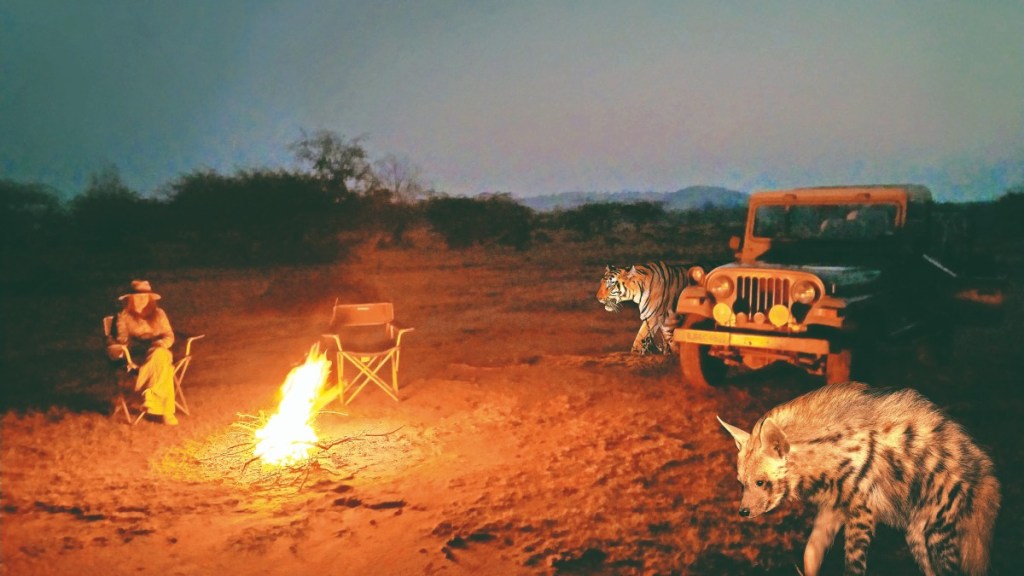
Night safaris have allured wildlife enthusiasts for a rare glimpse of the forest when its residents emerge from the dark. In India, where over 100 national parks and more than 500 wildlife sanctuaries form some of the world’s richest ecological landscapes, night-time wildlife experiences have offered mystery and excitement.
But this experience is about to change amid larger conservation concerns leading to a balance between ecological protection and experiential tourism.
A landmark shift came recently when the Supreme Court of India issued stringent directions governing tourism within tiger reserves in India. With the urgency of ecological restoration, the court ruled that night tourism must be completely banned inside tiger reserves. The bench accepted the recommendations of an expert committee appointed to examine ecological violations, stating unequivocally that “tiger safari shall not be permitted in the core or a critical tiger habitat area.”
Instead, tiger safaris, the court noted, may only be allowed in association with a full-fledged rescue and rehabilitation centre, meant for conflict, injured or abandoned tigers, and not for entertainment-driven tourism. The court reminded states that ecotourism cannot resemble mass tourism.
New eco-friendly resorts may be constructed in buffer zones but not in wildlife corridors. Community-run tourism, homestays, and local entrepreneurship, the order emphasised, should be encouraged.
Along with night tourism, the court also prohibited the use of mobile phones in core tourism zones of tiger reserves, marking a larger push to restore not just land but also the acoustic and behavioural integrity of wildlife habitats.
Global Contrast
Conservationists and naturalists have welcomed the judgment for its clarity and environmental ethos.
Amith Bangre, naturalist, conservationist and wildlife educator with two decades of experience, says the order strengthens national tiger governance by reinforcing eco-tourism principles such as low disturbance, community involvement and strict environmental controls. “The requirement to treat entire Tiger Reserves and Eco-Sensitive Zones (ESZs) as ‘silence zones’ means resorts and tourism facilities will now have to operate with much more responsibility, limiting noise, light pollution and activities that disturb wildlife,” he says.
This opinion resonates among ecologists, who argue that night-time activity such as lights, engines, and human movement, disrupts species’ feeding and breeding patterns, even when done with good intentions. While India tightens regulatory boundaries, another continent faces a different kind of scrutiny. A brand-new luxury safari camp in Kenya’s Maasai Mara, the Ritz-Carlton Maasai Mara Safari Camp, has come under criticism from Maasai leaders and wildlife experts for allegedly blocking a major wildlife corridor along the Sand River.
The lodge, which opened in August and charges around $3,500 per night, promises guests ‘front-row seats’ to the Great Migration, one of the world’s most dramatic animal movements. But critics argue the camp’s location forces wildlife to divert or turn back from established routes, potentially inviting conflict and disrupting one of nature’s most ancient patterns.
The contrast is quite sharp: while India’s Supreme Court tightens the reins on night-time tourism to protect its tiger habitats, Kenya grapples with commercial expansion into sensitive corridors, and raising questions of how luxury, wilderness, and sustainable practices intersect.
Challenge of Implementation
Despite restrictions, research suggests that night-time experiences are preferred among Indians. According to Booking.com, over 60% of travellers prefer destinations with limited light pollution as they seek dark-sky experiences and deeper connections with nature. India’s National Tiger Conservation Authority (NTCA) prohibits any kind of tourism inside core tiger areas at night, limiting activities to buffer zones. These regions, already multi-use spaces with villages and local traffic, create a delicate balancing act between community needs and conservation.
Manav Khanduja, co-founder of Pugdundee Safaris, explains the divide in conservation circles: “There is a faction of conservationists who believe that wilderness areas, especially Tiger Reserves, should be left undisturbed for a large part of the day and especially at night. On the other hand, many support the idea but in a controlled manner. In India, night safaris are only operated in buffer areas, which are multi-use areas with their own local traffic and pressures.”
Even in these buffer zones, challenges persist. In Tadoba, for instance, night safaris initially drew significant interest, but restrictions on artificial lighting have made it restricted. “With only jeep headlights, the experience became limited and most sightings depended purely on whether an animal happened to cross the road. As a result, many visitors felt disengaged and interest dropped sharply,” says Ranjit Mandal, GM of Svasara Jungle Lodge, Tadoba.
However, the Supreme Court’s judgment indicates that tiger conservation is not about preserving land, but protecting the soundscape, behavioural rhythms, and ecological equilibrium of wild spaces, especially at night, when the forest belongs to its non-human inhabitants. Now how the NTCA and state governments translate the court’s principles into detailed guidelines will shape the future of nocturnal tourism in India. As the country moves toward a more responsible eco-tourism model, the challenge remains to create experiences that inspire without intruding.