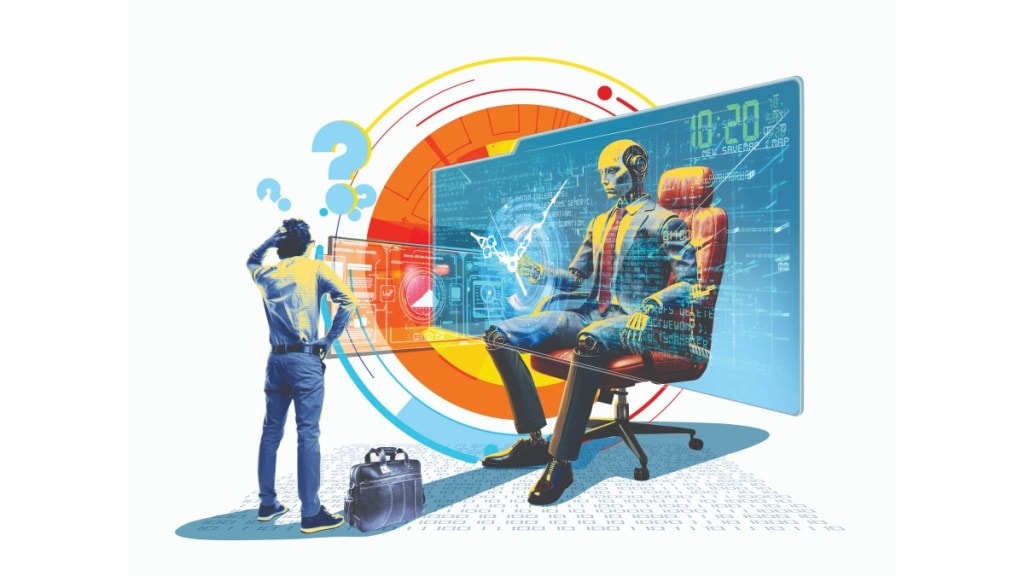
Workplaces have changed many times before, but the shift happening now feels sharper. Computers replaced typewriters. Email sped up communication. Mobile phones and messaging apps reshaped how teams stay connected. But this time, it is different. The speed and depth of change is becoming visible across industries and continents. According to the World Economic Forum’s Future of Jobs Report 2025, artificial intelligence (AI) is likely to displace 92 million jobs. The report, which surveyed 1,000 global companies, states that 86% of employers expect AI and information processing technologies to transform their businesses by 2030.
At Microsoft, this shift is visible across its core products. Copilot tools now draft emails, rewrite documents, summarise meetings and extract action points inside Word, Outlook, Excel and Teams. GitHub Copilot Workspace plans entire coding sequences across repositories, suggesting what should be built next rather than waiting for instructions.
In India, where large parts of the global technology workforce are based, that shift is being matched by investment at scale. Rajiv Kumar, president and MD of the Microsoft India Development Center, says the country is reaching a turning point in how AI is embedded into daily work. “India is entering a pivotal moment in its AI journey, defined by how deeply intelligence is being embedded into everyday work and public life,” he tells FE. “AI is moving beyond experimentation to become a foundational capability in workplaces, helping organisations reimagine productivity, decision making, and how people build new skills for the future.”
Microsoft has committed $17.5 billion over the next four years to expand cloud and AI infrastructure in India and plans to equip 20 million people with AI skills by 2030 by doubling its skilling initiatives. “Our focus is on pairing innovation with responsibility,” Kumar says, pointing to the need for both scalable infrastructure and people who can apply AI thoughtfully in daily work.
This view is shared across the technology sector. Amazon Web Services (AWS) has begun preparing customers for what it calls “frontier agents”, autonomous systems designed to run extended tasks with minimal human oversight. AWS chief executive Matt Garman says these agents could represent “the next 80% to 90% of enterprise AI value,” shifting AI from a productivity aid into a core operational layer. Inside Amazon, employees have been asked to refer to such systems as “Teammates”, signalling that they are expected to work alongside humans rather than sit in the background.
Research from International Workplace Group (IWG) suggests that this transition is already under way. AI copilots are becoming embedded in routine operations, taking over administrative, scheduling and information-retrieval tasks that once consumed large portions of the working day. More than a third of workers surveyed by IWG said the time saved through AI is already being redirected toward creative work, learning and collaboration, indicating that automation is reshaping not just productivity but how time itself is allocated inside organisations.
“We will continue to see a fundamental shift in the geography of work with the centre of gravity moving towards local communities. The remarkable advances in cloud technology and videoconferencing software—both vital to enabling effective hybrid working—mean workers no longer need to travel long distances on a daily basis,” says Mark Dixon, founder and CEO, IWG.
New operating layer
AI adoption is expanding beyond traditional enterprise software. In November 2025, OpenAI said it had reached 1 million paying business customers across more than 150 countries using ChatGPT for Work or its developer platform. India ranked among the top markets. The way people use ChatGPT has also changed. OpenAI researchers found that 47% of consumer ChatGPT messages were work-related in June 2024, but that share fell to 27% a year later as personal use surged. “Non-work messages have grown faster and now represent more than 70% of all consumer ChatGPT messages,” the researchers write, noting that AI’s impact outside paid work is now comparable in scale.
Microsoft has widened access to its own tools as well. After launching Copilot in 2023, the company introduced Copilot Business in December 2025, extending the full Microsoft 365 Copilot suite to organisations with fewer than 300 users.
Operational change is especially visible in logistics. Shipsy, a Bengaluru-based supply-chain platform operating across India, the Middle East and Southeast Asia, has rebuilt its delivery operations around AI. “We are looking at AI not as a point solution but as part of an end-to-end transformation where it becomes deeply embedded in the way of working,” says CEO Soham Chokshi. Shipsy’s agents plan routes, predict micro-level congestion, interpret unclear addresses, communicate with customers and trigger billing automatically. The company reports a 20% increase in driver productivity and a 35% reduction in customer enquiries. “In a business where minutes matter,” Chokshi says, “AI has become the operations backbone.”
Across India’s consumer internet sector, agentic systems are being deployed at scale. Zomato and Swiggy use autonomous tools to balance demand and assign riders. Zepto applies AI to manage micro-fulfilment centres. MakeMyTrip is testing travel-planning agents that assemble itineraries and execute bookings. Urban Company uses AI to match service professionals with customers and adjust pricing. HDFC Bank is piloting agentic workflows to support credit checks and risk monitoring.
In professional-services and engineering firms, AI is reshaping how work is structured. At Wissen Technology, headquartered in Hyderabad, CEO Raghu Pareddy says tasks that “required large teams and lengthy time durations” now happen almost instantly. He describes AI as “a new calibre of employee… one who can write code faster, summarise hundreds of documents in seconds and create personalised content with a single prompt”.
Human resources functions are undergoing similar changes. AscentHR, based in Bengaluru, uses AI to answer employee queries and guide workers toward internal job opportunities and training programmes. “These nudges are especially visible in learning, internal referrals and IJP movements,” says CHRO Murali Santhanam. At ManpowerGroup India, CHRO Lulu Khandeshi says AI has reshaped recruitment and operations. “AI has fundamentally transformed daily workflows by automating repetitive operational tasks and enabling teams to focus on strategic, high-impact work,” she says, adding that employees remain uneasy when algorithms influence decisions they do not fully understand.
At Findability Sciences, which operates across India, Japan and the United States, CEO Anand Mahurkar says companies are entering a second phase of adoption. “The first wave of generative AI mostly sat on the side of the desk… Agentic AI moves from responding to initiating.” In manufacturing plants, the firm’s agents detect anomalies, recommend corrective actions and log decisions, reducing operator cycles by 30% to 40%. “We are heading toward workplaces where 70% to 80% of routine activity is executed autonomously,” Mahurkar adds.
Enterprise software platforms are evolving in parallel. Zoom has announced AI updates across Meetings, Team Chat, Docs, Phone, Whiteboard and Contact Center, adding agentic capabilities that allow its AI Companion to manage calendars, generate clips and assist with writing. “AI Companion is evolving from a personal assistant to being truly agentic, which signals a major leap forward in how AI can enhance productivity and collaboration at work,” says Smita Hashim, Zoom’s chief product officer. Nvidia and Capgemini are building 100 bespoke AI agents tailored for automotive, financial services, life sciences, telecommunications and manufacturing.
India is also exporting its own agentic systems. Food-delivery platform Zomato has built an internal AI tool called Nugget to handle live chat, natural-voice support, ticketing workflows and quality audits. “Built three years as an internal tool, Nugget now powers 15 million support interactions per month for Zomato, Blinkit and Hyperpure,” founder and CEO Deepinder Goyal says. Zomato Labs has made the system available to external businesses, offering it free in some cases for the remainder of existing agentic AI contracts.
Confusion inside companies
Despite rapid deployment, understanding of AI’s limits has not kept pace. IWG’s research shows that while workers welcome AI for reducing administrative burdens, clarity around oversight and accountability often lags. Employees are comfortable handing routine tasks to AI but hesitate when decisions involve financial risk, compliance or performance evaluation. Some fear being held responsible for mistakes produced by automated systems.
Managers share similar concerns. A study by Harvard Business Review Analytic Services found that many executives do not yet trust AI to autonomously manage core processes. Their reservations include uncertainty about accuracy, lack of explainability and potential regulatory exposure.
Real-world incidents have reinforced that caution. In Australia, Deloitte refunded fees to the federal government after an AI system used in a public-sector engagement produced flawed outputs. Responsibility ultimately rested with the people overseeing the technology.
Global monitoring shows a rise in reported AI-related errors and controversies. Jared Spataro, who oversees modern-work initiatives at Microsoft, says the conversation inside organisations has shifted. “Organisations are asking not how to start with AI, but how to manage and govern it responsibly at scale.”
IWG’s findings suggest AI is reshaping management itself. As administrative work is absorbed by AI copilots, managers are spending less time supervising tasks and more time coordinating people and systems. “The role of managers will increasingly be one of orchestration, focusing on fostering human-AI collaboration,” the report says.
The shift is also affecting skills. Citing World Economic Forum data, IWG notes that 40% of existing skill sets are expected to change within five years. Employers are placing greater emphasis on skills-based hiring and continuous learning. “Hybrid workers will stack ‘micro-certifications’ instead of relying on traditional degrees,” the report says. At the same time, Gallup estimates global productivity losses of $438 billion a year due to disengagement, highlighting the risk of poorly managed automation.
Labour market in motion
AI is reshaping labour markets alongside workflows. The US Federal Reserve reports slower hiring for entry-level administrative and clerical roles as automation absorbs repetitive work. A Reuters/Ipsos poll finds that 71% of Americans fear AI will “put too many people out of work permanently”.
The World Economic Forum estimates that nearly two-thirds of jobs globally will be disrupted in some way as AI alters tasks and responsibilities. Roles built around routine work face the greatest exposure, while jobs requiring judgement, creativity or physical skills appear more resilient.
Amazon illustrates how large organisations are responding. In a letter to employees, CEO Andy Jassy writes, “Today, in virtually every corner of the company, we’re using generative AI.” He describes AI’s role in Alexa+, shopping recommendations, advertising and customer service. Amazon has more than 1,000 generative AI applications built or in progress. As deployment expands, Jassy says, “We will need fewer people doing some of the jobs that are being done today, and more people doing other types of jobs.”
Across the technology sector, restructuring reflects similar dynamics. Meta has cut around 20,000 jobs since 2023. Amazon has reduced roles across Alexa, AWS and Prime Video. Google has trimmed engineering and support teams while investing heavily in AI. Accenture has reduced staff even as it hires tens of thousands for AI-focused roles. In India, TCS has reduced campus hiring as productivity gains from AI tools increase.
At the same time, AI adoption is creating new categories of work. More than one in ten companies expect AI to increase hiring in areas such as model governance, agent orchestration and AI oversight, roles that barely existed a few years ago. Depa of EY says middle managers may feel the most pressure, as coordination and monitoring tasks increasingly fall to AI systems. The coming year will test how organisations and workers respond to technologies that are no longer tools at the edge of work, but collaborators embedded inside it.