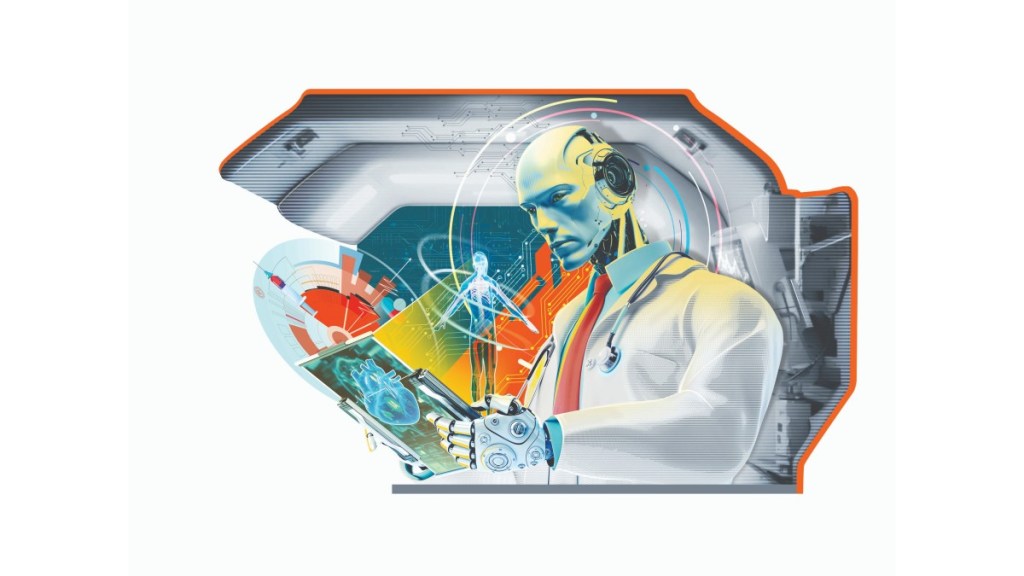
Of the several tools artificial intelligence has brought to our fingertips, a ‘doctor’ is one perhaps most oft used. More and more people are turning to chat bots for medical advice, be it to know what their symptoms could mean or seeking detailed information on their conditions.
As use of AI in medicine grows into a swiftly developing phenomenon across the globe for medical practitioners, agentic AI and chatbots are becoming a significant pillar of modern healthcare and medicine for the general public. Even doctors feel artificial intelligence provides for better patient coverage and disease detection. As per the annual Philips Future Health Index for 2025, 76% of HCPs (healthcare professionals) agreed that AI can direct patients to the appropriate care settings, enhancing access, while also enhancing healthcare resources.
A 2024 study by Kaiser Family Foundation (KFF), a health policy research group, said about one in six adults – about a quarter of adults under 30 – used chatbots to find health information at least once a month. Further, a Docus (an AI-powered health platform) report, quoting Google Trends of 2024, revealed that Google searches for ‘AI Symptom Checker’ increased by 134.3% from 2023 to 2024, and searches for ‘AI doctor’ rose by 129.8% in the same time. Searches for AI for medical diagnosis increased by 49.3% according to the report. Further, a report released by OpenAI titled How People Are Using ChatGPT shows that between May 2024 and June 2025, health related prompts were a common topic. Roughly 6% of the conversations were tagged as related to medical and health style queries.
Decreased OPD load, better patient engagement
Chatbots and agentic AI today already manage tasks like “answering standard medical questions, creating discharge summaries, tracking symptoms, reviewing wearable-device data, simplifying medical instructions, and providing basic mental-health support or crisis guidance,” says Dr Mehul Shah, additional director, critical care medicine, Sir HN Reliance Foundation Hospital. “The push for innovation in these technologies is mainly driven by doctor shortages, rising patient loads, need for faster services, and growing comfort with digital health tools,” he adds.
Dr Aashish Chaudhury, managing director at Delhi-based Aakash Healthcare, speaking of the role of agentic AI and chatbots in the healthcare sector at large, says these systems offer operational efficiency and patient triage capabilities and continuous patient interaction. “The healthcare system faces difficulties in delivering immediate accessible conversational support which patients now expect from their healthcare providers.” “Chatbots decrease outpatient department workloads and minimise superfluous patient visits while delivering immediate medical information to patients who lack direct doctor access, providing an affordable initial contact point” elaborates Dr Chaudhury.
Viral incidents of AI help just incentivise people to turn to AI. For instance, in an incident that went viral globally earlier this year, a woman based in Paris was told by ChatGPT that the symptoms she entered into the AI system were those of blood cancer. Having received this suggestion from an internet generated source, she decided to ignore the advice, only to be told by a doctor a year later that she had Hodgkin’s lymphoma, a rare type of blood cancer. Another case picked up by newspapers widely reported an Indian X user’s experience — no doctor could successfully identify and diagnose her mother’s persistent cough for nearly 1.5 years.
ChatGPT then suggested that the cough could be a result of an ingredient in the lady’s blood pressure medication. The X user confirmed the same with a doctor, who then changed the medication in question. Her mother’s condition began improving soon after. It is incidents like these — a combination of AI-trained analysis and sheer fluke — that encourage people to rely on AI chatbots.
On innovations to look forward to in this sector, Apple is reportedly gearing up to launch their AI doctor or health coach in 2026. The initiative is called ‘Project Mulberry’, and entails revamping of Apple’s health app to include a health coach via an AI agent, which will conduct analyses similar to a doctor. Reportedly, the app will collect data from all the user’s devices like iPhone, Apple Watch, earbuds and even third-party products, and use it to make personalised recommendations to improve the user’s health. On home ground, the Jivi AI App is to be integrated into public hospitals under Ayushman Bharat in 2026.
This AI-powered, voice-first tool, has been available to the public since 2024, but will be integrated into a majority of Indian government hospitals from 2026. This acts like an AI health assistant to the consumer or at best a clinician, and deals with issues like availability, affordability and quality of basic healthcare. UNICEF India, for example, has the DISHA app which was launched earlier in 2025. The Digital Smart Healthcare Assistant is a one-of-a-kind chatbot created for supporting the frontline workforce like ASHA workers and ANMs (auxiliary nurse midwives),to keep them abreast with latest knowledge.
A helping hand, not replacement
In October of this year, OpenAI made some changes to its usage policies, sparking much debate over what they might mean for the users. It clarified that users can still use ChatGPT to learn about health, but should not rely on it for personalised professional advice without consulting qualified experts. This conversation appeared that much more relevant at the time, as it came close on the heels of a lawsuit filed against OpenAI.
This lawsuit was brought by the parents of a teenage boy who shared his suicidal thoughts and anxieties with ChatGPT, only to be provided with a step-by-step guide on how to kill himself over the course of his online interaction, the parents alleged. Several similar cases have been reported since, with family members of teenagers and young adults bringing similar claims.
Doctors are also united in the understanding that while agentic AI and chatbots can significantly reduce workload, they can obviously never replace doctors and clinicians. Dr Neelam Banerjee, senior consultant and robotic surgeon, head of IVF and fertility, Yatharth Super Specialty Hospital in Greater Noida, says: “AI and chatbots can support doctors in medical management and even in surgical planning, but they cannot replace a clinician.
Human beings respond differently and the same disease does not behave the same way in every patient,” she explains. Dr Pooja Jain, infertility and IVF specialist at Apollo Fertility, who also utilises AI in her work to monitor embryos, track her patients’ ovulation cycles and more, says, “With AI agents, patients can receive reminders of upcoming treatments, help with determining their symptoms, schedule appointments, prepare for their consultations, and have prior educational material on what to expect during their visits,” she opines, adding, “The functionality and capabilities of AI will continue to evolve over time, chatbots should be expected to serve as a foundational component of patient engagement.”
Harvard Medical School has introduced a course dealing with AI in healthcare, as reported in The Harvard Gazette, and added a PhD track on AI in medicine. The school is also planning a ‘tutor bot’ to provide supplemental material beyond lectures; and is developing a virtual patient on which students can practice before their first encounter with the real thing. Predicting the future of AI-assisted chatbots, Dr Chaudhury says, “The technology needs to develop through responsible means, while healthcare organisations must establish medical supervision and follow regulatory standards, together with medical evaluation and specific operational limits,” he adds, stressing that AI also has undeniable disadvantages that ensure they can never replace doctors with a 100% guarantee when it comes to patient assessments.
Risks of chatbot diagnosis, room for innovation
Elaborating on the risks of using chatbots without reasonable judgment and expert opinion, Dr Chaudhury says, “The main security concerns stem from patients receiving false information, developing excessive trust in AI systems, and facing privacy threats. When chatbots fail to understand medical symptoms correctly, they provide unspecific advice which might cause patients to postpone their essential medical care.” Warns Dr Shah from Sir HN Reliance Foundation Hospital, “Excessive automation may reduce human connection in care,”adding, “Without proper supervision, these tools might also lead to misdiagnosis or delayed treatment.” Dr Jain from Apollo Fertility says, “The potential issue of misinformation is higher if the AI is not of medical grade.” “AI-assisted health chatbots still lack the ability to perform physical exams, read body language, judge complex symptoms or understand emotional depth the way trained professionals do,” states Dr Lokesh B.
A vast number of possibilities emerge with the integration of artificial intelligence into healthcare and medicine. Not chatbots alone, but AI-enabled robots have made their way into operating theatres, being the literal hands and eyes of experienced surgeons, making minute incisions and performing complex surgeries. Surgical patients often prefer to have a robotic surgery over a regular surgery performed only by a team of docs, as many are well aware of the difference in recovery time, size of incision, margin of error and more, shares Dr Sudhir Srivastava, founder of SS Innovations International, which is making India’s first made in India surgical robot, the SSI Mantra.
LAB REPORT
- 76% of healthcare professionals agree AI can direct patients to appropriate information
- Google searches for ‘AI Symptom Checker’ rose by 134.3% from 2023 to 2024, searches for ‘AI doctor’ rose by 129.8%
- About one in six adults — about a quarter of adults under 30 — use chatbots to find health information at least once a month
- A report by OpenAI shows that between May 2024 and June 2025, about 6% prompts were health-related