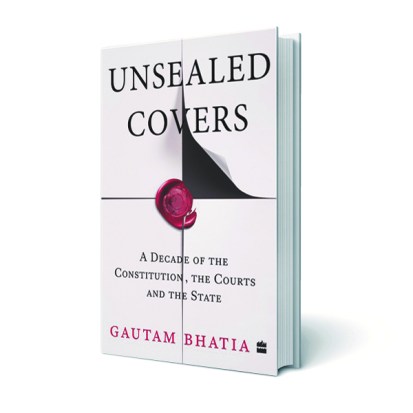
Unsealed Covers: A Decade of the Constitution, the Courts and the State
Gautam Bhatia
HarperCollins
Pp 496, Rs 699
The judicial system has never been more in the limelight as now, for its role as a watchdog as well as its own independence and relevance. At a time when the present Chief Justice, DY Chandrachud, has given a call for the courts to be more accessible to citizens, lawyer Gautam Bhatia’s book Unsealed Covers attempts to do just that, dejargonising milestone cases and judgments and even judges’ tenures. Edited excerpts from an interview:
Let me address the most pertinent question first: As an insider privy to the courts’ functioning, how free do you think the Indian judiciary is presently?
The judiciary’s relationship with the other wings of State is a complex and layered one. As the old adage goes, “the judiciary controls neither the sword nor the purse”. It, therefore, depends upon the executive for the implementation of its judgments. It also depends upon the executive for other things, such as, for example, in India, the formal warrant for the appointment or transfer of a judge. This means that judiciaries at all times and at all places have had to operate in a constrained political space, the scope of which also depends on how strong and assertive the executive is at any given time. The Indian judiciary is no exception to this general rule. And with the present executive being a particularly assertive one, the space in which the judiciary operates is correspondingly a more limited one.
The strength of the judiciary, you write, is inversely proportional to the strength of the government. So how would you sum up the judiciary’s response to a controlling executive over the years— from Emergency to today?
The judiciary’s response to the relative strength of the political executive has varied according to the domain. For example, if you look at something like gender rights or the rights of sexual minorities, you see the judiciary becoming incrementally more progressive and rights-sensitive over the years, regardless of the orientation of the political executive. On the other hand, if you look at something like civil rights, the right to personal liberty, preventive detention —the judiciary has largely been deferential to the executive, no matter the relative strength of the executive. In some domains—following from the first question above—of course, how assertive the judiciary can be does track the strength of the executive: for example, the extent of its intervention in alleged ‘policy’ decisions, its willingness to entertain systemic or structural public interest litigation, and so on. There are, of course, exceptions to each trend, and individual judges can always surprise you.
Do you think that the Supreme Court is selective in making a noise about taking on the executive, like Manipur, but remaining silent on some cases, such as granting of bail to opposition leaders? Is the judiciary more a mouse than a lion? What do you have to say on the Rahul Gandhi case?
The issue is not ‘selectivity’—each judicial intervention must be examined on its own merits. For example, in the Manipur case, the SC has passed a detailed order on sexual violence recently. However, one needs to remember that the viral video which triggered judicial cognisance did not come out for so long because the government had imposed an Internet blackout; while this Internet blackout was challenged in both the Manipur HC and the SC, the courts’ intervention was limited, and quite late.
With respect to bail—which, again, needs to be looked at on its own terms—the issue is that the courts are far too deferential to investigative agencies when it comes to ‘special laws’ such as the PMLA and the UAPA. Investigative powers under these laws have been expanded because of judicial interpretation, these expanded powers are being used to the hilt, and the problem is then compounded when courts refuse bail, leaving people to spend years in jail without trial.
With respect to the Rahul Gandhi case, everyone can see that it is a case of what Latin American constitutional scholars call lawfare—i.e., of weaponsing the law for political ends. The defamation case was frivolous, and ought to have been thrown out at the outset. The trial court entertaining it, imposing the maximum sentence of two years’ imprisonment (which never happens for defamation), and then the High Court refusing to stay it, were all glaring judicial errors, and a failure to recognise and check lawfare, which is the job of courts.
You talk of management of the roster in outcome of cases. For a common man, how does this play out—is it more a case of manipulation or irony of fate? For cases in the limelight, like the bail for M Zubair and Sudha Bhardwaj, where you write how case assignment by the ‘master of the roster’ led to positive outcomes, is this sort of ‘knowing’ manipulation routine?
I’ve neither used the word ‘manipulation’ nor the phrase ‘knowing manipulation’ in the book. The point I’ve made is that judicial approaches vary across judges—for example, some are more deferential to the executive in personal liberty cases, some are more sceptical of executive claims.
In such a situation, when you have a court of 30+ judges, the power to assign a case to a particular judge or bench ends up playing a non-trivial (although not determinative) role in the outcome of the case. The issue, then, is the existence of a more or less opaque power of case assignment, vested in whichever individual is occupying the office of the Chief Justice. It’s important that this power be democratised, and made more transparent.